Prove Women’s Pay Equity.
Every International Women's Day March 8 we annually recognize women’s contributions to industry, leadership, innovation, families, and communities.
Then March 8 comes around again.
- We publish another statistic.
- We discuss another gender pay gap.
- We celebrate incremental progress.
- Then, too often, we return to business as usual.
Women have participated in the workforce and created economic value for generations. Yet measurable differences in earnings remain, and the wage and pay equity gap has grown.
In 2025, women working full time in the United States had median weekly earnings of $1,089, compared with $1,326 for men. That means women’s median earnings were 82.1% of men’s.
So the question deserves to change.
What are we going to do about it?
Y2K to AI Equity women manage major incidents.
First, we should be precise. An economy-wide gender pay gap does not prove that every woman receives less pay than a man for the same work.
However, it does reveal a persistent disparity that organizations should investigate rather than simply observe.
Moreover, federal law already prohibits sex-based wage discrimination when men and women perform substantially equal work requiring substantially equal skill, effort, and responsibility under similar working conditions.
Therefore, the challenge is recognizing the principle, planning the playbook, and proving the outcome.
Stop Counting. Start Correcting.
Data should trigger action. Consequently, Women AI Labs™ proposes a different model for women’s pay equity. We have been in the workforce for centuries, and there is no reason the World Economic Forum estimation of 123 years to gender parity should continue unchallenged. We learned very quickly how to adjust YY to YYYY when 1999 roled around.
- Assess the disparity. Determine where pay differences exist across comparable work, job levels, compensation structures, bonuses, promotions, starting salaries, and advancement.
- Explain the drivers. Identify which differences have legitimate, documented explanations and which require deeper examination or corrective action.
- Propose the resolution. Create a measurable remediation plan with clear responsibilities, actions, milestones, controls, and success measures.
- Partner on remediation. Bring employers, compensation leaders, employees, researchers, policy experts, community organizations, and other stakeholders into the work of changing the systems that produce the outcome.
- Prove the result. Return to the baseline. Measure again. Document what changed. Validate whether disparities decreased and whether the corrective action produced the intended result.
- Sustain the improvement. Continue measuring so that corrected disparities do not quietly return through hiring, promotions, bonuses, job changes, or compensation decisions.
That is proof.
What Does Proof Require?
Proof begins with a baseline. Without one, leaders cannot demonstrate improvement.
- Next, proof requires a documented intervention. An organization should be able to say what it changed and why.
- Then, proof requires a measurable result. Leaders should compare the new outcome with the original condition.
- Afterward, independent or appropriately governed validation should test whether the result withstands scrutiny.
- Finally, proof requires continued monitoring.
A corrected number today does not guarantee an equitable outcome tomorrow.
Therefore:
Baseline + Action + Measured Improvement + Validation + Sustained Results = Proof.
Why Five Years?
Five years gives us time to do more than raise awareness. It gives us time to build a committed community of employers, partners, researchers, and advocates who test solutions, share what works, accelerate progress, and prove measurable gains in gender fairness.
- Year One: Assess and Set the Standard
Build the Women AI Labs Pay Equity Assessment, establish baselines, and recruit founding employers. - Year Two: Resolve and Demonstrate
Implement remediation plans, measure outcomes, and share responsible evidence of progress. - Year Three: Deepen the Evidence
Expand analysis across race, ethnicity, career level, occupation, caregiving, and other relevant factors. - Year Four: Scale What Works
Grow partnerships, share acceleration practices, and extend proven approaches across organizations and communities. - Year Five: Prove the Results
Publish longitudinal evidence showing what changed, what worked, what did not, and which improvements lasted.
That is how we move from awareness to accountability, and from commitment to proven progress.
The Partnership Is the Strategy
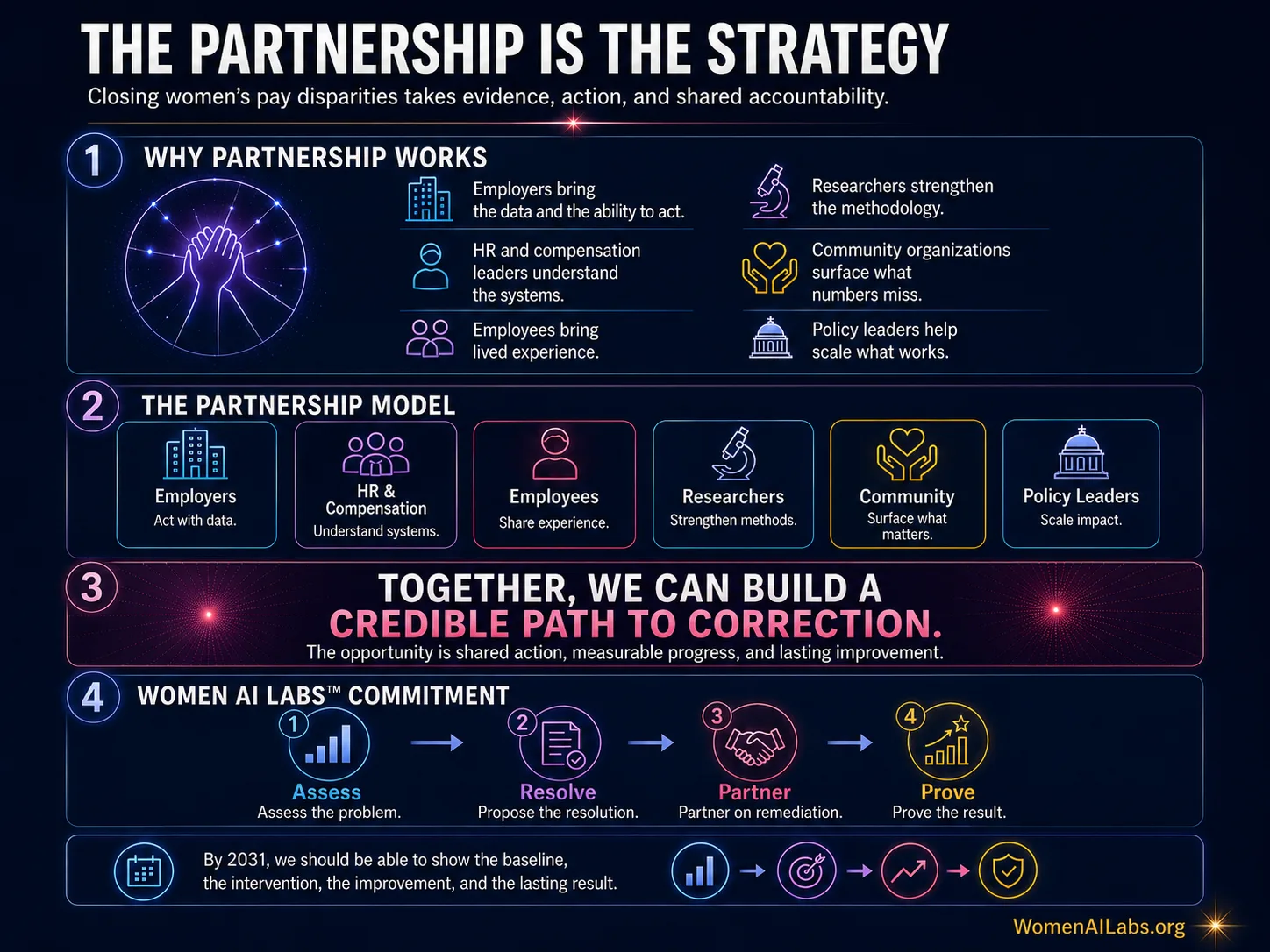
Women AI Labs, and really no single organization cannot close women’s pay disparities alone.
- Employers hold compensation data and control many workplace decisions.
- Compensation and HR leaders understand the systems behind those decisions.
- Employees understand how those systems feel and function in practice.
- Researchers can strengthen methodology.
- Community organizations can surface experiences aggregate numbers may hide.
- Policy leaders can translate evidence into scalable standards.
Who will help us to baseline and prove it?
- Prove Women’s Pay Equity.
- Assess. Resolve. Remediate. Prove.
- Measured. Corrected. Proven.
Resources:
- Action Proves AI Fairness — Women AI Labs
- AI Data Science Practice — Women AI Labs
- AI Tools Directory — Women AI Labs Best for Research, Career Tools, Productivity
- Fairness Before Bias Becomes Personal - HBR 60 Years of Data — Women AI Labs
- Fixing the 123-Year Defect — Women AI Labs
- Get Involved — Women AI Labs
- Underrepresented. Unlisted. Unseen. Erased. Less Talk. — Women AI Labs
- Women Experts Shape AI Through Teaching, Building, & Leading — Women AI Labs