Fixing the 123-Year Defect
The 123-year gender parity defect is not a distant social issue. It is a global production failure affecting decisions, products, employment, healthcare, innovation and economic growth.
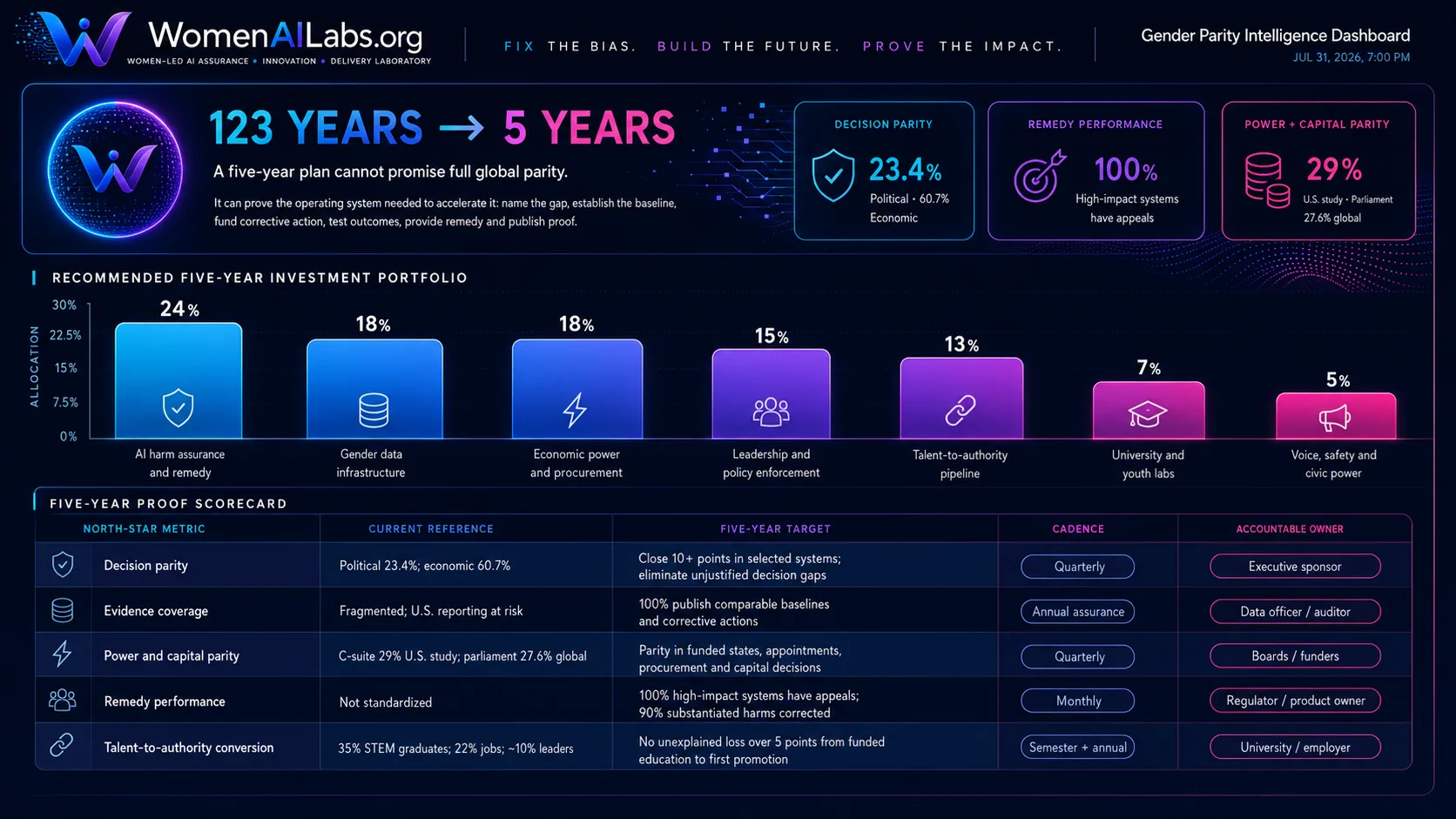
In 2025, the World Economic Forum estimated that full global gender parity remained 123 years away. The world had closed 68.8% of the overall gap. However, economic parity remained near 61%, while political parity remained below 23%.
At the current pace, economic parity could take 135 years and political parity 162 years.
That is intolerable.
If a production defect affected half the world’s population and carried a 123-year resolution target, no manufacturer, hospital, government or responsible technology company would accept it. Leaders would declare a major incident, assess the impact, identify the root cause, assign accountable owners and fund corrective action.
Therefore, WomenAILabs™ is treating the 123-year gender parity gap as a production defect that the world must measure, manage and correct.
Polytunity where Gender Bias Breaks Systems, transformation uplifts:
Gender bias does not only harm women. It weakens the systems, products and decisions that everyone depends on.
Georgetown Women’s Leadership Institute's Catherine Tinsley shares Why Women Leave STEM Majors and underscores the importance of representation in research, engineering, leadership, investment and product testing, manufacturers lose insight into half their market.
Healthcare systems can overlook women’s symptoms and treatment needs. Hiring technology can determine whose résumé gets seen. Promotion systems can reward visibility while ignoring invisible labor. Meanwhile, AI development teams can code past experiences they have never lived or examined.
Consequently, gender bias becomes a product-quality problem, a workforce problem, a safety problem and an economic-performance problem.
IBM explains that algorithmic bias can reinforce existing gender and socioeconomic inequalities, distort high-impact decisions and create legal, financial and reputational risk. IBM also recommends applying transparency, explainability and governance across the AI lifecycle. IBM on Algorithmic Bias
AI Can Scale Defects
Our white paper, Silence of the Algorithm: How Gender Bias, Invisible Labor, and AI Systems Shape Human Outcomes, warned that AI can make inequality harder to see, challenge and remedy.
The evidence increasingly supports that warning.
AI does not enter a neutral environment. Instead, it learns from historical data, existing institutions, incomplete records and past decisions. When organizations automate those patterns without a defensible baseline, AI can reproduce the defect faster and at a far greater scale.
Women also hold a greater share of occupations exposed to generative AI. Therefore, workforce automation, restructuring and AI-related layoffs require transparent impact assessments, representative data and documented human oversight. International Labour Organization
Faster deployment does not automatically create safer operations. Likewise, reducing headcount does not prove that AI created sustainable value. Without disciplined controls, organizations may simply transfer cost into discrimination complaints, failed products, security incidents, customer harm and reputational damage.
Five Years Plan To Proof
WomenAILabs™ is not promising full global gender parity in five years.
Instead, we are building a five-year proof system that can accelerate progress from baseline to corrective action.
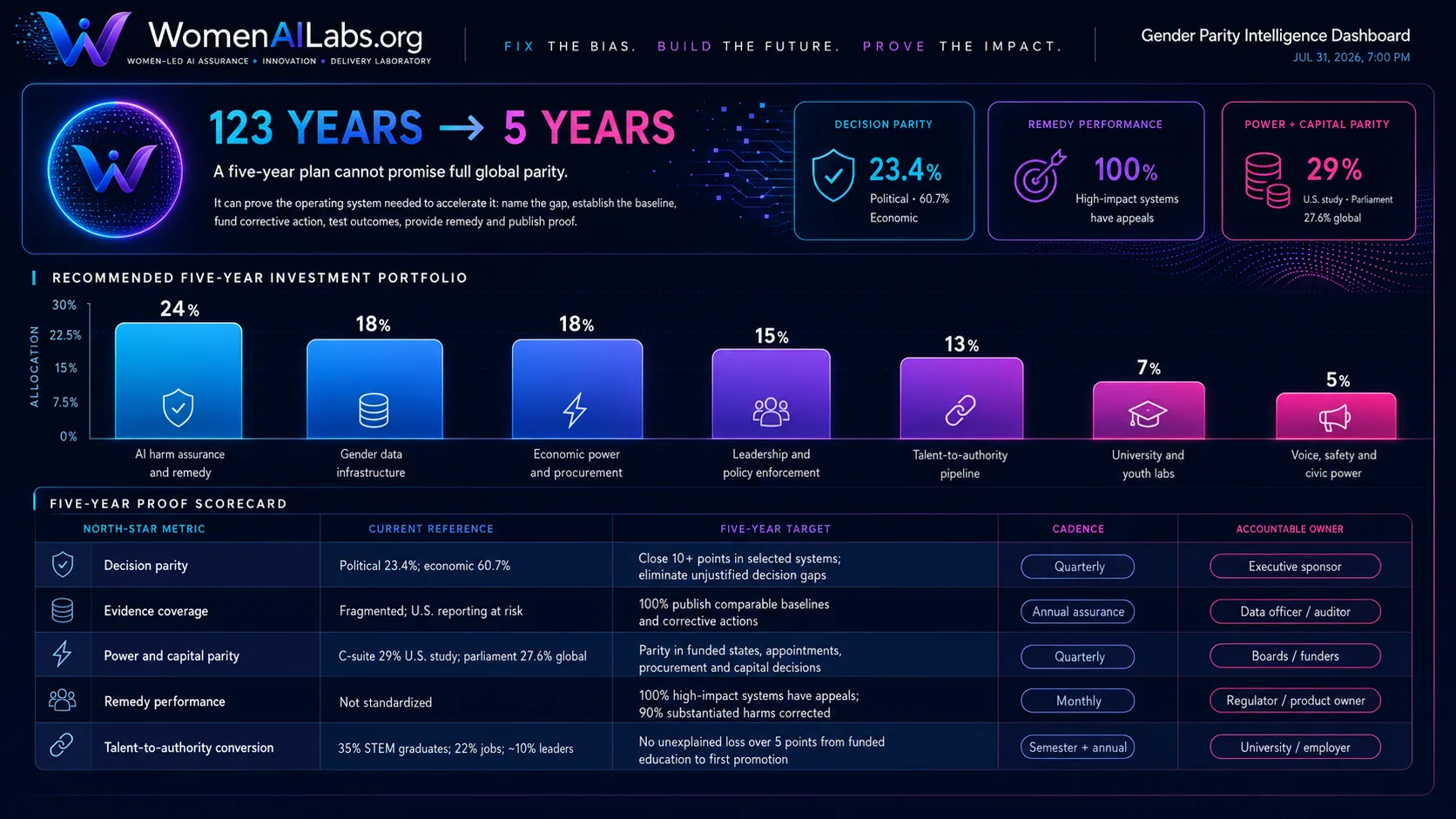
Our Gender Parity Intelligence Dashboard measures five outcomes:
- Decision parity: Who gets selected, rejected, funded, promoted, treated or heard?
- Evidence coverage: Can an organization produce a comparable baseline, test results and corrective-action record?
- Remedy performance: Can an affected person appeal, obtain human review and receive a documented correction?
- Power and capital parity: Who controls funding, procurement, investment and leadership decisions?
- Talent-to-authority conversion: Where do women disappear between education, employment, promotion and decision-making power?
These measures convert broad commitments into accountable operating metrics.
Control The AI Portfolio
Organizations should manage AI with the same discipline they apply to finance, cybersecurity, product safety and operational resilience.
That discipline must cover the complete AI portfolio lifecycle:
Strategy and ideation → demand and funding → design and development → testing and delivery → operational transition and support → integrated and third-party risk → major incident response → root-cause problem management.
As a result, every high-impact AI initiative should include:
- A human-impact baseline before funding
- Representative and verified data before development
- Bias, safety and accessibility acceptance criteria
- Independent testing before release
- Human review for consequential decisions
- Appeal and remedy pathways for affected people
- Continuous monitoring after deployment
- Major incident and root-cause processes when harm occurs
NIST similarly calls on organizations to govern, map, measure and manage AI risks throughout the design, development, deployment and evaluation lifecycle. NIST AI Risk Management Framework
Solve It Together
No single nonprofit, company, university or government can correct the 123-year gender parity defect alone.
However, we can build a shared correction system.
- Government can establish protections, reporting requirements, enforcement and meaningful rights to human review.
- Industry can open real systems for testing, fund remediation and accept responsibility for the AI it builds, buys and deploys.
- Universities can contribute independent research, representative datasets, scientific testing and external validation.
- Students and emerging talent can learn responsible AI by solving real public-interest problems.
- Affected communities can reveal harms that system owners and developers may never see.
- WomenAILabs™ can convene the partners, structure the challenges, mobilize builders and publish repeatable proof.
First, an expert panel will define the problem, affected population, current baseline, potential harm and measurable outcome. Next, multidisciplinary teams will convert that definition into industry-specific Vibe-Coding challenges across employment, healthcare, manufacturing, education, government and public services.
Then, independent experts will test the resulting prototypes against representative data, failure scenarios, human-review requirements and remedy standards.
Finally, the partners will publish what worked, what failed, what changed and what others can reproduce.
Replace Hope with Evidence
The world does not need another unmeasured promise about responsible AI or gender equality.
It needs evidence.
What WomenAILabs™ suspected is beginning to appear in the metrics. Therefore, we will continue to watch the data, challenge our assumptions and report whether outcomes improve or worsen.
We will also work with government, industry, universities and communities to transform the 123-year gender parity defect into measurable corrective action.
Define together. Build responsibly. Test independently. Correct quickly. Publish the proof.
Five years to proof. Not 123 years to hope.
123-Year Gender Parity Resources
- WomenAILabs: Silence of the Algorithm: How Gender Bias, Invisible Labor, and AI Systems Shape Human Outcomes
- Dr. Sreenivasan Narayanan: Fairness Before Bias Becomes Personal
- Britt Bowman: WomenAILabs Art of the Possible
- Dawn C. Simmons: AI Gender Bias Warnings
- World Economic Forum: Global Gender Gap Report 2025
- International Labour Organization: Women Face Greater Workplace Exposure to Generative AI
- UN Women: How AI Reinforces Gender Bias
- IBM: What Is Algorithmic Bias?
- IBM: Championing Female Leadership in the Age of AI
- Joy Buolamwini and Timnit Gebru: Gender Shades Research
- Algorithmic Justice League: Research and Action on Algorithmic Harm
- Dr. Fei-Fei Li: Human-Centered AI Leadership at Stanford
- NIST: AI Risk Management Framework
University Resources
Londa Schiebinger, Stanford University she converts gender-bias research into practical engineering, research, and product-design methods.
- Inclusive Design Will Help Create AI That Works for Everyone | Stanford HAI
- Inclusive Crash-Test Dummies
- Rethinking Standards and Reference Models
- Why Gender Matters in Engineering
- Gender and Fairness in Machine Learning and Robotics
- Inclusive AI Design
- Gendered Innovations Methods and Case Studies
Dr. Sigrid Luhr, University of Illinois Chicago publishes Engineering Inequality: Informal Coaching, Glass Walls, and Social Closure in Silicon Valley
Northwestern University researching gender and racial discrimination in hiring, evaluation, promotion, pay, and job assignments.
- Gender-Biased Resource Allocation in STEM
- Gender and Racial Discrimination in Hiring Before and During the COVID-19 Pandemic: Evidence from a Field Experiment of Accountants, 2018-2020
- Labor Force Participation Over the Life Course: The Long-Term Effects of Employment Trajectories on Wages and the Gender Wage Gap.