AI Data Science Practice is an essential collaborative emerging standard. WomenAILabs™ is forming the founding team for its DAUGHTER™ AI Data Science Practice, a collaborative initiative designed to move Responsible AI from broad commitments to practical evidence.
We are bringing together data scientists, researchers, engineers, educators, governance professionals, judges, mentors, and domain experts. Together, these contributors will create working methods, measurable tests, open resources, and documented improvements that organizations can apply to real AI systems.
This is not a discussion-only advisory group.
WomenMembers will build, test, review, teach, document, and continuously improve practical resources. Our goal is to help provide a standard set of five essential questions to standardize the intake and analysis. Our purpose is complete analysis with actionable data that can be tested, validated, corrected, and proven:
- What did you examine?
- Who was represented?
- What harm did you find?
- What did you change?
- What evidence do we have that the correction improves the outcome?
That evidence chain could change how organizations understand AI fairness.
What Is the DAUGHTER™ AI Data Science Practice?
Responsible AI requires more than good intentions. It requires evidence.
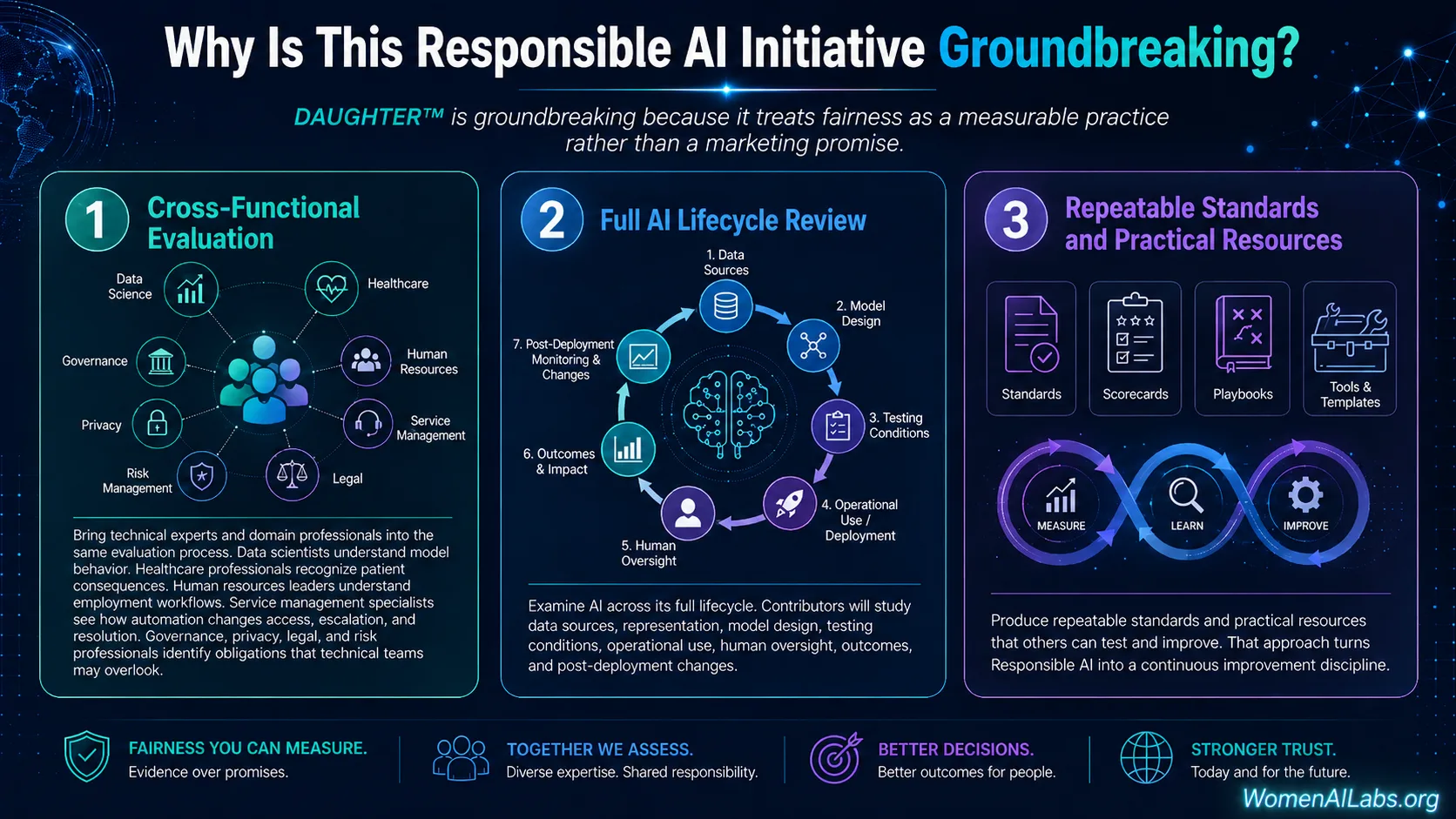
The DAUGHTER™ AI Data Science Practice validates the data, builds scalable tests, identifies the causes of unfair or unusable outcomes, applies meaningful remediation, and proves through retesting that the solution works.
We turn Responsible AI principles into repeatable data science practices that organizations can measure, trust, and scale.
Many organizations already have ethical AI statements, governance committees, or risk policies. However, policies alone do not reveal whether a hiring model disadvantages women returning from medical leave. They do not show whether a healthcare algorithm performs consistently across racial groups. Nor do they prove that a customer service system gives people with different accents, disabilities, or language backgrounds the same quality of support.
Therefore, DAUGHTER™ will focus on the space between principles and performance.
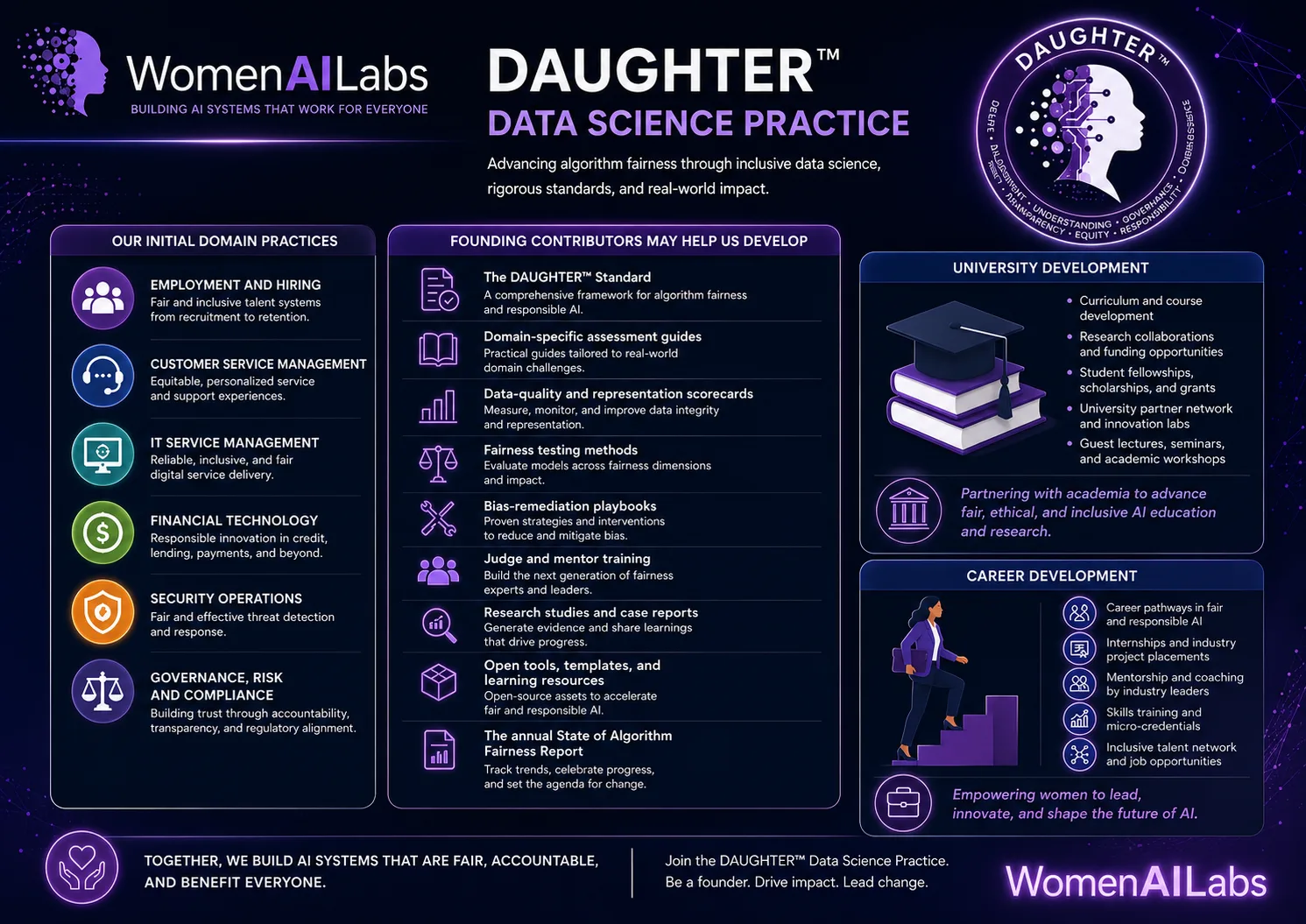
Founding contributors may help develop the DAUGHTER™ Standard, domain-specific assessment guides, data-quality and representation scorecards, fairness-testing methods, bias-remediation playbooks, judge and mentor training, research studies, case reports, open tools, learning resources, and the annual State of Algorithm Fairness Report.
Why Does Data-Driven AI Fairness Matter Now?
AI adoption continues to accelerate.
The Stanford Institute for Human-Centered AI 2026 AI Index reports that organizational AI adoption reached 88 percent in 2025. At the same time, documented AI incidents rose from 233 in 2024 to 362 in 2025. Stanford also found that Responsible AI reporting has not kept pace with capability testing.
Organizations are implementing AI faster than many can measure its social, operational, and human effects.
The workforce implications are equally important. The International Labour Organization’s 2025 global analysis found that one in four workers holds an occupation with some exposure to generative AI. In the highest exposure category, the share of female employment was 4.7 percent, compared with 2.4 percent for male employment.
Meanwhile, UNESCO reports that women represent 41.2 percent of the global workforce but only 28.2 percent of the STEM workforce. When women and underrepresented communities remain absent from technical leadership, AI systems can miss important experiences, risks, and opportunities.
That is why participation matters now. The people affected by automated decisions should have meaningful opportunities to shape how organizations design, test, and govern those systems.
How Will the AI Fairness Practice Work?
The DAUGHTER™ approach will align practical work with internationally recognized frameworks.
- NIST AI Risk Management Framework helps organizations govern, map, measure, and manage AI risks. NIST designed the voluntary framework to improve trustworthiness throughout the design, development, use, and evaluation of AI systems.
- UNESCO Recommendation on the Ethics of Artificial Intelligence calls for auditable and traceable systems, diverse stakeholder participation, impact assessment, oversight, accountability, and transparency. All 193 UNESCO member states adopted the recommendation in 2021.
- United Nations Global Digital Compact also calls for an inclusive, open, safe, and secure digital future. It emphasizes balanced, risk-based AI governance and broader participation in shaping digital systems.
DAUGHTER™ will help teams apply those principles to real workflows. For example, contributors may define representation requirements, select fairness measures, document limitations, test outcomes across groups, recommend corrective action, and measure whether that action worked.
Which Responsible AI Domains Will We Address?
Our initial domain practices will include
- Employment and Hiring,
- Customer Service & IT Service Management,
- Financial Technology,
- Security Operations, Governance, Risk and Compliance,
- Healthcare and Medical,
- University and Career Development.
Each domain needs specialized tests.
A fair hiring assessment requires different evidence from an AI-supported clinical decision. A cybersecurity system presents different risks from a customer service chatbot. Therefore, DAUGHTER™ will combine a shared standard with domain-specific assessment guides.
Healthcare and medical AI will receive particular attention because errors can affect diagnosis, treatment, access, safety, and trust. The World Health Organization’s guidance on AI for health states that ethics and human rights must remain central throughout design, deployment, and use. WHO also emphasizes accountability to healthcare workers, patients, and affected communities.
Why Join the Founding Team Now?
Get Involved with Women AI Labs" Founding members have the leading voices to shape the methods that become established practices.
Experienced leaders can contribute tested knowledge, oversight, and domain judgment. Emerging professionals can bring new research, technical skills, lived experience, and questions that established systems may have failed to ask.
Moreover, contributors will gain practical experience creating Responsible AI assessments, reviewing evidence, designing scorecards, conducting fairness tests, documenting findings, and explaining results to varied audiences.
Most importantly, members will help build tools that can improve employment opportunities, customer experiences, financial access, technology services, security decisions, healthcare outcomes, and organizational accountability.
The objective is expanding the art of the possible and fairness for all AI Users. What could become possible when more organizations can prove that they found an unfair outcome, corrected it, and measured the improvement?
Help Build Fair and Equitable AI
We are seeking contributors who can commit approximately four to eight hours per month.
Please reply with your preferred domain or workstream, relevant experience, the role you would like to perform, approximate monthly availability, and one tool, training resource, research topic, or use case you would like to help create.
Responsible AI should do more than reduce organizational risk. It should expand opportunity, improve services, protect human dignity, support better decisions, and help communities benefit from technological progress.
Together, we can move Responsible AI from promises to proof.