AI Bias Erases People we explore why AI Bias Is Bigger Than the Y2K impacts. Y2K taught IT how to act before systems failed. We found the defect. YY had to become YYYY.
- First, we identified the critical risk and established executive urgency. Then, we inventoried affected systems, applications, infrastructure, and dependencies. We used CMDB and asset data to determine what we owned, who owned it, what services depended on it, and what could fail.
- Next, we assigned technical and business owners. We prioritized critical services, remediated defects, tested applications, validated integrations, and documented known risks. At the same time, we activated business continuity plans, prepared contingency procedures, established escalation paths, and drilled our response.
- Finally, as the critical deadline approached, we staffed command centers, placed technical teams on standby, monitored critical services, and prepared to restore operations immediately.
Y2K Was a Global Major Incident Response : Y2K was a date defect.
What Is Algorithmic Bias?
Algorithmic bias occurs when an automated system creates unfair, discriminatory, or systematically unequal outcomes.
- The risk can enter an AI system through historical data, incomplete datasets, system design, proxy variables, business rules, human decisions, or a lack of testing and governance.
- According to the National Institute of Standards and Technology AI Risk Management Framework, organizations need structured approaches to govern, map, measure, and manage AI risks.
- Therefore, organizations cannot treat AI bias as simply a technology problem.
It is a business, government, workforce, and community risk.
AI Bias and Automated Resume Rejection How Can AI Make Qualified Jobseekers Invisible?
Research from Stanford Institute for Human-Centered Artificial Intelligence found that AI hiring tools can produce discriminatory outcomes and systemic rejection patterns. AI hiring systems increasingly influence who gets sourced, ranked, screened, interviewed, and rejected.
- However, jobseekers often cannot see how these decisions happen.
- A qualified candidate can get filtered out before reaching a recruiter or hiring manager.
- As a result, people may never know why they were rejected.
- They may never receive feedback.
- More importantly, they may never get the opportunity to correct inaccurate information or challenge an unfair automated decision.
Therefore, automated resume rejection creates a larger workforce problem.
When AI decides who gets seen, invisibility becomes an economic risk.
Why Women Missing From AI Matters: Women Have Always Been Part of IT
Women helped build, operate, support, test, secure, document, recover, and govern technology. We were always present in IT Service Management. We were involved before Y2K, in 091101, in Covid-19.
- taught ITIL and ITSM Process.
- Managed Major incidents.
- restored services.
- documented processes.
- supported customers.
- tested releases.
- governed data.
- lead organizational change.
- We kept businesses running.
However, AI systems trained on incomplete histories can undervalue or overlook support roles, caregiving gaps, nonlinear careers, operational leadership, community work, and invisible labor.
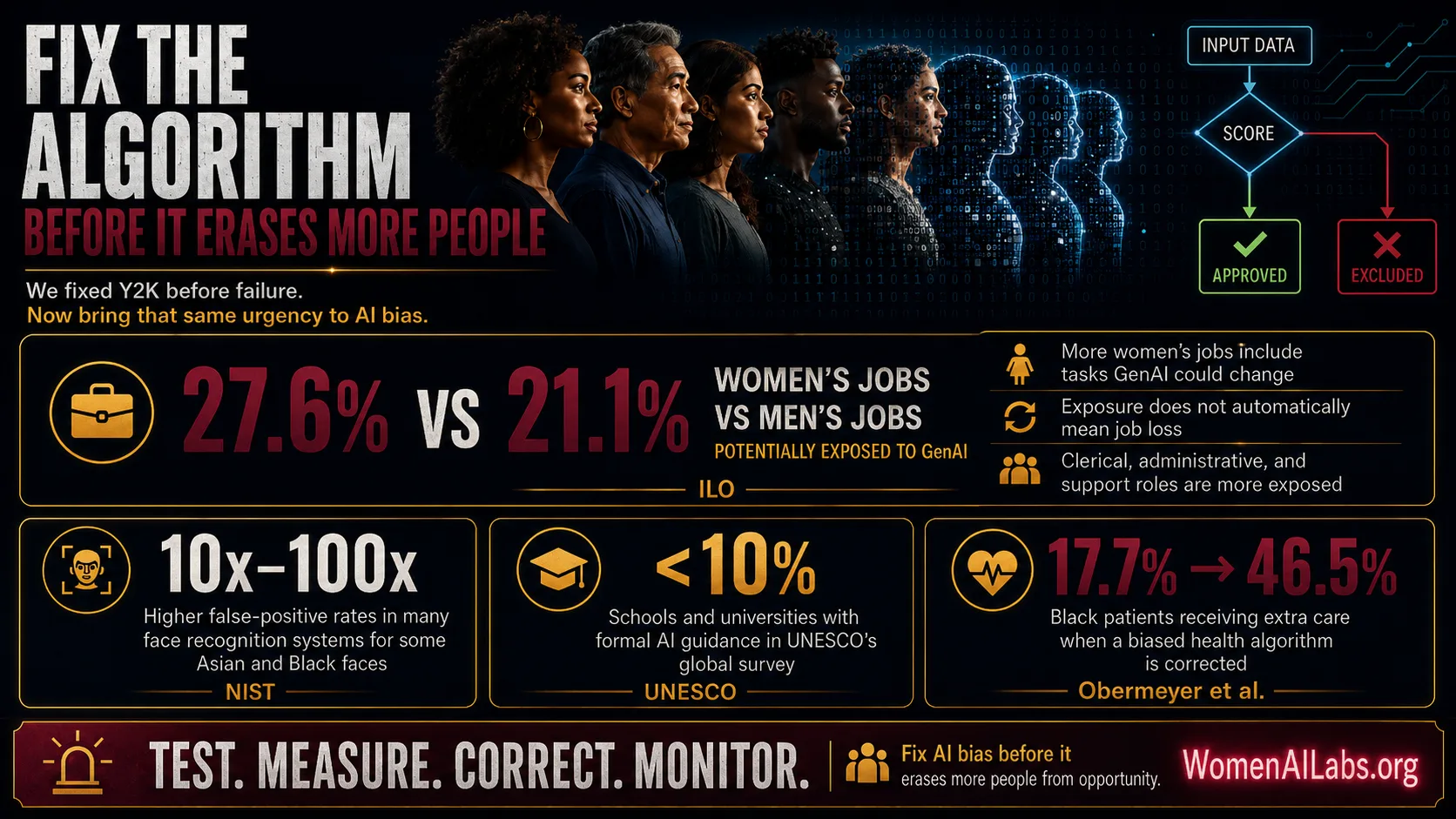
- Research from the International Labour Organization shows that women face greater occupational exposure to generative AI transformation than men.
- Meanwhile, the World Economic Forum Global Gender Gap Report continues to document significant global gender disparities.
Therefore, women are not simply missing from technology leadership.
Biased AI can erase women from future economic opportunity.
AI Bias Creates Government Risk How Does Algorithmic Bias Affect Public Services?
Government agencies increasingly use automated systems to support decisions involving benefits, fraud detection, public safety, employment, education, housing, and other public services.
However, biased or poorly governed systems can create unequal outcomes at enormous scale.
The U.S. Government Accountability Office AI Accountability Framework provides guidance for accountability, governance, data, performance, and monitoring of AI systems.
Likewise, the White House Blueprint for an AI Bill of Rights identified protections related to algorithmic discrimination, data privacy, notice, explanation, and human alternatives.
Therefore, governments must ask critical questions about who and how they are involved: Who does the:
- system benefit and who is overlooked?
- experiences harm, and who can challenge the decision?
- owns remediation of proof of impact?
Without clear answers, automated decision-making can scale inequality faster than governments can identify or correct it.
AI Bias Creates Business Risk How Can Algorithmic Bias Damage Companies?
Businesses increasingly use AI for hiring, workforce management, customer service, cybersecurity, lending, healthcare, marketing, productivity, and operational decisions.
However, AI adoption without strong governance can create financial, legal, regulatory, reputational, and workforce risks.
The Stanford AI Index Report tracks the rapid growth of AI adoption, investment, incidents, and regulation.
Meanwhile, the U.S. Equal Employment Opportunity Commission AI Initiative addresses how automated technologies can affect employment decisions and civil rights protections.
Therefore, business leaders must move beyond asking:
Are we using AI?
Instead, leaders must ask:
Is our AI producing fair, explainable, measurable, and defensible outcomes?
AI Bias Creates Risk What Happens When People Become Invisible to Algorithms?
Communities experience the consequences when automated systems repeatedly exclude people from opportunity the:
- person denied employment may lose income.
- family denied fair financial access may struggle to build wealth.
- patient overlooked by a healthcare system may experience delayed treatment.
- student incorrectly flagged by an automated system may lose educational opportunity.
- small business owner overlooked by funding algorithms may never receive capital.
Therefore, one biased decision rarely affects only one person. The impact can spread across families, neighborhoods, employers, local economies, and future generations.
The UNESCO Recommendation on the Ethics of Artificial Intelligence calls for human rights, fairness, transparency, accountability, and human oversight throughout the AI lifecycle.
When algorithms repeatedly make people invisible, algorithmic bias becomes community and economic risk.
AI Bias in Education: Who Gets Admitted, Flagged, Supported, or Advanced?
AI increasingly supports educational decisions involving admissions, student assessment, plagiarism detection, academic advising, personalized learning, and student risk identification.
However, incomplete data and biased models can reinforce historical inequalities. Therefore, educational institutions must test AI systems for unequal outcomes before those systems influence student opportunity.
The UNESCO Guidance for Generative AI in Education and Research calls for a human-centered approach to the responsible use of generative AI.
AI Bias in Healthcare: Whose Symptoms Get Seen, Diagnosed, and Treated?
Healthcare algorithms can influence diagnosis, risk prediction, resource allocation, patient prioritization, and treatment decisions. However, biased data can produce unequal outcomes.
Research published in Science on racial bias in healthcare algorithms demonstrated how a widely used healthcare algorithm underestimated the health needs of Black patients.
Therefore, healthcare organizations must test not only whether an algorithm works.
They must test for whom it works, for whom it fails, and who experiences harm.
AI Bias Affects Hiring, Pay, Promotion, and Layoffs Who Gets Seen for Opportunity?
AI bias increasingly influences the entire employee lifecycle.
It can affect:
- Hiring and recruiting: who gets sourced, ranked, interviewed, and selected.
- Performance management: whose contributions get recognized and rewarded.
- Promotion: who gets identified as leadership material.
- Compensation: whose performance and market value influence pay decisions.
- Layoffs: whose role or skills get classified as less valuable.
- Rehire: whose profile gets rediscovered and whose experience disappears from search results.
Therefore, organizations must examine AI across the entire workforce lifecycle.
The question is no longer whether AI makes decisions. The question is whether organizations can prove those decisions are fair.
Why AI Bias Is Bigger Than Y2K: Y2K Threatened Systems. AI Bias Threatens People.
| Y2K Major Incident | AI Bias Major Incident |
|---|---|
| Y2K had a visible deadline: December 31, 1999. | AI bias has no countdown clock. It is already running quietly in daily decisions. |
| Y2K had a known technical defect: YY had to become YYYY. | AI bias hides inside data, models, workflows, business rules, vendor tools, and automated decisions. |
| Y2K threatened system availability. | AI bias threatens human opportunity. |
| Y2K could take applications, infrastructure, and business operations offline. | AI bias can take people offline from hiring, healthcare, education, funding, promotion, pay, and rehire visibility. |
| Y2K forced organizations to inventory systems, assign owners, test, remediate, and drill continuity. | AI bias requires the same discipline: identify affected users, test outcomes, prove harm, fix the algorithm, and prevent recurrence. |
| Y2K failures were expected before they happened. | AI harm is often discovered only after people lose opportunity, care, income, access, or trust. |
| Y2K was treated as a global technology crisis. | AI bias must be treated as a human-impact Major Incident. |
| Y2K asked: Will the system fail? | AI bias asks: Who is the system failing? |
| Y2K threatened business continuity. | AI bias threatens social, economic, and human continuity. |
| Organizations mobilized to prevent Y2K failures before they happened. | Now, organizations must mobilize before AI harm becomes normalized. |
That must change.
IT Knows How to Fix Complex Problems: Apply Y2K Discipline to AI Bias Remediation
IT already knows how to respond to enterprise risk.
- Find the risk. Identify the impacted systems.
- Assign ownership. Understand the data. Test the outcomes. Document the harm.
- Remediate the bias. Retest the solution.Proof the remediation. Measure improvement.
- Govern continuously.
Therefore, the solution requires more than responsible AI promises.
We need proof.
Fix the Algorithm Before It Erases More People
We fixed Y2K because government, business, technology leaders, and communities recognized the risk and acted. Now, we must bring that same urgency to AI bias.
Proof of Current Algorithmic Bias Impact
- Government services: AI in public programs needs governance, data quality, performance checks, and monitoring because flawed automation can affect benefits, services, and public trust.
- Business risk: AI tools can expose companies to discrimination claims, regulatory action, reputational damage, and poor workforce decisions.
- Hiring and job search: AI screening tools have shown racial bias and systemic rejection patterns, meaning qualified candidates may never reach a human reviewer.
- Healthcare access: A widely used healthcare algorithm underestimated the needs of Black patients because it used healthcare cost as a proxy for medical need.
- Education: UNESCO warns that AI in education brings risks that have outpaced policy and regulation, affecting how students learn, get assessed, and receive support.
- Workforce rights: The EEOC states that anti-discrimination laws still protect workers when AI systems influence employment decisions.
We fixed Y2K before it broke the world. Now we must fix AI bias before it erases more people from opportunity.
Fix. Prove. Scale. Repeat.
The technology community solved complex global problems before.
We can do it again.
However, this time, we are not simply protecting systems.
We are protecting people.