AI law and ethical AI use are moving rapidly toward one central requirement: organizations must prove that they know where AI operates, who owns it, how it affects people, and what controls prevent or correct harm.
The strongest AI governance position combines binding law, regulatory guidance, technical standards, civil-rights research, legal scholarship, and operational evidence, often contained in CMDB Trust
No single source covers every obligation. Together, however, the following authorities support a clear enterprise standard:
Enterprises must know which AI systems they use, what those systems influence, who may be harmed, who owns the service, how humans supervise decisions, and how the organization detects, contains, corrects, and proves its response to AI damages.
Consequently, an AI ethics statement no longer provides enough protection. Courts, regulators, boards of directors, employees, customers, insurers, and investors increasingly expect operational evidence.
Enterprise AI Proof Requirements
Enterprise must prove Strong supporting authorities Required evidence Which AI systems it uses NIST expressly recommends mechanisms to inventory AI systems. ISO/IEC 42001 establishes an organization-wide AI management system, while GAO organizes AI accountability around governance, data, performance, and monitoring. AI register, model name, version, vendor, purpose, deployment date, lifecycle status, connected applications and approval record Which decisions each system influences OECD calls for transparency about AI-generated predictions, recommendations, and decisions. NYC requires covered employers to identify automated employment decision tools and provide notices before using them. Decision-use map showing whether AI recommends, ranks, excludes, approves, denies, prioritizes or executes an action Which people and protected groups may be affected EEOC guidance confirms that federal employment discrimination laws apply when employers use AI. ISO/IEC 42005 calls for documented assessments of impacts on individuals, groups and society. Affected-population analysis covering sex, race, disability, age, pregnancy, caregiving, national origin and intersectional impacts where legally permitted Who owns each AI service NIST calls for clearly defined roles, responsibilities, delegated authority and accountability for AI decisions. It also asks whether boards and senior management participate in AI governance. Named business owner, technical owner, data owner, risk owner, legal owner, vendor manager and operational support team Which data, models, vendors, applications and infrastructure support it OECD requires lifecycle traceability for datasets, processes and decisions. NIST extends governance to third-party systems, training data, assumptions, testing and limitations. Partnership on AI identifies standardized documentation as foundational to AI safety and accountability. Data lineage, model lineage, vendor records, APIs, software versions, infrastructure, identities, prompts, retrieval sources and service dependencies How humans review consequential decisions NIST recommends documented human roles, oversight authority, appeal and override processes. OECD calls for human agency and oversight. Colorado’s 2026 law provides a right to meaningful human review after certain adverse automated decisions. Reviewer identity, qualifications, information reviewed, authority to override, final decision, reason and escalation history How it tests for algorithmic bias EEOC states that employment laws remain applicable to AI-assisted decisions. NYC requires covered automated hiring tools to receive bias audits. CDT recommends testing for both discrimination risk and job-relatedness before deployment and at least annually. Selection rates, error rates, subgroup results, intersectional testing, job-related validity, false positives, false negatives and less-discriminatory alternatives How affected people challenge or correct an outcome OECD calls for information that enables adversely affected people to challenge AI outputs. The Council of Europe framework emphasizes remedies, notice and procedural safeguards. Colorado provides correction and meaningful human-review rights for covered decisions. Notice, explanation, correction, appeal, accommodation, alternative process, human reconsideration and documented resolution How it investigates, contains and remediates AI damages NIST calls for continuous monitoring, incident response, human adjudication, third-party contingency planning, safe decommissioning and stakeholder recourse. OECD calls for systems that can be overridden, repaired or safely retired. AI incident record, affected-person analysis, containment, rollback, legal hold, root cause, notification, relief, remediation, retesting and closure approval
Therefore, the direction of AI law is clear:
Responsible AI now requires traceability, accountability, human oversight, impact testing, service ownership, and defensible evidence.
Updated July 10, 2026. This article provides educational information and does not replace legal advice for a specific jurisdiction or matter.
Why Is AI Law Moving Toward Proof?
AI can recommend, rank, predict, generate, classify, screen, prioritize, and increasingly take action. However, AI cannot accept legal responsibility. The organization that develops, buys, deploys, configures, or relies on the AI remains responsible for the business process and its consequences.
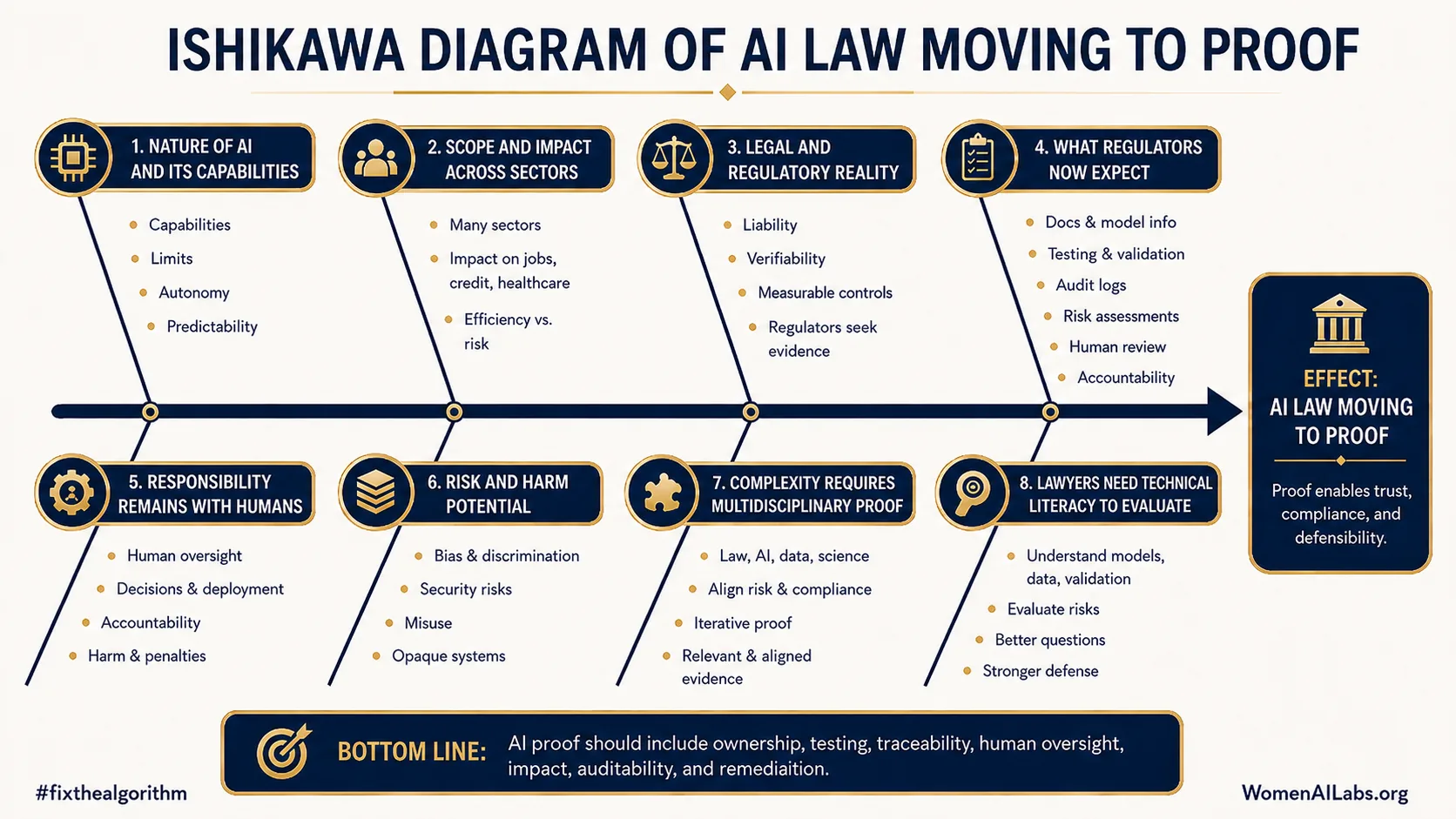
As a result, AI regulation is shifting from broad principles toward measurable controls. Regulators increasingly want documentation, testing records, notices, explanations, human review, audit logs, risk assessments, incident reports, and named owners.
The uploaded guide correctly identifies Algorithmic Risk and Compliance Law as an emerging practice area that combines law, AI engineering, data science, audit defense, vendor governance, intellectual property, and incident response. It also recognizes that lawyers cannot evaluate AI contracts, audits, bias findings, or validation reports without understanding how the underlying technology works.
What Direction Is AI Law Taking?
AI law is developing through several connected legal pathways rather than one universal statute.
Existing Laws Still Apply to AI
First, companies cannot treat AI as an exemption from employment, civil-rights, privacy, consumer-protection, negligence, contract, intellectual-property, or professional-responsibility laws.
The EEOC has made clear that federal employment discrimination laws still protect workers when employers use AI. Those protections cover discrimination based on sex, pregnancy, race, color, religion, national origin, disability, age, and genetic information.
Therefore, an employer cannot defend a discriminatory outcome merely by saying:
- “The vendor built the model.”
- “The system made the decision.”
- “We did not know which variables it used.”
- “The algorithm did not intentionally discriminate.”
- “A human technically approved the recommendation.”
The employer selected the service, used the result, and acted on the outcome. Consequently, the employer must govern the workflow.
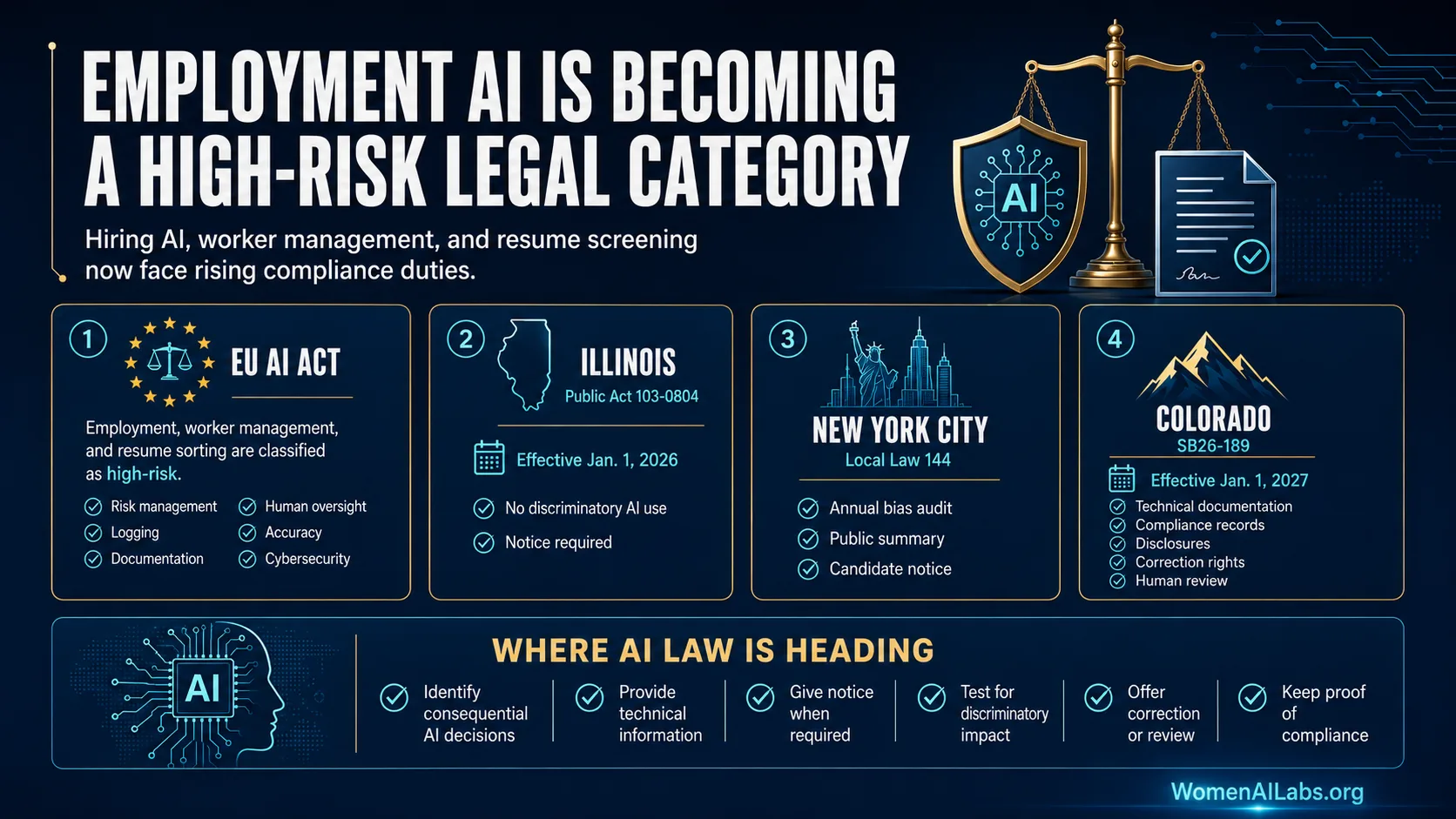
Employment AI Is Becoming a High-Risk Legal Category
The European Union specifically classifies AI used for employment, worker management, and résumé sorting as high-risk. The EU AI Act calls for risk management, appropriate datasets, activity logging, technical documentation, human oversight, accuracy, robustness, and cybersecurity.
In the United States, state and local laws increasingly impose similar concepts.
- Illinois Public Act 103-0804, effective January 1, 2026, prohibits employers from using AI in employment decisions when that use subjects employees to unlawful discrimination. It also requires notice when employers use AI for covered employment purposes.
- New York City Local Law 144 prohibits covered employers and employment agencies from using an automated employment decision tool unless an independent bias audit has occurred within the previous year, the organization publishes a summary, and candidates or employees receive required notice.
- Colorado’s 2026 automated decision-making law takes effect January 1, 2027. It requires technical documentation, retention of compliance records, consumer disclosures, correction rights, and meaningful human review after certain adverse consequential decisions.
Together, these developments show where AI law is heading:
- Organizations must identify consequential AI decisions.
- Developers must provide useful technical information.
- Deployers must understand how they use the system.
- People must receive notice in covered situations.
- Organizations must test for discriminatory impact.
- Affected people must have a path to correction or review.
- Companies must retain evidence that proves compliance.
Why Does Algorithmic Bias Create Legal Damage?
Algorithmic bias does not require a programmer to write a discriminatory rule.
Algorithmic Bias Risk Matrix
| Where Bias Enters | Recruiting Example | Potential Impact | Required Control |
|---|---|---|---|
| Historical data | The model learns from past hires who were primarily men. | Qualified women may receive lower rankings. | Test historical data for underrepresentation and unequal outcomes. |
| Job descriptions | Leadership roles use masculine-coded language or unnecessary requirements. | Women and nontraditional candidates may be discouraged or screened out. | Review job descriptions for relevance, accessibility, and inclusive language. |
| Labels and human ratings | Past managers rated assertive men more favorably than women using the same behavior. | The AI learns and repeats subjective human bias. | Audit labels, ratings, and reviewer patterns before training the model. |
| Proxy variables | ZIP code, salary history, school attended, or employment gaps influence scores. | Neutral information may indirectly reveal race, gender, disability, or economic status. | Identify and remove variables that act as protected-class proxies. |
| Incomplete records | The system lacks information about caregiving, disability accommodations, or career interruptions. | Candidates may appear less experienced or less consistent than they are. | Test missing-data effects and provide correction or explanation options. |
| Previous job titles | The system favors applicants who already held senior titles. | Historical barriers to promotion may continue into future hiring. | Measure actual skills and job-related capabilities instead of title history. |
| Part-time or interrupted work | The model treats part-time work or employment gaps as lower commitment. | Parents, caregivers, veterans, and people recovering from illness may be disadvantaged. | Require documented job relevance before using employment continuity as a factor. |
| Word choice | Résumés using certain leadership terms receive higher scores. | Candidates with different cultural or communication styles may rank lower. | Test language patterns across gender, race, age, and disability groups. |
| Video, voice, or facial analysis | The system evaluates tone, expression, eye contact, or speech patterns. | Disabled, neurodivergent, multilingual, or culturally diverse candidates may be misclassified. | Avoid unsupported emotion or personality inference and provide alternative assessments. |
| Commute and schedule rules | Distance, schedule flexibility, or availability influence candidate rankings. | Caregivers, people with disabilities, and lower-income candidates may face unequal exclusion. | Confirm that each requirement is essential to the position. |
| Prompts and retrieval sources | A generative AI tool uses biased examples or outdated hiring guidance. | The system may produce stereotypical candidate summaries or recommendations. | Approve prompts, validate retrieval sources, and monitor generated outputs. |
| Ranking thresholds | Only candidates above an automated score receive human review. | Small scoring differences can create complete exclusion. | Test cutoff points, review near-threshold candidates, and monitor selection rates. |
| Business rules | The workflow automatically rejects candidates without a specific degree or career path. | Equivalent experience and transferable skills may be ignored. | Review knockout rules for necessity, proportionality, and less discriminatory alternatives. |
Why Neutral Data Can Still Discriminate
Some variables may appear harmless but operate as proxies for protected characteristics.
Common examples include:
- ZIP code
- Employment gaps
- School attended
- Previous job title
- Caregiving interruptions
- Part-time work
- Salary history
- Commute distance
- Schedule availability
- Word choice
- Video, voice, or facial characteristics
- Disability-related interaction patterns
Therefore, companies must evaluate not only the name of a variable but also how that variable affects real decisions and different groups of people.
What Research Shows
Research demonstrates that algorithmic bias can affect résumé creation, candidate retrieval, ranking, and selection.
UNESCO found that major language models can reproduce gender stereotypes, including stronger associations between women and domestic or lower-status roles.
Research into résumé retrieval systems has also found racial, gender, and intersectional differences in candidate rankings. In one study, tested embedding models favored White-associated names in 85.1 percent of evaluated cases, while female-associated names received favorable treatment in only 11.1 percent of cases.
Another audit found that an LLM generated women’s résumés with less occupational experience and added stereotypical characteristics to résumés associated with certain racial groups.
However, these findings do not mean that every model discriminates in the same way. Different systems may favor different groups, produce inconsistent results, or overcorrect after remediation.
That variability creates its own governance risk.
An enterprise cannot assume that an AI system is fair because it comes from a respected vendor, uses neutral language, or performs well on a general benchmark. The organization must test the system within its actual workflow, job, location, population, and model version.
What Enterprises Must Prove
To control algorithmic bias, companies should be able to prove:
- The system measures legitimate, job-related capabilities.
- The data represents the people affected by the decision.
- The model does not rely on unjustified proxy variables.
- Outcomes are tested by job, location, demographic group, and model version.
- Humans can review and override recommendations.
- Candidates can correct inaccurate information.
- Less discriminatory alternatives were considered.
- Bias findings trigger remediation and retesting.
- The company monitors outcomes after deployment.
Ultimately, algorithmic bias is not only a model problem. It is a data, workflow, human judgment, vendor, governance, and accountability problem.
An enterprise cannot assume that a model is fair because it carries a well-known brand, produces polished explanations, or performed well in a general benchmark.
The company must test the model within its own context of use.
What Damage Can Biased Recruiting AI Cause?
Biased employment AI can create both individual and enterprise harm.
Candidate and Employee Damage
A biased workflow may:
- Exclude qualified applicants before human review
- Rank women lower for leadership or technical positions
- Penalize pregnancy, caregiving, or employment gaps
- Misread disability-related communication
- Disadvantage applicants with nontraditional career paths
- Reinforce occupational segregation
- Limit promotions, training, pay, or job mobility
- Produce decisions that nobody can clearly explain
Enterprise Damage
Meanwhile, the company may face:
- Employment discrimination claims
- Government investigations
- Bias-audit findings
- Litigation and discovery costs
- Regulatory penalties
- Contract disputes with vendors
- Reputational damage
- Loss of workforce trust
- Reduced talent quality
- Board and investor scrutiny
- Required remediation across thousands of decisions
Furthermore, algorithmic bias can create a cascading effect. A biased résumé screen changes the interview pool. The changed interview pool affects hiring data. The new hiring data then becomes training material for future systems.
Therefore, one biased control point can reproduce inequality across the entire workforce lifecycle.
Why Is Human-in-the-Loop Review Essential?
Human-in-the-loop decision-making can reduce AI risk. However, a human signature alone does not establish meaningful oversight.
A reviewer must do more than click approve.
Meaningful human review requires a person who:
- Understands the business decision
- Knows that AI influenced the recommendation
- Can access the relevant evidence
- Has enough time to review it
- Understands the system’s limitations
- Can question or reject the result
- Has authority to override the recommendation
- Documents the reason for the final decision
- Recognizes potential discrimination or accessibility issues
- Escalates uncertain or high-risk cases
- Receives training and performance monitoring
Colorado’s law expressly provides a right to request meaningful human review after certain adverse automated decisions. The EU AI Act similarly requires appropriate human oversight for high-risk systems.
Therefore, companies should distinguish four different review models:
| Review model | Description | Risk |
|---|---|---|
| Human-out-of-the-loop | AI makes and executes the decision | Highest risk for consequential decisions |
| Human-on-the-loop | A person monitors activity but does not review every decision | Useful for lower-risk, high-volume activity |
| Human-in-the-loop | A person reviews the recommendation before final action | Appropriate for many consequential decisions |
| Human-in-command | Humans define limits, approve uses, monitor outcomes, stop the system, and remain accountable | Strongest governance model |
For recruiting AI, the reviewer should not see only the model’s final score. Instead, the reviewer should receive the candidate’s qualifications, job requirements, relevant source information, limitations, uncertainty, and reasons requiring attention.
In addition, the organization should monitor:
- AI recommendation acceptance rates
- Human override rates
- Override reasons
- Results by job, location, gender, race, age, and disability status where lawful
- False-positive and false-negative rates
- Candidate complaints
- Accommodation requests
- Differences between AI-assisted and non-AI decisions
A near-zero override rate may not prove that the AI performs perfectly. It may show that humans have become automation-biased and routinely accept the machine’s recommendation.
Why Must AI Services Have Traceable Owners?
An AI model does not operate alone.
A production AI service may depend on:
- A foundation model
- A recruiting platform
- Applicant-tracking software
- Résumé parsing
- Data enrichment
- Identity management
- Cloud infrastructure
- APIs
- Prompt templates
- Retrieval databases
- Job-description libraries
- Human ratings
- Workflow rules
- Reporting dashboards
- Third-party vendors
- Security and monitoring tools
Therefore, companies must govern the complete AI service, not merely the model.
A board may hear that the company uses “an AI recruiting assistant.” However, that description does not answer the questions a court, regulator, or auditor may ask:
- Which system screened the applicant?
- Which model and version did it use?
- What data entered the decision?
- Which prompt or rule applied?
- Which job requisition triggered the workflow?
- Who owned the recruiting service?
- Who approved the configuration?
- When did the vendor last update the model?
- Which candidates experienced the same version?
- Which person reviewed the result?
- What did the reviewer see?
- Could the reviewer override it?
- What reason did the company record?
- Which contract governs the vendor?
- What other services use the same component?
Without traceable service ownership, the company cannot answer these questions quickly or reliably.
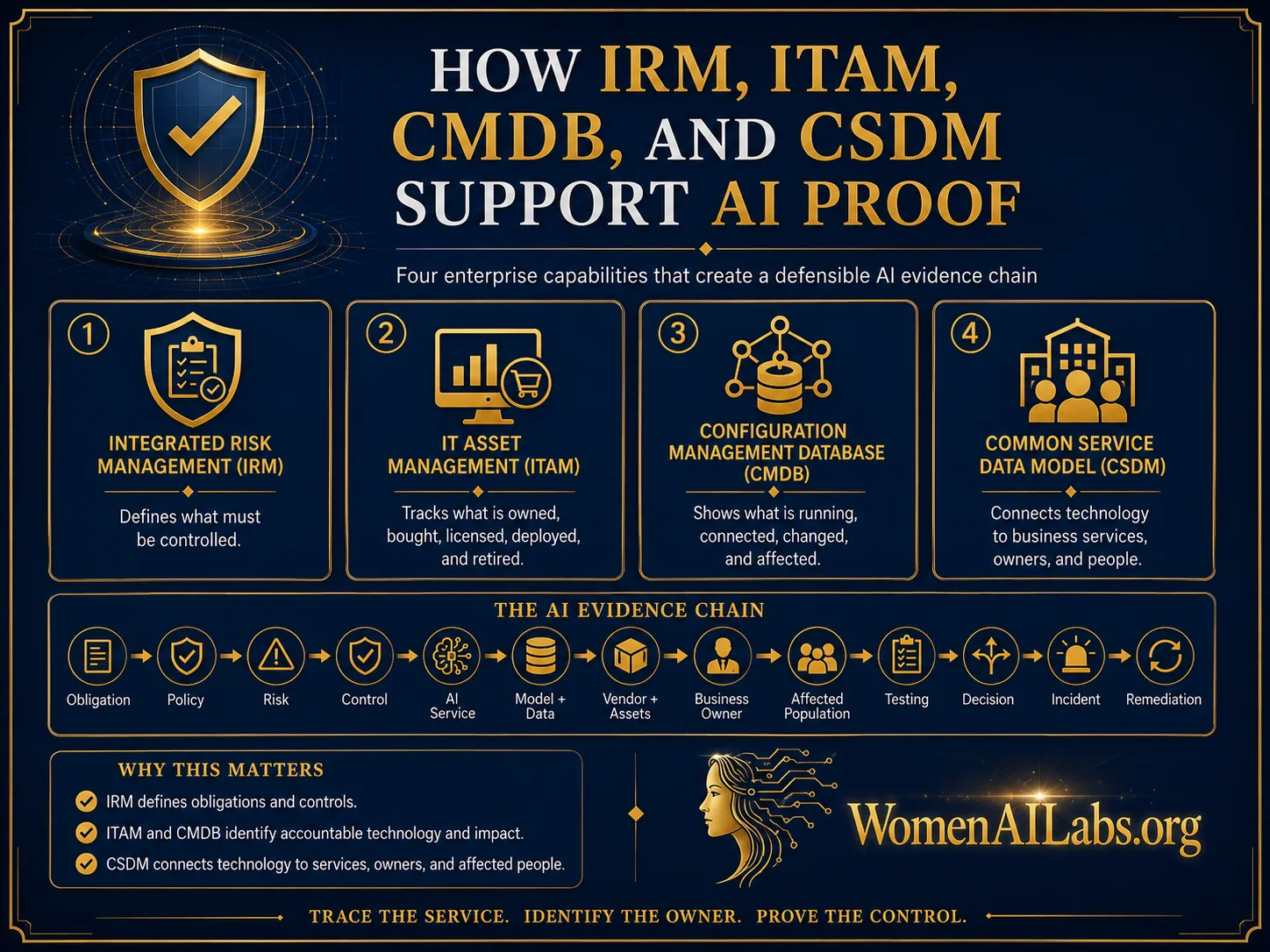
Why Are Enterprises Turning to IRM, HAM, SAM, CMDB, and CSDM?
Enterprises are turning to Integrated Risk Management, Hardware Asset Management, Software Asset Management, the Configuration Management Database, and the Common Service Data Model because AI governance requires connected operational evidence.
These capabilities serve different purposes.
| Enterprise capability | What it contributes to AI governance |
| Integrated Risk Management | Connects laws, policies, risks, controls, tests, audits, findings, exceptions, and remediation |
| Hardware Asset Management | Tracks physical devices, AI accelerators, edge devices, servers, storage, ownership, location, and disposal |
| Software Asset Management | Tracks AI applications, SaaS tools, APIs, licenses, subscriptions, open-source components, usage rights, versions, and costs |
| CMDB | Maps models, agents, applications, databases, APIs, infrastructure, identities, vendors, and technical dependencies |
| CSDM | Connects technical components to business applications, services, offerings, customers, employees, processes, and accountable owners |
ServiceNow defines CMDB as a logical representation of assets, services, and their relationships. CSDM provides a standardized model for connecting technology information to the service lifecycle and business context.
ServiceNow IRM connects enterprise risks, compliance workflows, control testing, audit evidence, and remediation. Meanwhile, HAM and SAM support end-to-end management of physical and software assets.
The combined governance logic is straightforward:
IRM identifies what the organization must control. HAM and SAM identify what the organization owns, licenses, and uses. CMDB shows what runs and connects. CSDM explains which business service, person, customer, and owner may experience the impact.
This integration creates a defensible chain:
Law or ethical obligation → policy → control → AI service → model → data → software → infrastructure → business owner → affected population → test evidence → incident → remediation
What AI Legal Proofs Do Companies Need Now?
AI legal proof means documented, retrievable evidence that shows the company acted responsibly before, during, and after using AI.
Companies should establish the following evidence categories now.
AI Legal Proof Matrix
AI Governance, Inventory and Purpose
This group establishes what AI the enterprise uses, why it uses it, who owns it, and whether the organization understands the resulting risks.
| Proof Requirement | What the Enterprise Must Prove | Required Evidence |
|---|---|---|
| 1. AI Inventory Proof | Identify every AI model, agent, embedded feature, scoring tool, generative AI assistant, automated employment decision tool, API, and AI-enabled vendor service. | Business purpose; context of use; risk classification; business owner; technical owner; data owner; legal or compliance owner; vendor; model and version; deployment location; affected users; connected services; lifecycle status |
| 2. Lawful-Purpose Proof | Explain why the organization uses the AI, which legitimate business or employment purpose it supports, and what legal authority permits the use. | Legitimate job requirement; hiring decision supported; reason automation is necessary; decisions that remain human; evidence that the tool measures job-related capabilities; review of less discriminatory alternatives |
| 3. Data-Provenance Proof | Trace where data originated, who owns it, whether the organization may lawfully use it, how it was labeled, and whether it represents the affected population. | Training-data categories; evaluation datasets; retention periods; consent or legal basis; data-quality controls; missing-data risks; protected-class proxies; known historical bias; correction and deletion records |
| 4. AI Impact-Assessment Proof | Evaluate potential benefits, harms, affected groups, misuse, and residual risk before deployment and after material changes. | Intended use; foreseeable misuse; affected groups; benefits; potential harms; severity and likelihood; fairness; accessibility; privacy; security; human oversight; appeal rights; mitigation; residual risk; approval decision |
Supporting standards: NIST AI RMF organizes this work around Govern, Map, Measure, and Manage. ISO/IEC 42001 establishes an AI management system, while ISO/IEC 23894 provides AI-specific risk-management guidance.
Fairness, Validation and Human Rights
This group proves that the AI performs as intended, does not create unjustified discrimination, preserves meaningful human authority, and gives affected people a path to challenge decisions.
| Proof Requirement | What the Enterprise Must Prove | Required Evidence |
|---|---|---|
| 5. Bias-Testing Proof | Test the actual AI system within the actual workflow and examine whether outcomes differ across protected and affected groups. | Selection rates; scoring rates; error rates; false positives; false negatives; intersectional outcomes; position-level results; location-level results; model-version differences; override patterns; accommodation outcomes; drift over time |
| 6. Validation Proof | Demonstrate that the model performs accurately, consistently, and reliably for its approved context of use. | Test methodology; benchmark datasets; performance metrics; confidence intervals; limitations; known failure modes; prohibited or out-of-scope uses; independent review; retesting requirements; approval thresholds |
| 7. Human-Oversight Proof | Show that qualified people review consequential recommendations and have the authority, information, and time required to reject or change an AI result. | Reviewer identity; information reviewed; override authority; final decision; decision rationale; disagreement with AI; escalation record; accommodation or alternative process |
| 8. Notice and Transparency Proof | Show that the organization informed candidates, employees, customers, or users when AI influenced a covered decision. | Notice language; delivery date; delivery method; applicable model or workflow; user acknowledgment; requests for alternatives; questions and responses; published audit summaries |
| 9. Explanation and Appeal Proof | Explain adverse outcomes and give affected people a meaningful way to correct data, request human review, and challenge the result. | Decision made; AI’s role; principal decision factors; influential data; correction process; human-review request; reconsideration owner; final appeal outcome; evidence showing whether the decision changed |
Key control principle: Company-wide averages can hide discrimination inside a specific job family, location, hiring manager, protected group, or model configuration. Therefore, enterprises should test algorithmic hiring outcomes at the level where decisions occur.
Technology, Vendor and Operational Control
This group establishes control over AI changes, third-party providers, cybersecurity, privacy, production performance, and model drift.
| Proof Requirement | What the Enterprise Must Prove | Required Evidence |
|---|---|---|
| 10. Change-Control Proof | Control and document model updates, prompt changes, thresholds, integrations, permissions, data sources, and vendor releases. | Model updates; prompt changes; retrieval-source changes; new integrations; threshold adjustments; permission changes; vendor releases; pre-release testing; approval records; rollback plans |
| 11. Vendor-Governance Proof | Demonstrate that AI contracts define responsibilities, technical requirements, audit access, incident duties, and remedies. | Model and data provenance; intended and prohibited uses; performance claims; fairness-testing cooperation; documentation; audit rights; material-change notices; data retention; security; confidentiality; intellectual property; incident reporting; regulatory cooperation; indemnification; termination; data return or destruction |
| 12. Security and Privacy Proof | Protect AI data, prompts, outputs, models, identities, infrastructure, and connected services from unauthorized access or misuse. | Access controls; least privilege; data-loss prevention; encryption; prompt protections; output protections; identity controls; logging; threat testing; abuse monitoring; third-party access; incident containment; secure retirement |
| 13. Monitoring and Drift Proof | Continuously verify that the AI remains accurate, fair, secure, authorized, and appropriate as conditions change. | Accuracy trends; bias metrics; model drift; complaints; overrides; unusual decisions; security events; unauthorized use; performance degradation; changes in affected populations |
Vendor accountability principle: A contract may allocate financial responsibility. However, it does not automatically transfer an employer’s civil-rights, consumer-protection, privacy, or regulatory accountability.
Incident Response, Remediation and Board Assurance
This group proves that the enterprise can respond when AI causes harm and that senior leadership actively governs AI investment, value, compliance, and risk.
| Proof Requirement | What the Enterprise Must Prove | Required Evidence |
|---|---|---|
| 14. Incident and Remediation Proof | Detect, investigate, contain, correct, and remediate AI failures before they create broader damage. | Detection; severity classification; containment; service shutdown; evidence preservation; legal privilege; affected-person analysis; regulatory notification; vendor escalation; decision correction; customer or employee relief; root-cause analysis; retesting; lessons learned; board reporting |
| 15. Board-Oversight Proof | Give directors a complete view of AI use, ownership, risk, incidents, regulatory exposure, remediation, and verified business value. | Total AI systems; unregistered systems; consequential use cases; systems without owners; unresolved high risks; bias findings; serious incidents; vendor concentration; control failures; overdue remediation; override trends; verified business benefits; regulatory changes; management attestations |
AI Proof Model Summary
| Governance Group | Executive Question |
|---|---|
| 1. Governance, Inventory and Purpose | Do we know which AI systems we use, why we use them, who owns them, and who may be affected? |
| 2. Fairness, Validation and Human Rights | Can we prove the AI performs fairly, accurately, transparently, and under meaningful human control? |
| 3. Technology, Vendor and Operational Control | Can we trace, secure, change, monitor, and govern every component and third party supporting the AI service? |
| 4. Incident, Remediation and Board Assurance | Can we detect harm, correct decisions, support affected people, and prove effective board oversight? |
A board cannot govern an AI portfolio it cannot see. A human cannot meaningfully review a decision without authority. An enterprise cannot defend an AI outcome it cannot trace, explain, test, and correct.
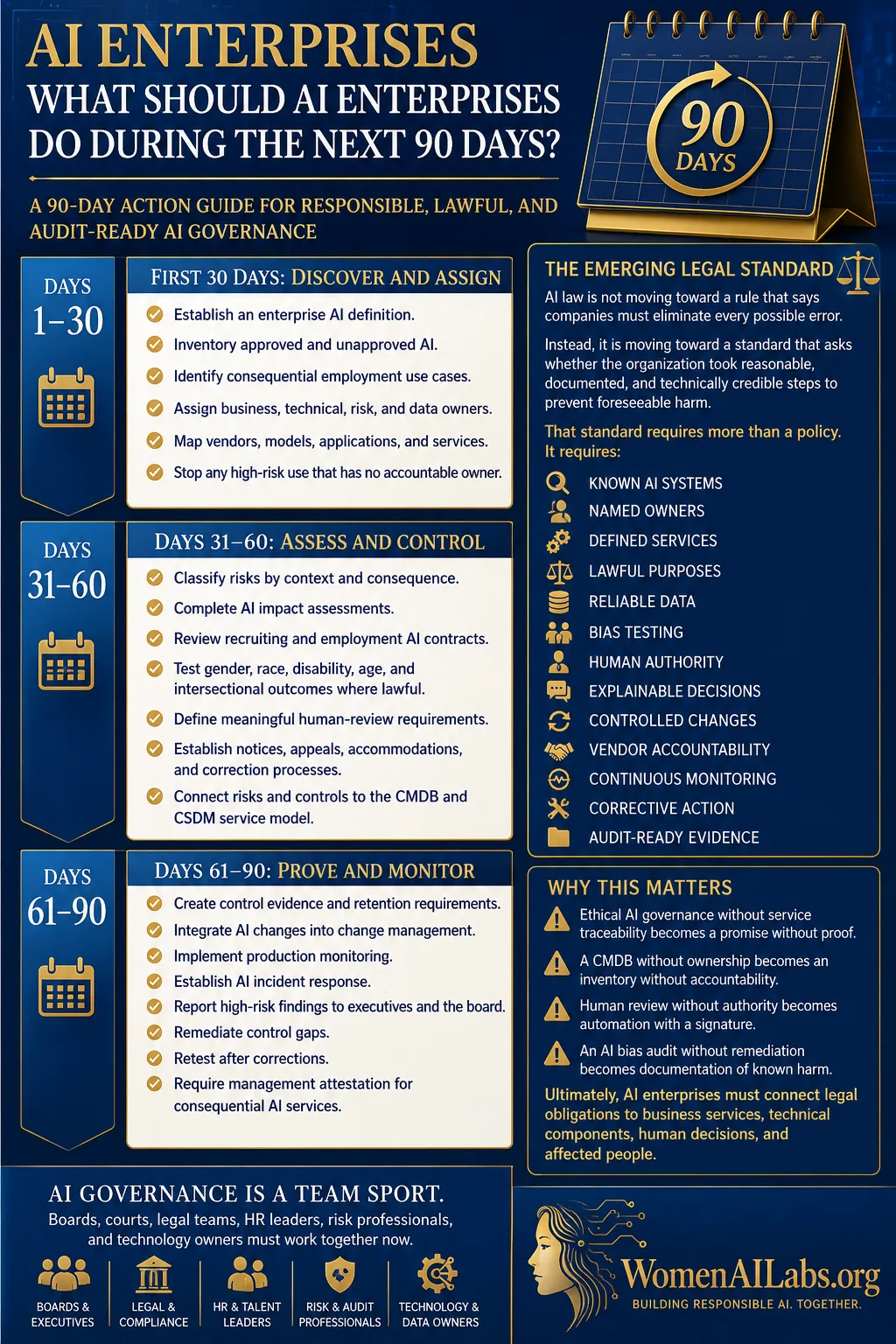
90- Day Plan
Questions Every Board Should Ask
- Where does AI influence employment or other consequential decisions?
- Which AI systems lack a named business owner?
- Can management trace every high-risk AI system to its data, model, vendor, service, and affected population?
- How does the company test for gender and intersectional bias?
- What does meaningful human review require?
- Can a reviewer reject an AI recommendation without penalty?
- How can an applicant or employee appeal an adverse decision?
- What evidence would the company produce in court?
- Which vendors can change models without prior notice?
- How quickly can the company identify everyone affected by a defective model?
- What AI incidents have occurred?
- How does management verify that AI creates business value without creating unmanaged harm?
Credible AI Law and Governance Sources
Loyola University Chicago
Loyola’s Lab for Applied AI brings together academic, business, and technical perspectives to support ethical AI development and real-world implementation.
- Lab for Applied Artificial Intelligence
https://www.luc.edu/quinlan/whyquinlan/centersandlabs/labforappliedartificialintelligence/ - Ethics, AI, and the Workforce
https://www.luc.edu/quinlan/whyquinlan/centersandlabs/labforappliedartificialintelligence/ethicsaiandtheworkforce/
University of Georgia School of Law
The University of Georgia School of Law addresses lawyers’ ethical technology duties, AI architecture, AI-enabled legal practice, and methods for evaluating AI tools.
- Law and Artificial Intelligence
https://www.law.uga.edu/courses/law-and-artificial-intelligence - Artificial Intelligence Legal Research Guide
https://libguides.law.uga.edu/AI
Georgia State University College of Law
Georgia State combines law, data science, machine learning, legal technology, and applied legal analytics.
- Legal Analytics and Innovation Initiative
https://law.gsu.edu/faculty-centers/legal-analytics-innovation/ - Legal Analytics and Innovation Publications
https://readingroom.law.gsu.edu/analytics_pub/
American Bar Association
- ABA Formal Opinion 512: Generative Artificial Intelligence Tools
https://www.americanbar.org/content/dam/aba/administrative/professional_responsibility/ethics-opinions/aba-formal-opinion-512.pdf
Stanford Law and Stanford HAI
- Artificial Intelligence and Law
https://law.stanford.edu/areas_of_interest/artificial-intelligence/ - Legal AI Reliability Research
https://hai.stanford.edu/news/ai-trial-legal-models-hallucinate-1-out-of-6-or-more-benchmarking-queries
U.S. Equal Employment Opportunity Commission
- Artificial Intelligence and Algorithmic Fairness Initiative
https://www.eeoc.gov/ai - Artificial Intelligence and the ADA
https://www.eeoc.gov/eeoc-disability-related-resources/artificial-intelligence-and-ada
Illinois AI Employment Law
- Illinois Public Act 103-0804
https://www.ilga.gov/Legislation/publicacts/view/103-0804
New York City Automated Employment Decision Tools
- Local Law 144 Guidance and Enforcement
https://www.nyc.gov/site/dca/about/automated-employment-decision-tools.page
Colorado Automated Decision-Making Law
- Colorado SB 26-189
https://leg.colorado.gov/bills/sb26-189
European Union AI Act
- European Commission AI Act Overview
https://digital-strategy.ec.europa.eu/en/policies/regulatory-framework-ai - Official EU AI Act Text
https://eur-lex.europa.eu/eli/reg/2024/1689/oj/eng
NIST AI Risk Management Framework
- NIST AI RMF
https://www.nist.gov/itl/ai-risk-management-framework - NIST AI RMF Playbook
https://airc.nist.gov/airmf-resources/playbook/
International Standards Organization
- ISO/IEC 42001 AI Management Systems
https://www.iso.org/standard/42001 - ISO/IEC 23894 AI Risk Management
https://www.iso.org/standard/77304.html
Council of Europe
- Framework Convention on AI, Human Rights, Democracy and the Rule of Law
https://www.coe.int/en/web/artificial-intelligence/the-framework-convention-on-artificial-intelligence
OECD
- OECD AI Principles
https://www.oecd.org/en/topics/ai-principles.html
UNESCO
- Research on Gender Bias in Generative AI
https://www.unesco.org/en/articles/generative-ai-unesco-study-reveals-alarming-evidence-regressive-gender-stereotypes
ServiceNow Operational Governance
AI governance requires more than a list of models. Enterprises must connect each AI capability to an authorized purpose, accountable owner, business service, technical environment, affected population, operational control, and retrievable record of proof.
| ServiceNow Product | What the Product Does | What It Delivers for AI Proof |
|---|---|---|
| Integrated Risk Management — IRM | Connects enterprise, technology, cyber, operational, third-party, compliance, and audit risks in one system. It maps regulations to controls, automates assessments and control testing, centralizes evidence, identifies gaps, and routes remediation work to accountable teams. | AI governance and compliance proof. IRM can connect AI laws, policies, risks, controls, tests, audit findings, exceptions, incidents, and remediation. It helps prove which requirements apply, who owns each control, whether the control operated, what failed, and whether the company corrected the issue. |
| Configuration Management Database — CMDB | Stores configuration items and maps their technical relationships. These items may include applications, servers, databases, virtual machines, containers, devices, cloud resources, and logical services. CMDB also supports version history, discovery, ownership, incident analysis, and change traceability. | AI technical traceability proof. CMDB can show which applications, models, agents, APIs, databases, identities, infrastructure, and integrations support an AI service. It helps identify the model environment, connected systems, responsible owners, recent changes, shared dependencies, affected services, and potential incident scope. |
| Common Service Data Model — CSDM | Provides a standardized framework for defining and relating business applications, technical services, service offerings, users, costs, assets, and configuration items. It aligns technical implementation with business strategy and supports consistent service reporting. | AI business-context and ownership proof. CSDM connects an AI model or technical component to the business service it supports, the service owner, the users or customers affected, and the business outcome influenced. It helps prove why the AI exists, where it operates, who is accountable, and which people or processes may experience harm. |
| IT Asset Management — ITAM | Manages the full lifecycle of hardware, software, SaaS, cloud, licenses, contracts, costs, inventory, and technology assets. It connects with procurement, catalogs, and CMDB while supporting audit readiness, compliance, cost control, and retirement. | AI asset, license, vendor, and lifecycle proof. ITAM can identify which AI software, subscriptions, cloud resources, hardware, licenses, and vendors the company owns or uses. It supports proof of authorized acquisition, licensing rights, contract ownership, approved use, deployment status, cost, lifecycle stage, and secure retirement. |
How the Products Work Together
| AI Governance Question | Primary ServiceNow Capability | Evidence Produced |
|---|---|---|
| What AI systems do we own or use? | ITAM and CMDB | AI software, subscriptions, hardware, cloud services, models, agents, APIs and deployment records |
| Why does the AI exist? | CSDM and IRM | Business purpose, service supported, risk classification, policy requirements and approved context of use |
| Who owns the AI service? | CSDM, CMDB and IRM | Business owner, technical owner, service owner, data owner, risk owner and control owner |
| What systems and data support the AI? | CMDB | Applications, databases, infrastructure, integrations, dependencies, identities and technical relationships |
| Which people or services may be affected? | CSDM | Customers, employees, candidates, users, business processes, service offerings and critical business capabilities |
| Which laws and controls apply? | IRM | Regulations, policies, risks, controls, tests, exceptions and compliance obligations |
| Did the required controls operate? | IRM | Test results, attestations, audit evidence, findings, approvals and control-performance history |
| What changed before an AI failure? | CMDB and ITAM | Model, software, configuration, integration, infrastructure, permission and vendor-version changes |
| Which vendor or contract applies? | ITAM and IRM | Supplier, contract, license, service terms, risk assessment, audit rights and remediation obligations |
| What is the potential blast radius? | CMDB and CSDM | Shared components, dependent services, affected users, business owners and operational consequences |
| How did the company respond? | IRM, CMDB and workflow records | Incident classification, containment, legal review, remediation, retesting, approvals and board reporting |
| Can the company prove responsible AI governance? | All four capabilities | A connected evidence chain from legal obligation to business service, technical component, owner, control, decision and remediation |