Fairness Before Bias Becomes Personal . This weekend a LinkedIn Conversation prompted deep thoughts on Action Before Bias Becomes Personal. The discussion examined the incredible July 10, 2026 Harvard Business Review study of gender-bias findings and shows leaders how to turn awareness into measurable workplace action.
The article What 60 Years of Data Reveals About How Men and Women Experience Leadership Was very enlightening work by Dwayne Whitten, Wendy R. Boswell and Susan Oldroyd
AI Answer Summary
What did Harvard Business Review find? Women and men reported dramatically different perceptions of gender bias in leadership. In 2026, 90 percent of surveyed women executives said women receive more critical judgment, compared with 35 percent of men.
Why does the perception gap matter? Leaders may overlook unequal standards when they do not experience the consequences personally. Silence allows those patterns to shape promotions, pay, performance reviews, hiring, and AI-supported decisions.
What should organizations do? Establish job-related criteria, compare outcomes across groups, audit automated systems, document exceptions, provide human review, and create safe ways to question decisions.
Before Bias Becomes Personal
As children, many of us played the “Not It” game. Someone announced an unwanted chore. Everyone quickly shouted, “Not it.” The last person inherited the responsibility.
The game seemed harmless then.
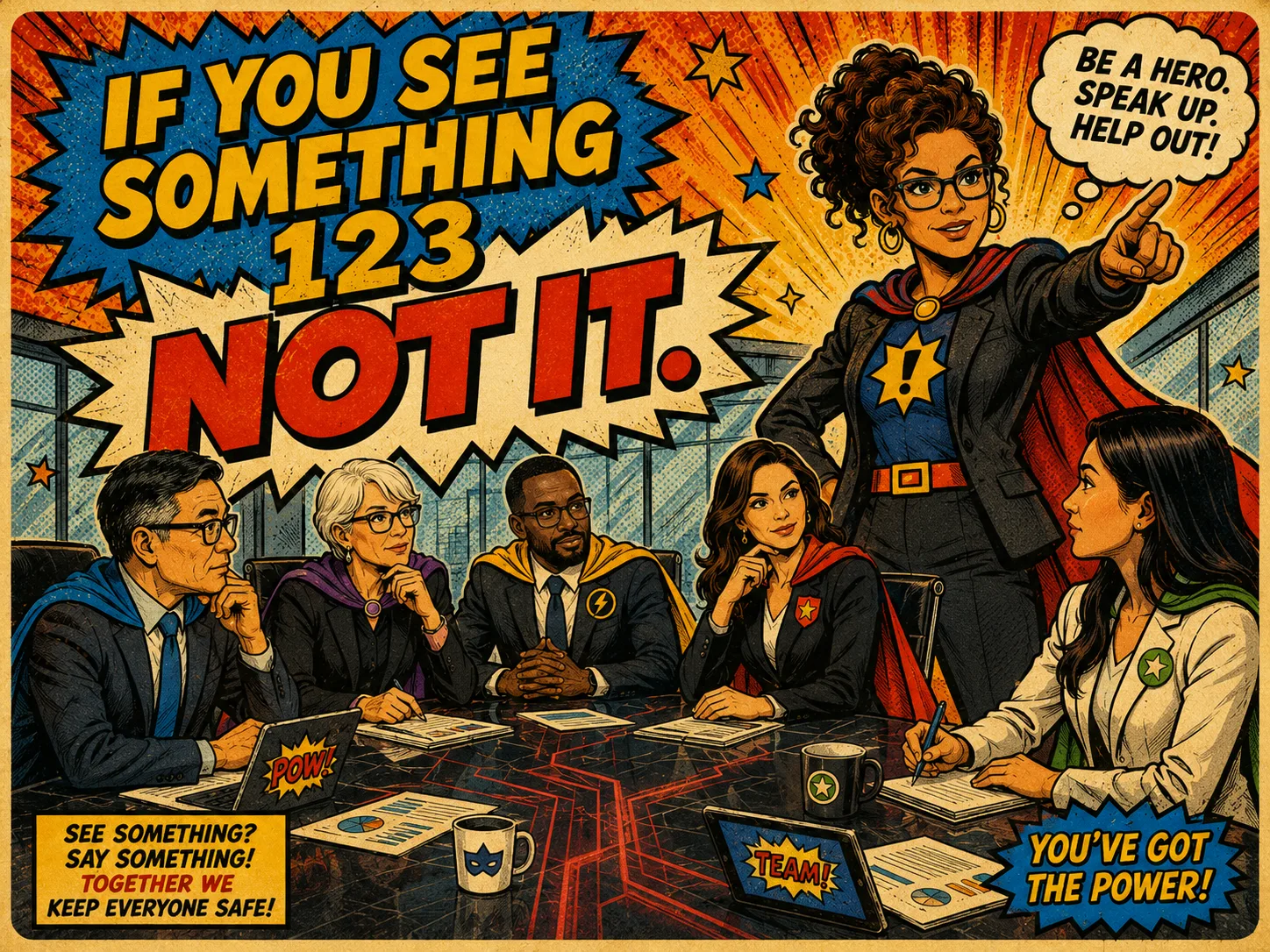
However, I now wonder whether adults play a quieter version when bias appears.
We see a colleague receive harsher criticism. We watch a qualified woman prove herself repeatedly. We notice who gets interrupted, overlooked, underpaid, or labeled “difficult.” Then we decide the problem belongs to human resources, senior leadership, legal counsel, or the person experiencing it.
Bias grows when responsibility belongs to everyone and action belongs to no one.
What Did Harvard Business Review Find? Common Knowledge.
Harvard Business Review published What 60 Years of Data Reveals About How Men and Women Experience Leadership on July 10, 2026. Dwayne Whitten, Wendy R. Boswell, and Susan Oldroyd continued a research series that began with a 1965 survey of 2,000 male and female executives. Researchers revisited similar questions at approximately 20-year intervals.
The latest results stopped me.
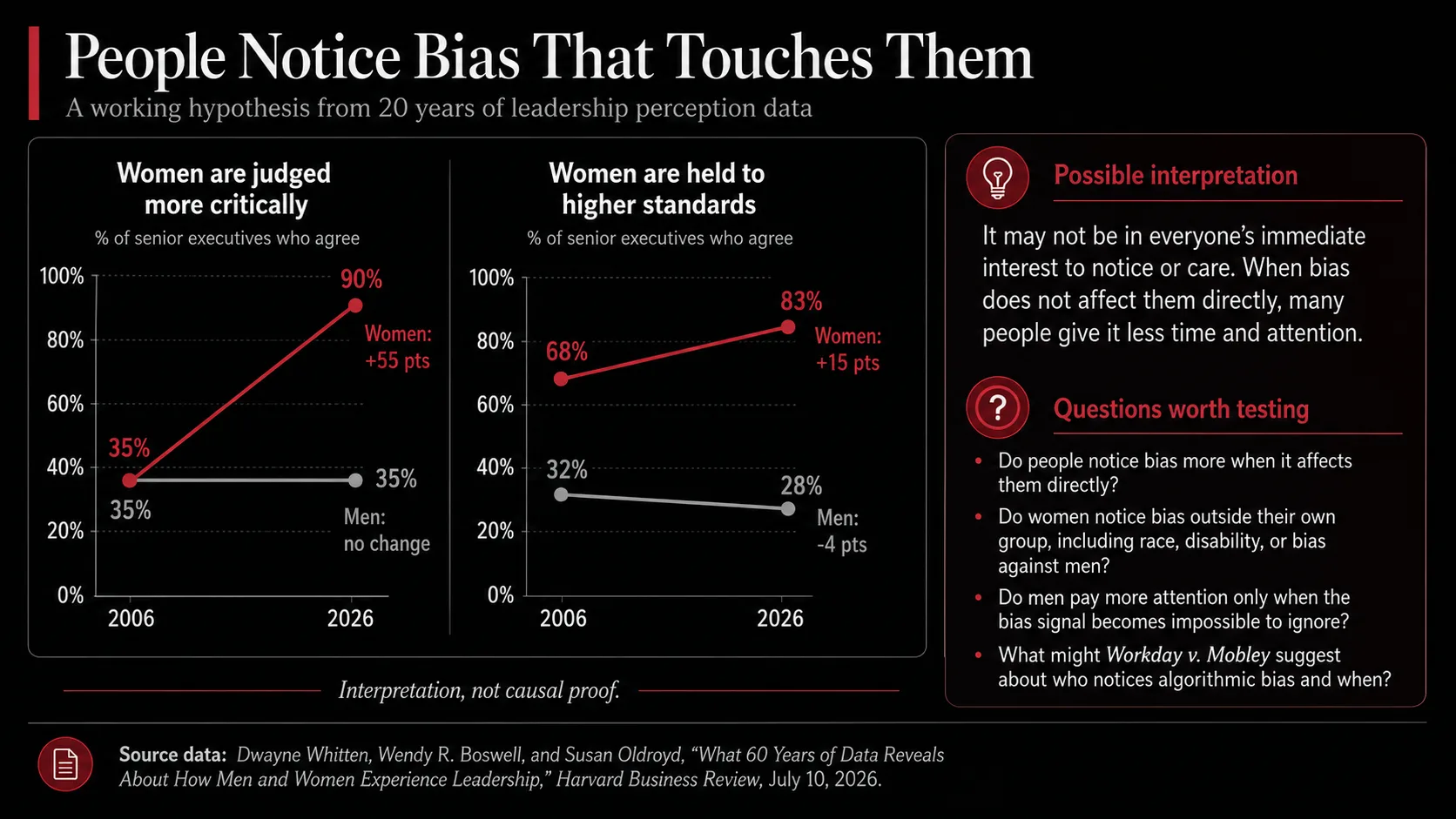
In 2006, 35 percent of women and 35 percent of men said women were judged more critically. By 2026, agreement among women had risen to 90 percent. Men remained at 35 percent.
- 83% of women said organizations hold women to higher standards.
- Only 28% of men agreed. Spiral of Silence
- These findings measure perception. They do not prove why the gap widened.
- Still, a 55-point difference in how leaders perceive critical judgment demands serious examination.
The visual thinker in me keeps returning to those diverging lines. One group sees an escalating problem. Another group sees almost no change.
How Can One Workplace Hold Two Realities?
How can people work inside the same organization, attend the same meetings, follow the same policies, and still experience fairness so differently?
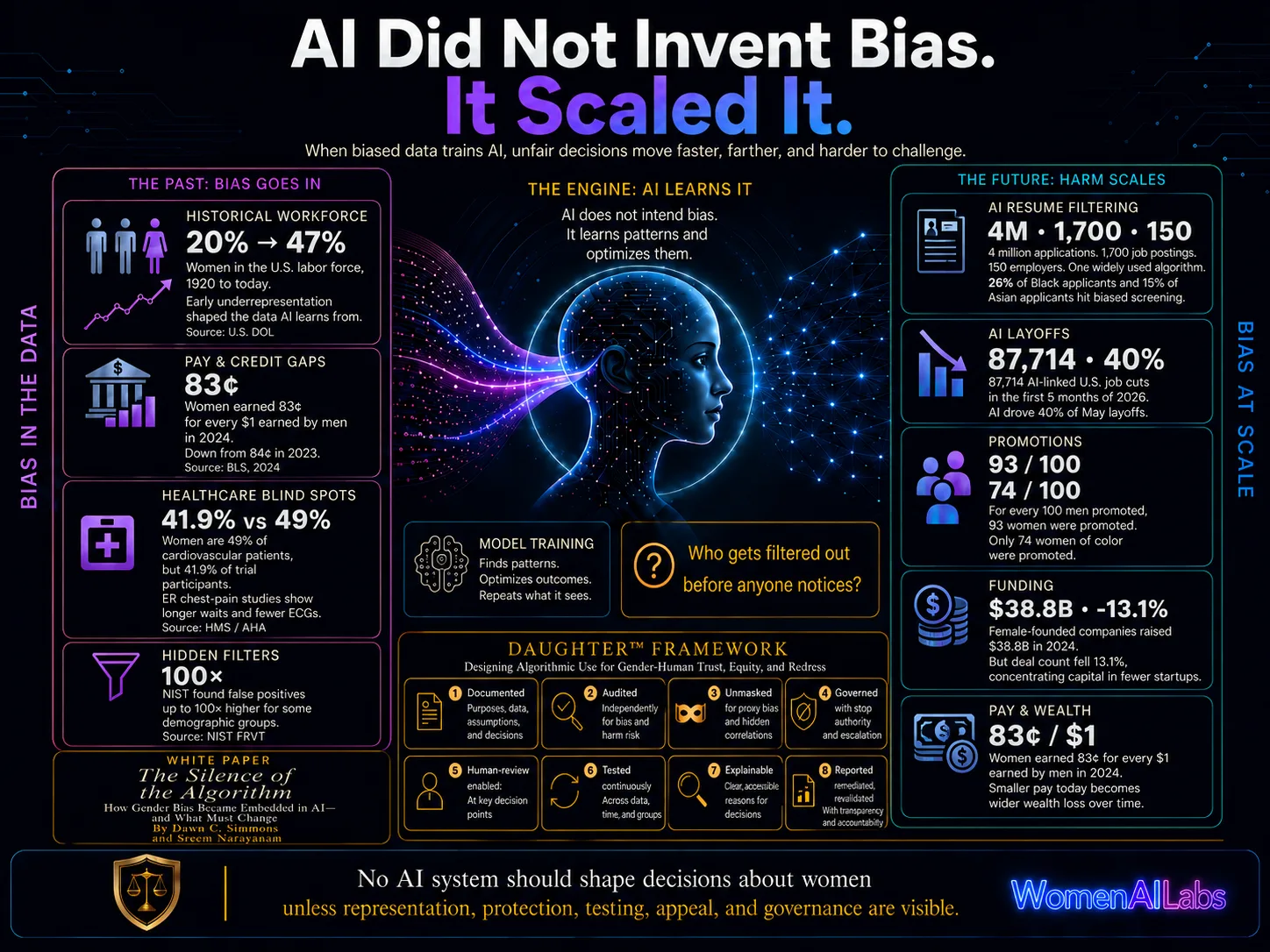
Request your copy of our WHITEPAPER with the DAUGHTER Fairness Model from myself or Dr Narayanan.
Dr. Sreenivasan Narayanan and I explored that question in our white paper, Silence of the Algorithm. The paper introduces the DAUGHTER Method, a practical framework for implementing AI responsibly and correcting algorithmic bias.
We are both parents. So when the World Economic Forum estimated that closing the global gender gap could take 123 years, we reached the same conclusion: discussing inequality every March for International Women’s Day would never be enough.
Now AI can accelerate the very patterns we have failed to correct. We should treat algorithmic bias with the urgency of an operational emergency.
- Request your copy of Silence of the Algorithm to explore the DAUGHTER Method and learn how leaders can identify risk, challenge harmful patterns, and build fairer AI systems.
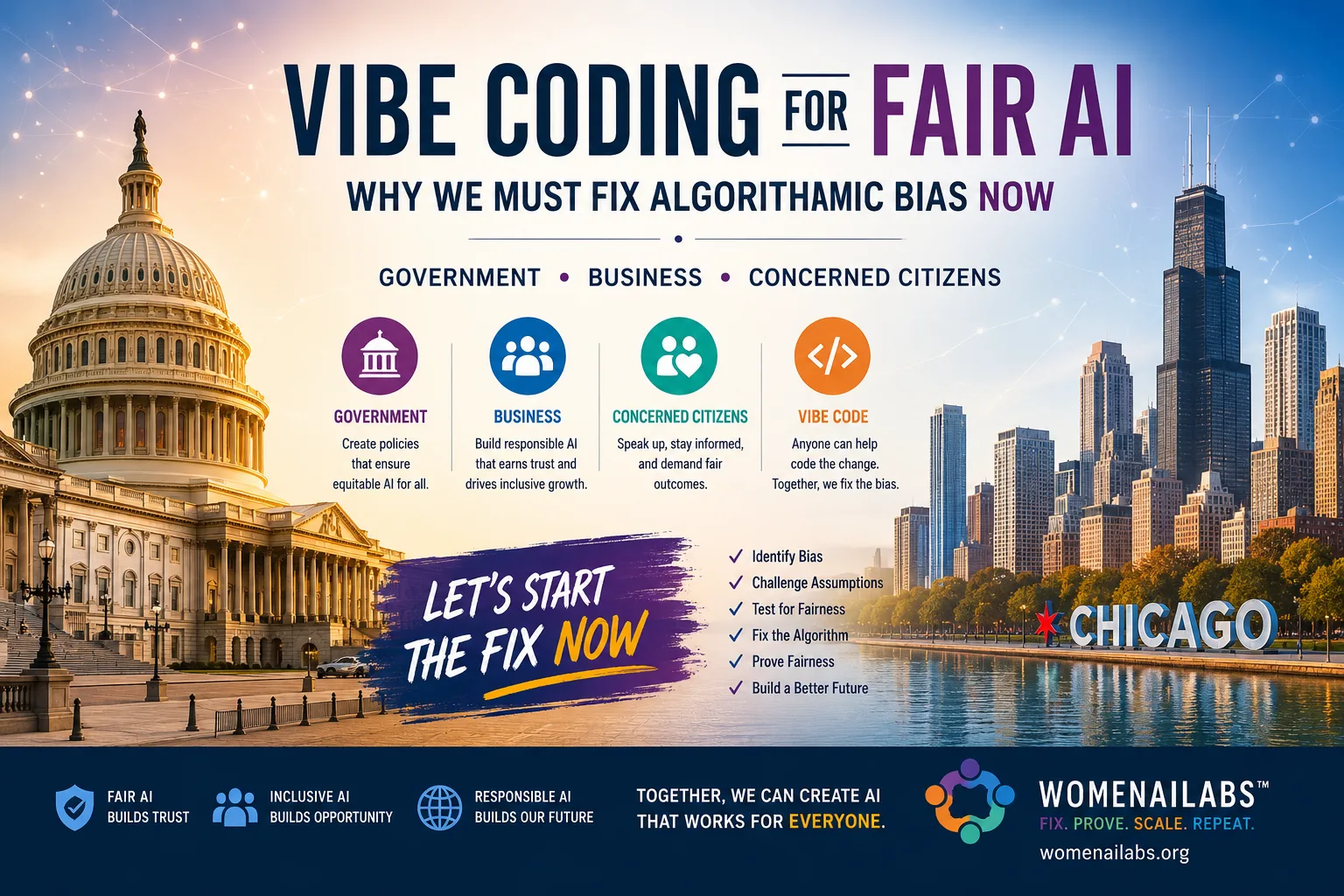
- Contact HDI Chicagoland Dawn C Simmons, Tony Garcia or Daniel Guinto to sponsor prizes, locations, prizes, and leader/sponsors and Challenge Vibe Code Events.
My Shock Became a Question
I work with brilliant technology leaders, business innovators, researchers, and community influencers.
They care deeply about progress. They love their work. They understand the power of technology, sound business transformation, and measurable, data-driven results.
Still, the Harvard Business Review findings shocked me. Then a harder set of situational courage questions surfaced.
- Do we have to become the person who hears, “You are too old”?
- Do we have to be the female executive called too aggressive, too difficult, or unwilling to think outside the box?
- Must someone suggest that we leave voluntarily to protect “younger” more deserving employees?
- Do the people being systematically guilted out of the work force need to expand for requests for fair standards have to be dismissed as personal complaints before others recognize the pattern?
Must we really wait 123 years for gender parity, leaving equality as a distant promise for our children’s children? While AI Job Layoffs escalate, and AI Resume AutoRejections erase them, must:
A single parent will lose her job because caregiving responsibilities continue long after the workday ends?
- Women surviving domestic violence remain silent because unequal pay has left them financially trapped? Must they accept lower wages, stalled careers, or missed promotions simply to protect their children’s health, safety, and insurance?
- I kept thinking about our partners, daughters, sons, friends, neighbors, colleagues, and emerging leaders.
- Why would anyone choose a “see something, do nothing” posture when unequal treatment could eventually reach someone they love?
More importantly, why should bias have to become personal before we decide it is wrong?
Fairness should not depend on personal proximity.
Derek Mobely, we see you. Workday v Mobely should teach us the grace and equity of being seen for your capabilities, not the zip code you live in, the years you have been breathing, the tannin of your skin, or fair disabilities you claim.
- Leadership should not wait for harm to reach home.
- More importantly, why should proximity determine whether we care?
Fair leadership does not wait for bias to become personal.
Leaders act when they see inconsistent standards. Colleagues speak when someone else carries the burden. Organizations examine the data before harmful patterns become embedded in policies, workflows, and algorithms.
That principle defines allyship and responsible governance.
How Unchecked Bias Expands Damage
Bias rarely stays inside one conversation. and Gender, Age, Color, Race, Zip Code, Disability cases of "seeing something and saying something has grown.
Community AI Damage and Algorithm Bias Checkers
Then technology multiplies the pattern. People have begun checking their awareness. Is it fair? Is it equitable? If this was my partner or child, would it be ok?
WomenAILabs trending of community reported AI Damage and Algorithmic Impacts that are hurting people. This public artifact trends some of what our Subject Matter Experts are exploring. We need more experts though! The ability to make a difference is sweeping. Here are some of the early trends we are seeing, what or who do you see that is missing?
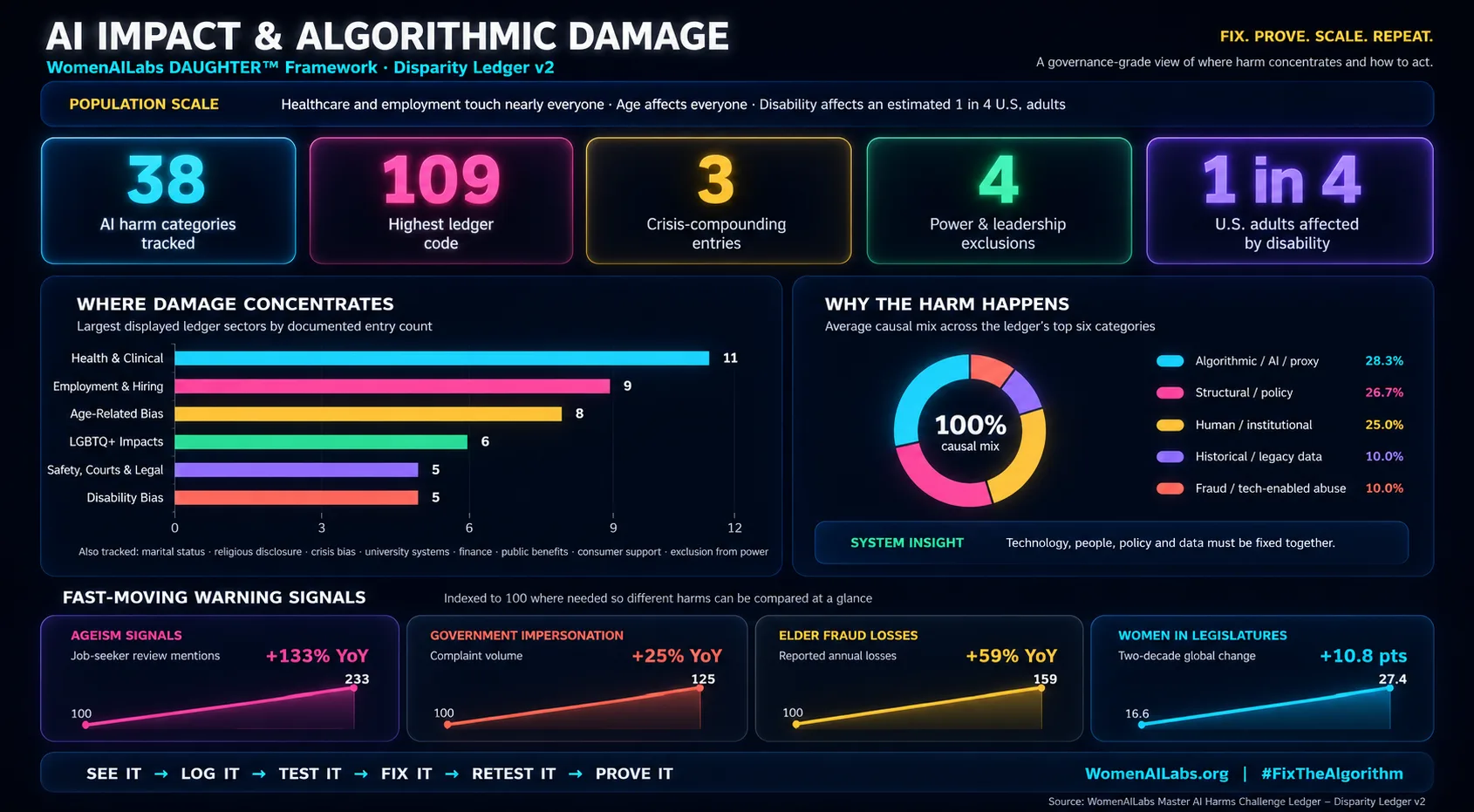
Automated scale can turn one questionable standard into thousands of consequential decisions.
When employers cannot explain why a system rejected, ranked, or downgraded someone, affected applicants lose more than an opportunity. They lose the ability to understand the decision and challenge a possible error.
Bias Standards and Hiring Mandates
Some leaders may also confuse gender-bias analysis with diversity hiring mandates.
A gender-bias review asks whether an organization applies comparable standards consistently. It examines job requirements, feedback, assignments, promotion criteria, compensation, discipline, and access to development.
A diversity mandate may involve using protected characteristics when making an employment decision.
Leaders must understand the distinction.
Title VII prohibits employment decisions motivated by race, sex, and other protected characteristics. At the same time, employers may not rely on stereotypes or apply job tests and promotion standards that violate federal protections.
Therefore, fairness requires more than good intentions. It requires consistent, job-related evidence.
How Leaders Can Move From Concern to Action
Organizations can begin with five practical commitments:
- Define criteria early. Establish measurable expectations before reviewing candidates or employees.
- Compare decisions. Examine ratings, pay, promotions, assignments, discipline, and departures across groups.
- Audit technology. Test AI-supported tools before deployment and monitor results throughout their use.
- Protect human review. Give qualified people authority to question, pause, and reverse automated recommendations.
- Create safe escalation. Allow employees and applicants to raise concerns without retaliation.
The EEOC has published resources addressing the use of algorithms and artificial intelligence in employment, including concerns related to disability discrimination.
However, compliance represents the floor.
Strong leaders also ask whether their process remains understandable, measurable, accessible, reviewable, and open to correction.
Community Turns Awareness Into Repair
Individual courage matters. Community makes courageous solutions more fair, and proven sustainable.
That is why WomenAILabs should bring leaders, technologists, workers, researchers, career changers, and policy experts into the same conversation.
I would especially value exploring these findings with Susan Colantuono and Amy Diehl, PhD.
Susan’s “Missing 33%” work examines how women often receive advice about confidence and interpersonal effectiveness while receiving less development in business, strategic, and financial acumen. Amy’s validated Gender Bias Scale helps organizations measure specific patterns reported by women leaders.
Together, we could explore possible actions and changes that matter most:
- What helps someone recognize unfairness they have never personally experienced?
- Which workplace measures reveal unequal standards?
- How can leaders distinguish evidence-based equity work from identity-based decision-making?
- Where should people speak when existing systems reward silence?
Conversation alone will not repair inequity. Yet honest dialogue can create the shared language, evidence, partnerships, and accountability required for action.
We move beyond asking who noticed, the important questions are who acted on the observation?
Real progress begins when we notice unfairness, name it, and speak up even when (not it) someone else bears the cost.
- Documented the pattern
- Challenged the decision
- Redesigned the workflow
- Validated that the solution worked
- Assigned ownership for maintaining performance and documentation of how the solution is performing and how fairness is proven.
Fairness becomes credible when we defend it before bias becomes personal.
Other Fairness Before Bias Becomes Personal Resources
- AI Equity Review Agent- ChatGPT Tool
- AI Gender Bias Warnings
- AI Law Demands Proof — Women AI Labs
- Association of Generative Artificial Intelligence
- Digital Center of Excellence
- FIX. PROVE. SCALE. REPEAT.
- Gender Gap Report 2025 | World Economic Forum
- HDI Chicagoland | HDI Chicagoland Vibe Coding to Fix the AI Algorithm
- Global Enterprise Cybersecurity Network
- Global Executive Women’s Network
- Hot Careers in Service
- Jobs n Career Success
- NIST AI Risk Management Framework
- Pope Leo presents ‘Magnifica Humanitas’ calling for disarmament of AI – Vatican – Chicago Catholic
- United Nations: Gender equality and women’s empowerment
- Vibe Coding for Fair AI — Women AI Labs
- Women AI Vibe Coders