Human-Centered Automation Protects Insurance
Human-Centered AI Fraud Protection places people, evidence and accountability at the center of insurance automation. Insurance companies face two connected threats: algorithmic bias inside their systems and AI-enabled fraud attacking those systems.
Algorithmic Bias Challenges
Insurers increasingly use AI for pricing, underwriting, prior authorization, claims adjudication and fraud detection. Among surveyed insurers, 88% of auto insurers, 70% of homeowners insurers and 92% of health insurers reported using, planning to use or exploring AI and machine learning.
However, AI can reproduce unequal outcomes when it learns from historical decisions or relies on variables that act as proxies for race, income, disability, age or geography. These variables may include ZIP code, credit history, employment data, purchasing behavior, medical utilization and incomplete digital records. The NAIC specifically identifies inaccuracy, unfair discrimination, weak transparency and data vulnerability as consumer risks.
The oversight gaps remain significant. In an NAIC health-insurer survey:
- 75% tested algorithmic outcomes for bias.
- 70% tested modeling data for bias.
- Only 63% documented unfair discrimination testing.
- Only 29% had a process to contest an adverse underwriting decision.
- Only 23% logged contested underwriting decisions.
Therefore, an apparently accurate model may still produce unequal delays, higher prices, unnecessary investigations or inappropriate claim denials.
Cyberfraud Challenges
At the same time, criminals use stolen identities, synthetic identities, account takeovers, manipulated documents, false medical claims, GPS spoofing and digital impersonation to defeat insurance controls. NICB estimates that 10% or more of property and casualty claims may contain fraud. Those losses raise premiums, taxes and consumer prices for everyone.
Additionally, NICB projected a 49% increase in insurance fraud involving identity theft during 2025. Nearly one-quarter of referred claims involving identity theft included a synthetic identity.
In 2025, NICB also reported:
- 208,956 questionable claim submissions reviewed
- 10,919 fraud tips, up 36%
- 1,647 newly identified organized crime rings
Why Both Risks Matter
Aggressive fraud algorithms can incorrectly flag legitimate customers. However, weak controls allow organized criminals to steal from the shared insurance pool.
Therefore, insurers must validate both sides of the equation:
- Is the system finding fraud accurately?
- Is it treating legitimate customers fairly?
The strongest workflow is:
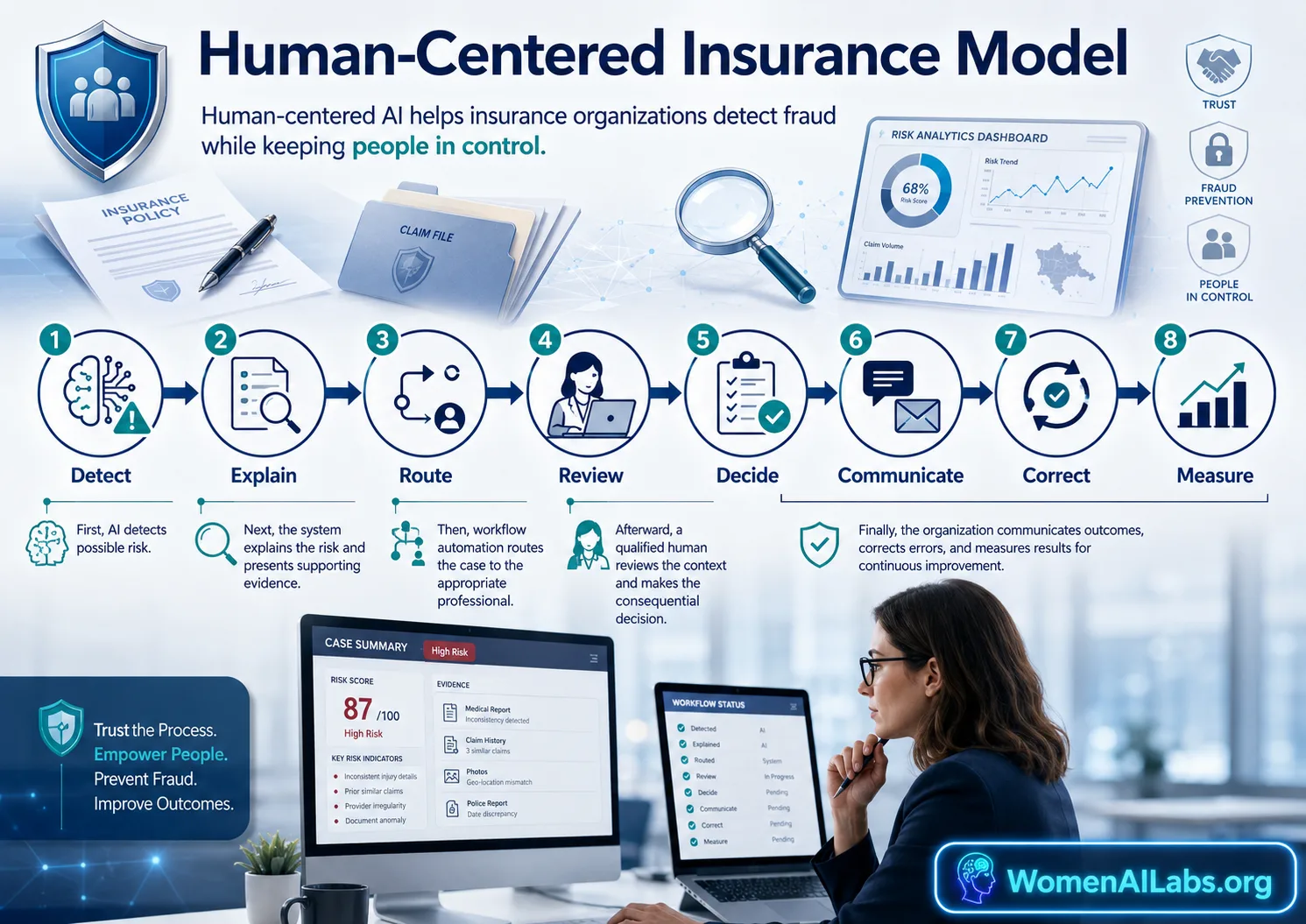
Detect → Explain → Route → Human Review → Decide → Communicate → Correct → Measure
AI should expose patterns and assemble evidence. Automation should route and track the work. Qualified professionals should retain authority over claim denials, payment delays, fraud referrals and other high-impact decisions.
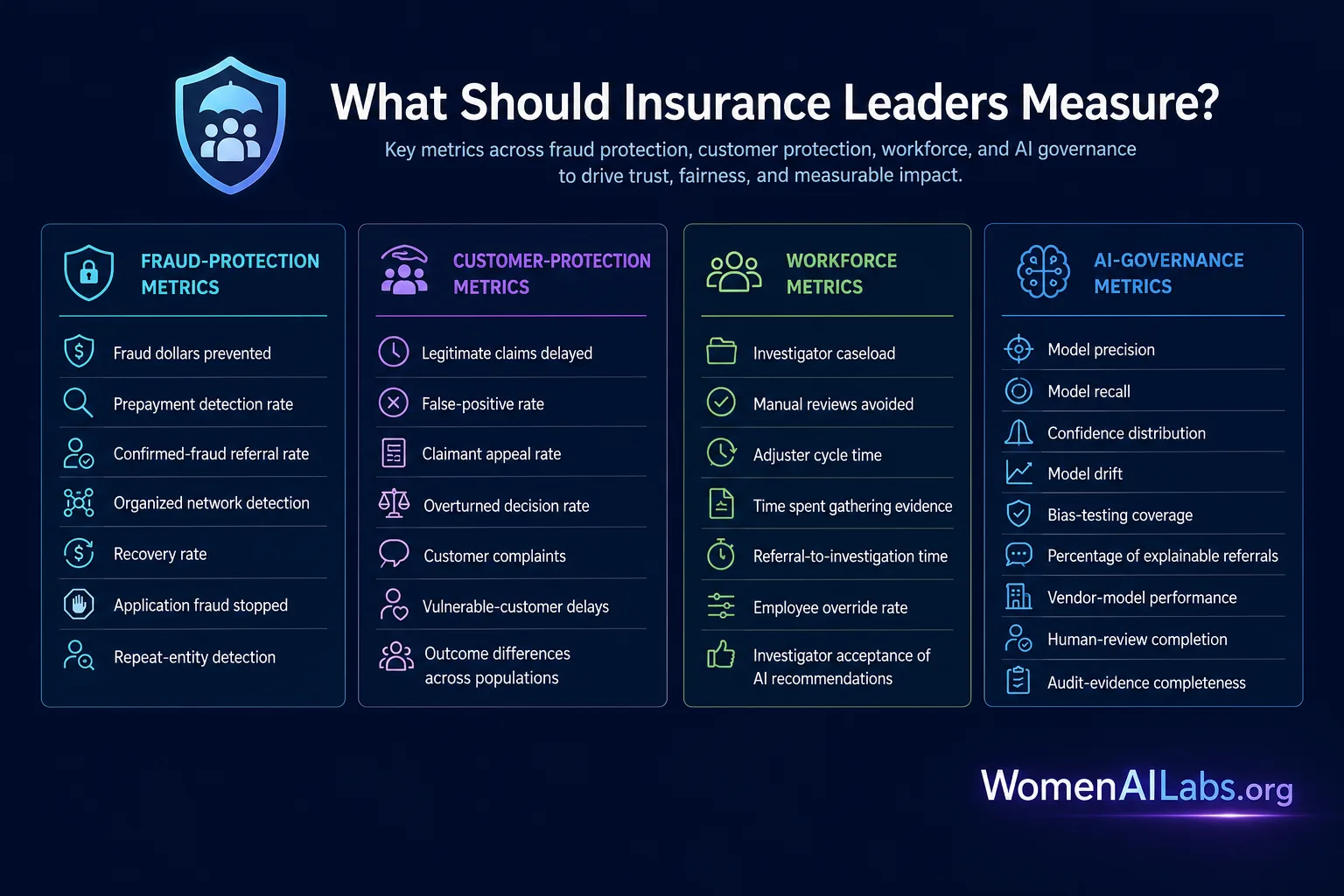
Insurers should measure confirmed fraud, false positives, processing time, customer-group outcomes, overrides, appeals, reversals and data corrections.
AI detects risk. Validation detects bias. Humans protect fairness.
Automated, validated AI workflows improve insurance outcomes by detecting suspicious patterns earlier, routing cases faster and giving professionals better evidence.
Validation also checks whether the AI is accurate, explainable and consistent. This helps reduce false alerts, unfair delays and biased decisions.
The result is stronger fraud prevention, faster legitimate claims and fairer service for every customer.
AI detects. Automation routes. Humans review. Validation protects fairness.
AI finds patterns. Automation moves work. Humans protect judgment, fairness and trust.
What Is Human-Centered AI Fraud Protection?
Human-centered AI fraud protection is an insurance operating model that uses artificial intelligence to detect risk while preserving human responsibility for investigation, communication, escalation and final decisions.
The model combines:
- Intelligent fraud detection
- Connected claims workflows
- Explainable risk indicators
- Human review
- Customer notification
- Appeal and correction rights
- Continuous performance monitoring
Consequently, insurers can fight fraud without treating every claimant as a suspect.
Why Does Insurance Need Human-Centered AI?
Insurance fraud costs U.S. consumers an estimated $308.6 billion each year. Furthermore, the FBI estimates that fraud may cost the average family between $4,000 and $7,000 in higher premiums over ten years.
At the same time, AI adoption has already reached insurance operations. The NAIC found that 84% of surveyed health insurers use AI or machine learning in some capacity.
However, adoption does not automatically create readiness.
Only 7% of surveyed anti-fraud professionals said their organizations were more than moderately prepared to detect or prevent AI-powered fraud. Additionally, only 29% reported using automation in their fraud programs.
Even more concerning, 75% said bias or fairness matters when adopting AI, but only 18% said their organizations test AI models for bias or fairness.
Therefore, insurers face two connected risks:
- Fraudsters can use AI faster than insurers can investigate.
- Insurers can deploy AI faster than they can govern it.
Human-centered automation addresses both risks.
AI is accelerating Insurance Fraud
Generative AI allows fraudsters to create convincing evidence at lower cost and greater speed.
For example, criminals can use AI to produce:
- Fabricated vehicle damage
- False accident scenes
- Altered medical records
- Synthetic repair estimates
- Generated receipts and invoices
- Cloned customer voices
- Fake beneficiaries
- Synthetic identities
- Automated insurance applications
- Exaggerated injury narratives
In 2025, Aviva identified more than 18,400 suspicious claims worth £233 million. The insurer also stopped more than 105,000 fraudulent insurance applications.
Moreover, Aviva reported that fraudsters increasingly used AI-generated images and manipulated documents to fabricate accident scenes and vehicle damage. In response, Aviva used advanced analytics and AI-supported tools with human oversight to stop suspicious claims earlier and accelerate genuine claims.
This example shows the human-centered principle in action:
Use AI to challenge suspicious evidence, not to automatically punish the claimant.
How Does Human-Centered AI Detect Fraud?
1. Verifies the claim
First, AI compares the claim against the policy, coverage dates, claimant identity, prior losses and submitted evidence.
For example, the system may identify:
- A claim filed immediately after policy activation
- Damage that does not match the reported accident
- A provider without appropriate credentials
- An invoice duplicated across several claims
- A claimant using multiple identities
- A photograph previously submitted elsewhere
The system then presents the inconsistency to an adjuster or investigator.
2. Detects abnormal behavior
Next, machine-learning models compare the claim with historical patterns.
They may identify unusual:
- Claim timing
- Treatment frequency
- Repair costs
- Provider activity
- Geographic concentration
- Payment requests
- Application behavior
- Device activity
However, an unusual claim is not automatically fraudulent.
Therefore, the model should generate a risk indicator, supporting evidence and recommended next action.
3.Connects hidden relationships
Fraud rarely exists in one isolated record.
Network analytics can connect:
- Claimants
- Providers
- Repair facilities
- Attorneys
- Addresses
- Devices
- Telephone numbers
- Bank accounts
- Vehicles
- Witnesses
As a result, investigators can see an organized fraud network instead of reviewing individual claims one at a time.
4. Analyzes documents and images
AI can compare invoices, photographs, medical records and repair estimates for signs of manipulation.
For example, it may detect:
- Repeated image elements
- Altered metadata
- Inconsistent lighting or damage
- Duplicate document templates
- Unusual fonts or signatures
- Conflicting dates
- Generated or copied language
Nevertheless, image or document detection can produce false positives.
Therefore, insurers should use the result as investigative evidence, not automatic proof.
5. Prioritizes the work
Human-centered automation separates claims into appropriate workstreams.
| Risk level | Automated action | Human responsibility |
|---|---|---|
| Low risk | Fast-track routine processing | Review exceptions |
| Moderate risk | Request validation or additional evidence | Evaluate inconsistencies |
| High risk | Refer to fraud specialists | Investigate and determine action |
| Vulnerable customer | Apply enhanced service and communication | Protect accessibility and fairness |
| Adverse decision | Pause automation | Complete documented human review |
Consequently, legitimate claims move faster while specialists focus on meaningful risk.
6. Records the evidence
Finally, the workflow records:
- Data reviewed
- Rules triggered
- Model score
- Confidence level
- Model version
- Investigator actions
- Human decision
- Customer communication
- Payment or denial outcome
- Appeal and correction activity
That record creates accountability.
Which Companies Support Human-Centered Insurance AI?
The following companies represent significant insurance, fraud-detection and workflow providers. This is a solution landscape, not an independent ranking.
| Company | Human-centered insurance role | How the technology detects or manages fraud |
| ServiceNow | Connects claims, customer service, investigations and operational work through Financial Services Operations. It summarizes claims, routes cases and provides recommendations while keeping humans involved in final decisions. | Uses connected case data, workflow rules, real-time monitoring, task orchestration and AI-supported recommendations. ServiceNow states that its financial-services AI agents automate routine steps while keeping humans in the loop for final decisions. |
| Shift Technology | Supports claims professionals and special investigation units with insurance-specific AI, contextual guidance and case management. | Analyzes claim and policy histories, identifies overlapping patterns, detects individual and network fraud, and flags claims for further investigation. |
| SAS | Helps investigators prioritize high-risk cases while reducing time spent reviewing false positives. | Combines machine learning, anomaly detection, network analytics, business rules and explainable insights to uncover hidden relationships and organized fraud. |
| FRISS | Screens underwriting and claims activity while allowing insurance professionals to review alerts and supporting evidence. | Scores claims in real time, applies predictive models and text mining, identifies suspicious networks and alerts investigators to potential fraud. |
| Guidewire | Manages core policy and claims workstreams and connects fraud-detection partners directly to adjuster workflows. | Supports automated first notice of loss, claim triage, cross-source data analysis and real-time fraud indicators. Complex claims then move to the appropriate adjuster or investigator. |
| Tractable | Uses visual AI to support vehicle and property claim reviews while reducing repetitive adjuster work. | Reviews claim images and estimates to identify potential errors, inconsistencies or fraud. It also supports more consistent claim settlements and human review of exceptions. |
| IBM | Provides AI orchestration, document intelligence and human-in-the-loop workflow capabilities across insurance operations. | Uses natural-language processing, image recognition, decisioning and agent workflows to analyze documents and route uncertain or consequential work to humans. IBM defines human-in-the-loop AI as human participation that supports accuracy, safety, accountability and ethical decisions. |
How Does ServiceNow Support the Human-Centered Workstream?
Fraud detection alone does not manage the complete insurance response.
An insurer must also coordinate:
- Claim intake
- Customer communication
- Adjuster assignments
- Document collection
- Fraud referrals
- Special Investigation Unit work
- Legal review
- Provider investigation
- Payment holds
- Appeals
- Complaints
- Regulatory reporting
- Corrective action
ServiceNow Financial Services Operations can centralize claims work and data while connecting the customer, adjuster, investigator and supporting teams through a transparent workflow.
Therefore, ServiceNow can serve as the workstream and evidence layer around specialized fraud engines such as Shift, SAS or FRISS.
For example:
Fraud engine detects risk → ServiceNow opens the investigation → AI summarizes the evidence → the system routes tasks → investigators review the case → managers approve consequential action → the insurer records the outcome.
This approach combines specialized detection with enterprise workflow accountability.
What Must Humans Continue to Control?
Insurers should require human review when an AI recommendation could:
- Deny or reduce coverage
- Delay essential medical care
- Place a payment hold
- Refer someone for criminal investigation
- Cancel a policy
- Increase a premium
- Label a provider as suspicious
- Affect a vulnerable customer
- Create a significant financial hardship
- Produce an unexplained or low-confidence result
Furthermore, human reviewers must have authority to disagree with the model.
A human-centered system must never turn the reviewer into a ceremonial approver.
How Does Human-Centered AI Protect Customers?
| Outcome | Description | Supporting statistics | Best practices |
|---|---|---|---|
| Pays legitimate claims faster | Automation can clear complete, low-risk claims while routing complex or suspicious cases to adjusters. Honest customers receive faster decisions without removing human expertise from consequential cases. | Aviva reported that AI-enabled claims transformation reduced complex liability-assessment time by 23 days, improved routing accuracy by 30%, and reduced customer complaints by 65%. | Define straight-through-processing eligibility; verify coverage, identity and documentation; establish payment limits; route exceptions to humans; monitor errors, reversals and customer complaints. |
| Reduces broad suspicion | AI should identify specific, explainable risk signals instead of adding delays and documentation requirements to every claimant. | Fraud is estimated to affect about 10% of property-and-casualty losses. In an NAIC health-insurer survey, 53% of respondents used, planned or explored AI to fast-track nonfraudulent claims, while 71% used, planned or explored AI to detect and refer potentially fraudulent claims. | Separate fraud detection from automatic denial; use multiple validated indicators; require human investigation; track false positives; prohibit adverse action based only on an AI fraud score. |
| Protects vulnerable people | Workflows can identify customers needing disability accommodations, language assistance, medical urgency or additional human contact. | More than 1 in 4 U.S. adults reports a disability. Additionally, 22% of people age five and older speak a language other than English at home. | Capture communication preferences voluntarily; provide accessible digital and telephone channels; offer qualified interpreters; flag urgent medical or hardship cases; never use accommodation needs as negative risk factors. |
| Provides clear explanations | Customers should understand what information created concern, what evidence is missing and how they can correct an error. | Among dissatisfied claimants, 47% said they were considering switching insurers. The NAIC identifies lack of transparency and explainability as material consumer risks when insurers use AI. | Provide plain-language reason codes; identify the policy provision and evidence involved; disclose material data sources; explain next steps; record the AI recommendation and human rationale separately. |
| Preserves appeal rights | Customers must be able to challenge incorrect information and obtain meaningful review by a qualified person with authority to change the decision. | In 2024, fewer than 1% of denied HealthCare.gov claims were appealed, and insurers upheld 66% of internal appeals. Conversely, 80.7% of appealed Medicare Advantage prior-authorization denials were partially or fully overturned, demonstrating why accessible review matters. | Explain appeal rights with every adverse decision; provide simple digital, telephone and written options; pause harmful automation during review; give reviewers complete case evidence; measure overturn rates and appeal abandonment. |
| Monitors unequal outcomes | Insurers should compare false-positive fraud flags, delays, referrals, denials, payments and appeals across customer groups to detect unequal impact. | An NAIC working-group update reported that 91% of surveyed insurers regularly audited model performance and 82% measured outcomes for unfair discrimination. However, only 50% could validate that marketing models did not unintentionally exclude particular groups. | Test outcomes before launch and continuously afterward; compare selection, delay and error rates across groups; assess intersectional impacts; monitor model drift; investigate material disparities; document corrective actions and retesting. |
Important distinction: several denial and appeal statistics above relate specifically to health insurance. They demonstrate the importance of human review and correction rights but should not be generalized as denial rates for every insurance line.
Frequently Asked Questions
What is Human-Centered AI Fraud Protection?
Human-Centered AI Fraud Protection uses artificial intelligence to detect suspicious insurance activity while humans retain control over investigations, adverse decisions, customer communication and appeals.
Does human-centered automation replace adjusters?
No. It reduces repetitive document review, data gathering and case routing. As a result, adjusters can spend more time applying judgment, helping customers and resolving complex claims.
The NAIC also states that AI will more likely support insurance professionals than replace them entirely because actuaries, underwriters, claims professionals and service representatives still provide essential judgment and consumer support.
Can an insurer automatically deny a claim because an AI system flags it?
An insurer should not treat a fraud score as automatic proof. Instead, a qualified professional should review the evidence, policy terms, individual circumstances and potential data errors before making a consequential decision.
How does AI detect organized insurance fraud?
AI uses entity resolution and network analytics to connect shared providers, addresses, vehicles, devices, bank accounts, repair shops and claimants across multiple records.
How does AI detect fake documents?
AI can identify inconsistent metadata, repeated templates, conflicting dates, altered image elements, duplicate invoices and unusual document patterns. However, a human should validate the findings.
What is the most important human-centered metric?
Insurers should measure both the prepayment fraud-detection rate and the false-positive rate.
The first shows how effectively the insurer prevents losses. The second shows whether the insurer creates unnecessary harm for honest customers.
Final Takeaway
Insurers build trust by making fair, explainable and provable decisions better. Human-Centered AI Fraud Protection improves decision making in high friction workstreams with automated insurance work including:
- Protecting honest policyholders from the cost of fraud.
- Helping investigators detect hidden networks.
- Better evidence validation for adjusters.
- Accelerates legitimate claims.
- Creates measurable accountability.
- Keeps important human in the loop centered responsibility for evaluating decisions that affect people.
Automate the evidence. Connect the work. Measure the impact. Keep humans accountable.
Women AI Labs on LinkedIn: Join Women AI Labs | About — Women AI Labs | Log Suspected Bias |