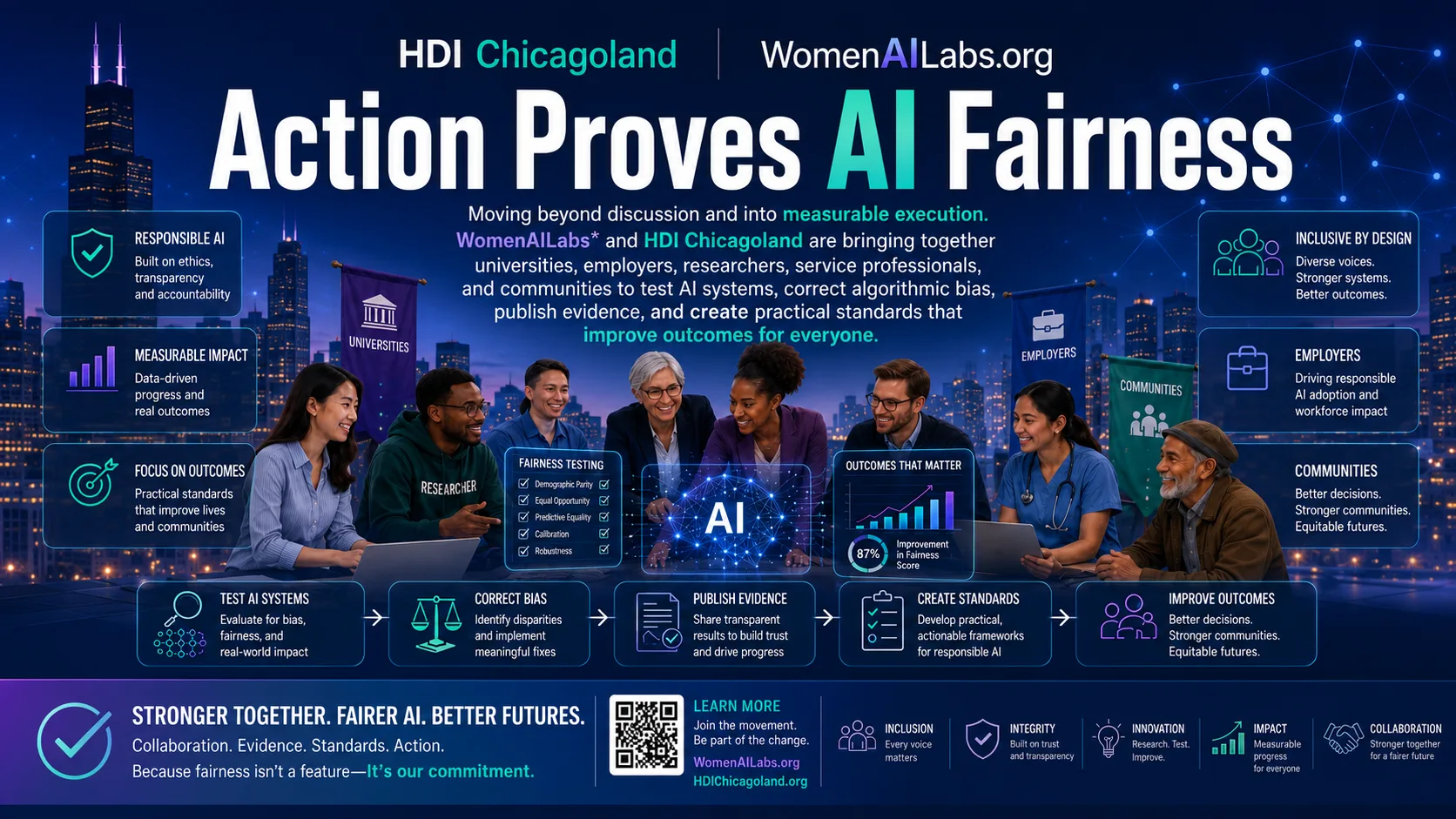
Action Proves AI Fairness by bringing researchers, employers, universities, service leaders, technologists, and affected communities together to test AI systems, remediate bias, and publish measurable results. WomenAILabs™ and HDI Chicagoland have begun community and global outreach to build a multidisciplinary coalition focused on implementation rather than observation.
Together, participating organizations will develop fairness assessments, remediation methods, governance models, operational playbooks, employer pilots, university collaborations, and public evidence.
The mission is direct:
Identify harm. Correct the system. Verify improvement. Scale what works.
Why AI Fairness Requires Action Now
Artificial intelligence already shapes employment, education, healthcare, finance, customer service, public benefits, and professional visibility.
- Hiring platforms rank applicants.
- Résumé systems filter candidates.
- Large language models generate recommendations.
- Automated tools influence access, advancement, support, and opportunity.
- Consequently, every untested decision can reinforce historical patterns at digital speed.
The World Economic Forum reported that the global gender gap reached 68.8% in 2025. Full gender parity is estimated at 123 years away at the current rate of progress.
Women missing from the AI Algorithm affects every area of business, not just the talent pool. UN Women further reported that women hold only 30% of managerial positions worldwide. Current progress would leave representation near 32% even by 2050.
UNESCO research found that generative AI systems can reproduce regressive gender stereotypes, we can create and grow fairness, or harm. Tested models associated women more frequently with domestic roles, while male identities received stronger connections to business, executive leadership, salary, and careers.
These findings establish a clear mandate. Organizations must evolve standards for fairness, and to test AI before automated decisions become accepted practice, embedded infrastructure, and future training data.
False Facial Matches Already Cause Harm
Facial-recognition failures have already caused wrongful arrests, detention, searches, public accusations, lost income, and lasting trauma. NIST defines a false positive as an incorrect match between two different people. Federal testing found higher false-positive rates for women, older adults, younger people, Asian faces, and African American faces. Some algorithms produced racial error differences ranging from 10 to 100 times.
Wrongful Arrest During Pregnancy
Detroit police arrested Porcha Woodruff in 2023 after facial-recognition software returned a faulty match.
Woodruff was eight months pregnant. Officers detained her for approximately 11 hours on robbery and carjacking allegations. She later required hospital care for dehydration and contractions.
A technical error triggered a damaging human chain:
False match → suspicion → arrest → detention → medical risk → lasting trauma
The ACLU identifies Woodruff as the first publicly reported woman among the initial six known wrongful facial-recognition arrests in the United States. Every person in that group was Black.
Six Months Lost to an Incorrect Match
Police arrested Kimberlee Williams, an Oklahoma grandmother, on a Maryland warrant after facial-recognition technology incorrectly identified her. Williams had never visited Maryland. Nevertheless, she spent approximately six months in jail before the case was resolved. The ACLU identifies her as the fourteenth publicly known person wrongfully arrested after police relied on erroneous facial-recognition results.
Six months in custody can destroy employment, housing, health, family stability, income, and reputation regardless of wrongful incarceration.
Women and Children Falsely Accused
The Federal Trade Commission alleged that Rite Aid deployed facial surveillance without reasonable safeguards. False alerts led employees to follow customers, search them, remove them from stores, contact police, and publicly accuse innocent people of shoplifting. According to the FTC, the system generated thousands of false positives and created heightened risks for women and people of color.
In one case, an employee stopped and searched an 11-year-old girl after the system falsely matched her to someone accused of shoplifting. The resulting federal settlement prohibited Rite Aid from using facial recognition for surveillance for five years.
Employment Harm Can Follow the Same Pattern
A false workplace match can block:
- Hiring
- Onboarding
- Building access
- Remote login
- Timekeeping
- Payroll
- Background screening
- Account recovery
- Project assignment
- Continued employment
Once a system labels someone suspicious, fraudulent, or unverifiable, the worker often carries the burden of disproving the machine. Pregnancy, race, age, disability, gender identity, medical treatment, caregiving, or domestic-violence safety concerns can intensify the consequences.
Require Proof Before Adverse Action
Every organization using facial recognition should require:
- Independent identity verification
- Immediate trained human review
- A secure non-biometric alternative
- Written notice of disputed results
- Rapid appeal and access restoration
- Demographic performance testing
- Strict data-use and retention limits
- Incident reporting for harmful errors
- Named accountability for remediation
- Compensation when failures cause loss
A facial-recognition alert must never serve as proof of fraud, misconduct, deception, or ineligibility. No person should lose liberty, income, employment, healthcare, education, housing, or dignity because software produced a possible match. Responsible leaders must prevent the next case before deployment.
WomenAILabs™ Builds Operational Proof
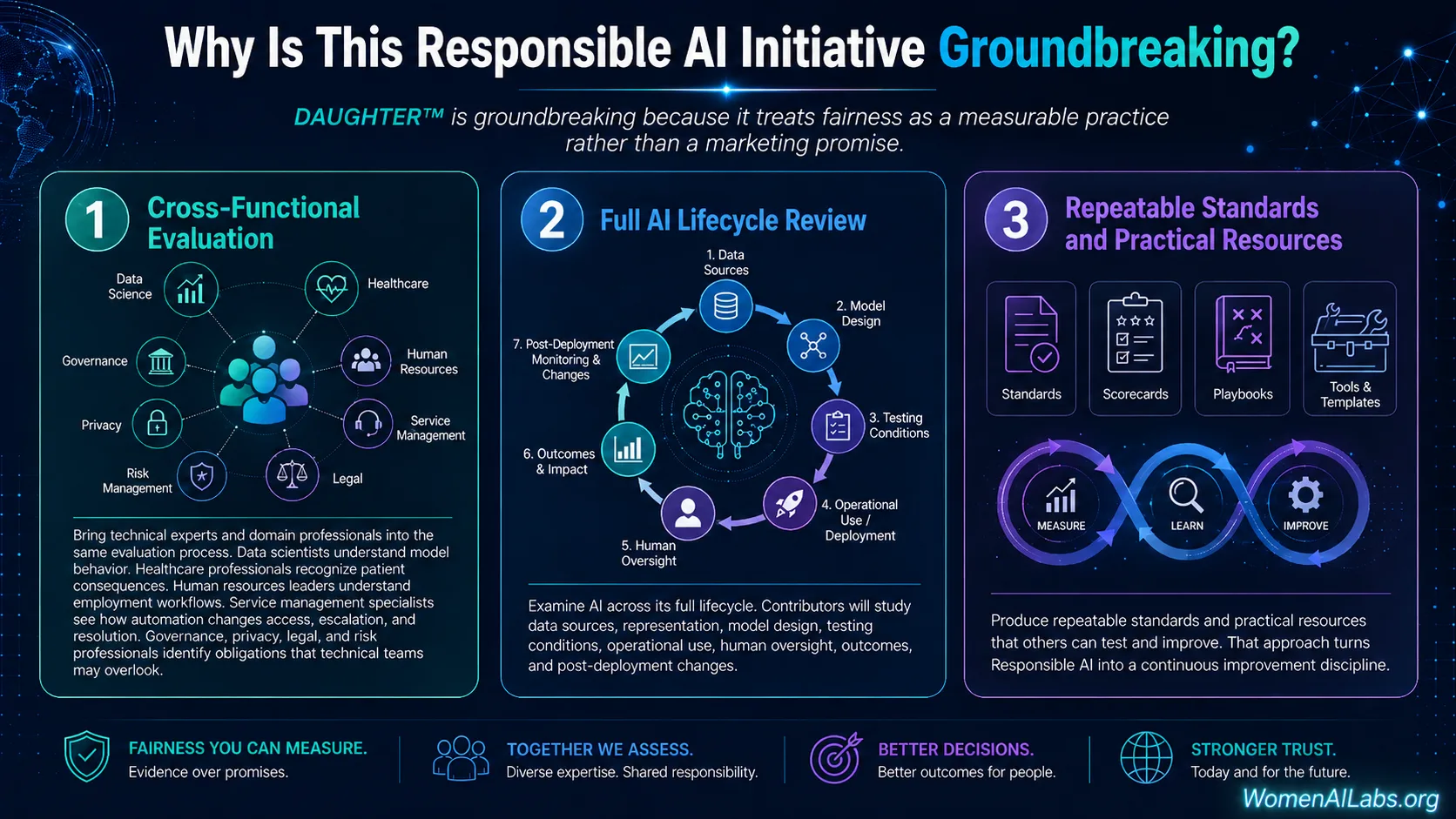
WomenAILabs™ converts responsible AI goals into testable practices. Each project will connect research, technology, governance, lived experience, and operational delivery. Participants will examine how a system works, where harm occurs, which populations experience unequal outcomes, and what correction produces measurable improvement.
A complete fairness lifecycle should include:
- Define the decision. Record the system, owner, purpose, vendor, users, inputs, and expected result.
- Map potential harm. Examine exclusion risks, inaccessible workflows, proxy variables, missing representation, and adverse consequences.
- Inspect the evidence. Review data sources, model assumptions, prompts, thresholds, evaluation criteria, and historical patterns.
- Test real outcomes. Compare system behavior across relevant populations, scenarios, identities, and user journeys.
- Correct identified failures. Adjust data, logic, interfaces, criteria, controls, workflows, or human oversight.
- Retest independently. Confirm improvement under realistic operating conditions.
- Document the result. Publish methods, limitations, ownership, evidence, and unresolved risks.
- Monitor performance. Detect drift, vendor changes, recurring incidents, emerging disparities, and unintended effects.
This approach creates traceable accountability. Measured outcomes establish credibility. Repeatable methods support scale.
Fairness Requires Multidisciplinary Delivery
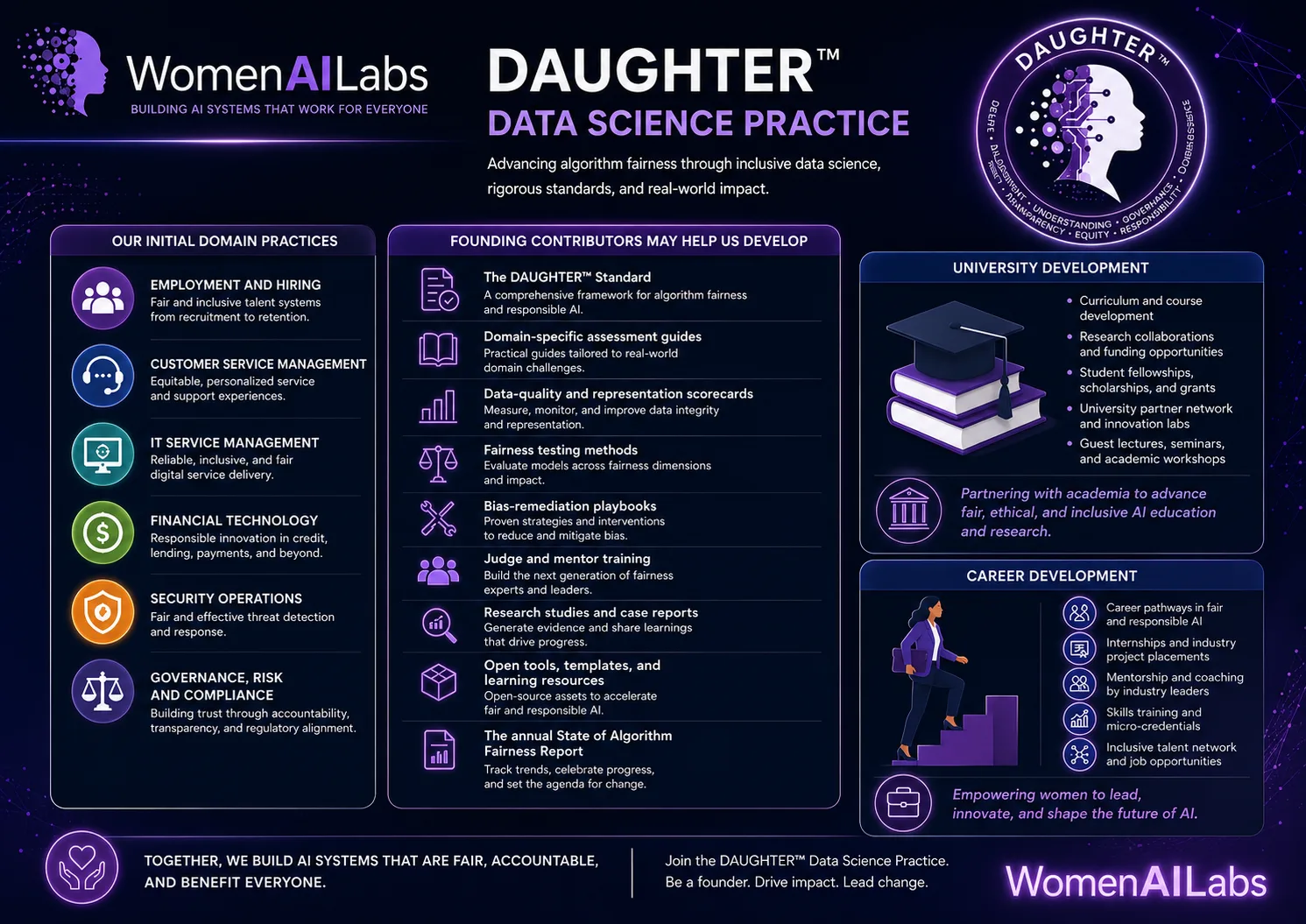
No single profession can govern complex AI systems alone. Data scientists understand model behavior. Human resources leaders recognize employment consequences. Recruiters identify workflow realities.
Legal specialists interpret obligations. Risk professionals design controls. Service managers detect operational failures. Educators prepare future practitioners.
Community members reveal harm that technical teams may overlook.
Accordingly, WomenAILabs™ seeks coordinated participation from:
- Technical builders who can examine models, data, prompts, integrations, and thresholds
- Employment specialists who understand hiring, advancement, performance, and workforce access
- Governance leaders who can assign accountability, evidence requirements, and escalation paths
- University partners capable of validation, interdisciplinary research, and student engagement
- Service professionals experienced in incidents, knowledge, experience, and continuous improvement
- Affected communities prepared to define harm, evaluate usability, and judge whether outcomes improve
- Employer sponsors willing to contribute use cases, operational access, funding, and implementation support
Shared expertise produces stronger testing and more credible results.
HDI Chicagoland Connects Fairness to Service
HDI Chicagoland brings service and support experience into responsible AI delivery. Technology becomes real when people use it, question it, depend on it, or suffer from its failure.
Frontline professionals often see problems before executive dashboards reveal them. Analysts hear recurring complaints. Knowledge teams identify inaccurate guidance. Problem managers connect repeated incidents to shared causes. Experience leaders recognize when automation creates confusion, delay, exclusion, or distrust.
Therefore, service management contributes essential capabilities:
- Incident detection
- Root-cause analysis
- Knowledge governance
- Human escalation
- Experience measurement
- Problem remediation
- Operational ownership
- Continual improvement
- Practitioner education
- Community activation
WomenAILabs™ provides the fairness mission, assessment framework, remediation focus, and proof requirements. HDI Chicagoland contributes local leadership, professional relationships, practical service expertise, and access to a wider support community.
Together, both organizations partner with companies, universities, government, and communities in teams to promote fairness, detect algorithmic harm, assign ownership, correct failures, improve human review, and prevent recurrence.
Universities Can Lead Responsible AI
Universities hold a powerful position between research, workforce preparation, industry adoption, public trust, and community impact. Academic leadership can unite computer science, law, business, psychology, sociology, education, healthcare, data science, public policy, and service management.
Illinois institutions already demonstrate the value of applied responsible AI work.
University of Chicago researchers have developed guidance for identifying and reducing bias in healthcare algorithms, showing how academic expertise can influence high-impact operational decisions.
University of Illinois programs have advanced responsible data science, fairness, privacy, explainability, and ethical technology through interdisciplinary research and education.
Georgetown University’s Center for Digital Ethics addresses algorithmic fairness, explainable AI, governance, worker impact, and threats to justice and democracy. Georgetown Law has also emphasized accountability, transparency, ongoing assessment, and remediation as central elements of algorithmic governance.
These examples show how universities can connect scholarship with measurable public value.
University Leadership Creates Strategic Value
Early participation offers direct benefits.
- Applied research gains relevance. Faculty can test theories against real systems, operational workflows, and measurable outcomes.
- Student experience becomes visible. Learners can build portfolios, analyze datasets, design assessments, create tools, and present verified findings.
- Employer partnerships grow stronger. Industry collaborators need talent capable of combining AI fluency with governance, ethics, testing, and implementation.
- Grant potential expands. Responsible AI, workforce innovation, public-interest technology, education, and community impact attract public and private funding.
- Institutional distinction increases. Universities that lead can strengthen recruitment, reputation, community confidence, and national visibility.
- Curriculum quality improves. Real cases help educators move beyond theoretical ethics into professional practice.
- Community trust deepens. Transparent collaboration demonstrates that academic expertise can address urgent human problems.
- Publishing opportunities multiply. Validated pilots can support white papers, case studies, standards, conference presentations, and peer-reviewed research.
Leadership allows universities to help shape responsible AI methods before commercial practices become difficult to change.
Delayed Participation Carries Consequences
Institutions that move slowly may lose influence over emerging standards, partnerships, and workforce expectations. Students could graduate without practical experience in AI risk assessment, algorithmic fairness testing, model governance, bias remediation, or human-centered validation.
Employers may form deeper relationships with institutions that respond faster.
Faculty research may remain separated from implementation. Campus technology could expand without adequate evaluation. Communities may view silence as a failure of leadership.
Additional consequences include:
- Missed sponsorship opportunities
- Reduced grant competitiveness
- Slower curriculum modernization
- Weaker graduate portfolios
- Limited pilot access
- Lower employer engagement
- Diminished public visibility
- Minimal influence over standards
- Greater exposure to preventable failures
- Reputational damage after harmful outcomes
Waiting transfers leadership to organizations already prepared to act.
Every Partner Has a Defined Role
When everyone does a little bit, collectively it inspires alot of significant progress for all.
- WomenAILabs™ calls for practical commitments.
- Universities can provide faculty validators, interdisciplinary teams, research support, student participation, facilities, datasets, and publication pathways.
- Employers can contribute anonymized use cases, controlled system access, accountable owners, operational expertise, and funding.
- Service leaders can design incident pathways, human escalation, knowledge controls, experience measures, and continuous-improvement practices.
- Researchers can convert evidence into testing protocols, thresholds, scorecards, and reproducible methods.
- Developers can build validators, dashboards, audit tools, workflow controls, and accessible interfaces.
- Legal advisors can map requirements, review risk, strengthen transparency, and clarify accountability.
- Community participants can identify harm, challenge assumptions, evaluate usability, and confirm whether changes improve lived outcomes.
- Sponsors can finance prototypes, student access, research activity, independent review, awards, and broader adoption.
Defined ownership moves responsible AI from aspiration into delivery.
Fairness Claims Need Evidence
Every project must answer clear questions:
- Which automated decision received evaluation?
- Who could experience harm?
- What information shaped the outcome?
- Where did unequal treatment appear?
- Which correction changed the process?
- How much improvement occurred?
- Who validated the finding?
- What limitations remain?
- Which control prevents recurrence?
- How will ongoing performance be measured?
Transparent answers strengthen trust. Independent review increases credibility. Reproducible standard evidence supports adoption.
WomenAILabs™ Will Build Usable Results
Community and global outreach will focus on practical outputs that organizations can apply.
Planned deliverables include:
- Algorithmic fairness test cases
- AI hiring bias assessments
- Data representation scorecards
- Bias remediation playbooks
- Human review standards
- Appeal and escalation processes
- AI incident-response guidance
- Governance ownership models
- Employer pilot programs
- University validation methods
- Open-source tools
- Practitioner training
- Case studies
- Measurable outcome reports
Each result must reveal the problem, document the correction, and verify the improvement.
Begin Responsible AI Action
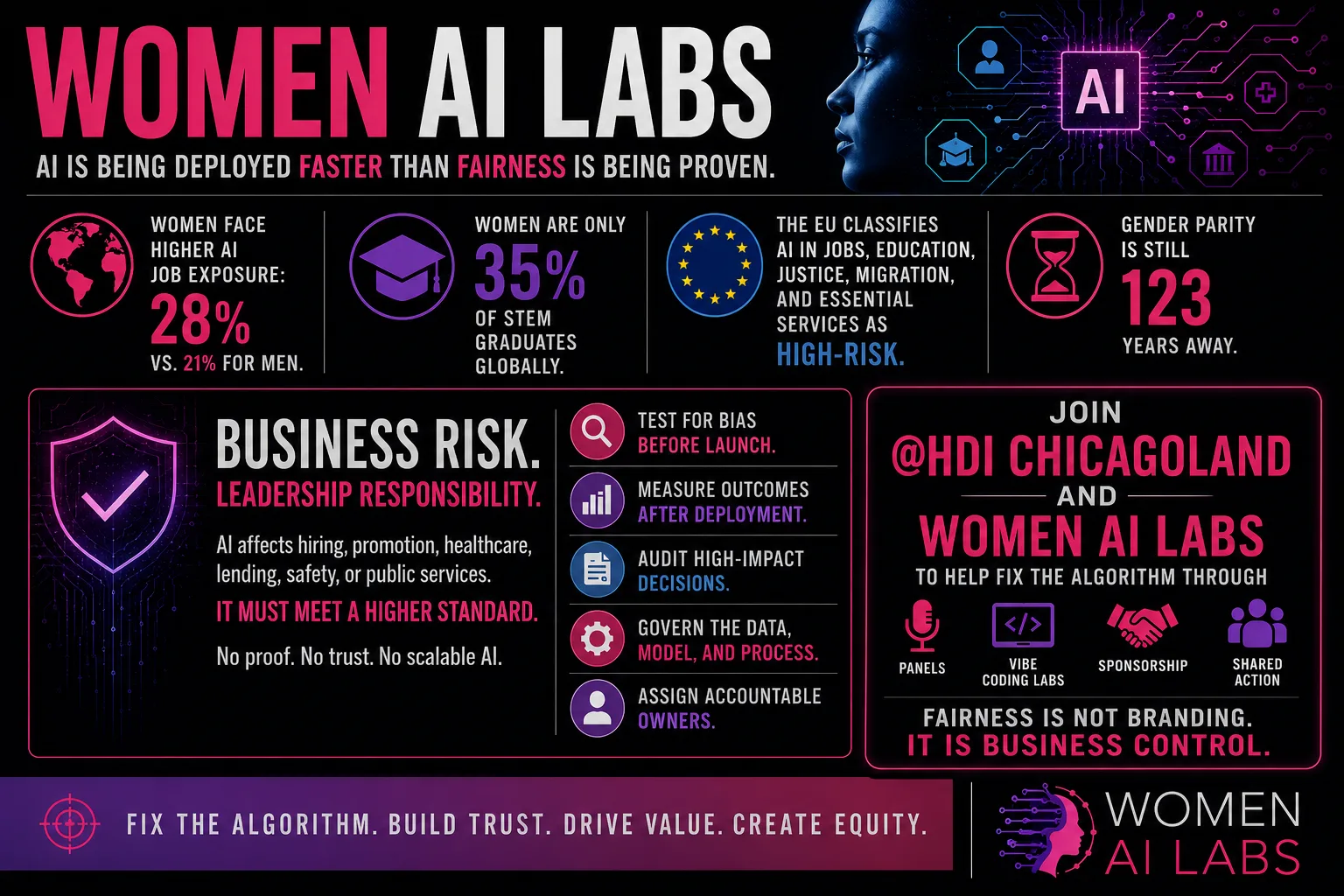
Invite leaders who can contribute. Engage employers willing to examine real systems. Activate universities capable of validation.
Recruit students ready to build. Include communities affected by automated decisions.
Equip service professionals to detect harm. Fund practical pilots.
Publish credible evidence and scalable standards. Improve weak approaches.
Scale successful methods.
WomenAILabs™ and HDI Chicagoland have started the outreach required to connect local knowledge with global expertise. Participation can begin with one use case, one faculty team, one employer sponsor, one testing method, or one affected community.
Every completed pilot adds evidence, verified correction improves practice, shared method helps another organization act faster.
Action Proves AI Fairness
Responsible AI requires disciplined execution, visible accountability, human participation, and measurable results. The evidence clearly demonstrates the present risk, as technology continues to advance.
Unmanaged AI-Automated decisions continue to damage lives. Therefore, as a responsible body of experts from different disciplines including universities, employers, service leaders, researchers, technologists, sponsors, and communities, we must act now.
Fix the Algorithm. Prove the Change. Scale What Works.
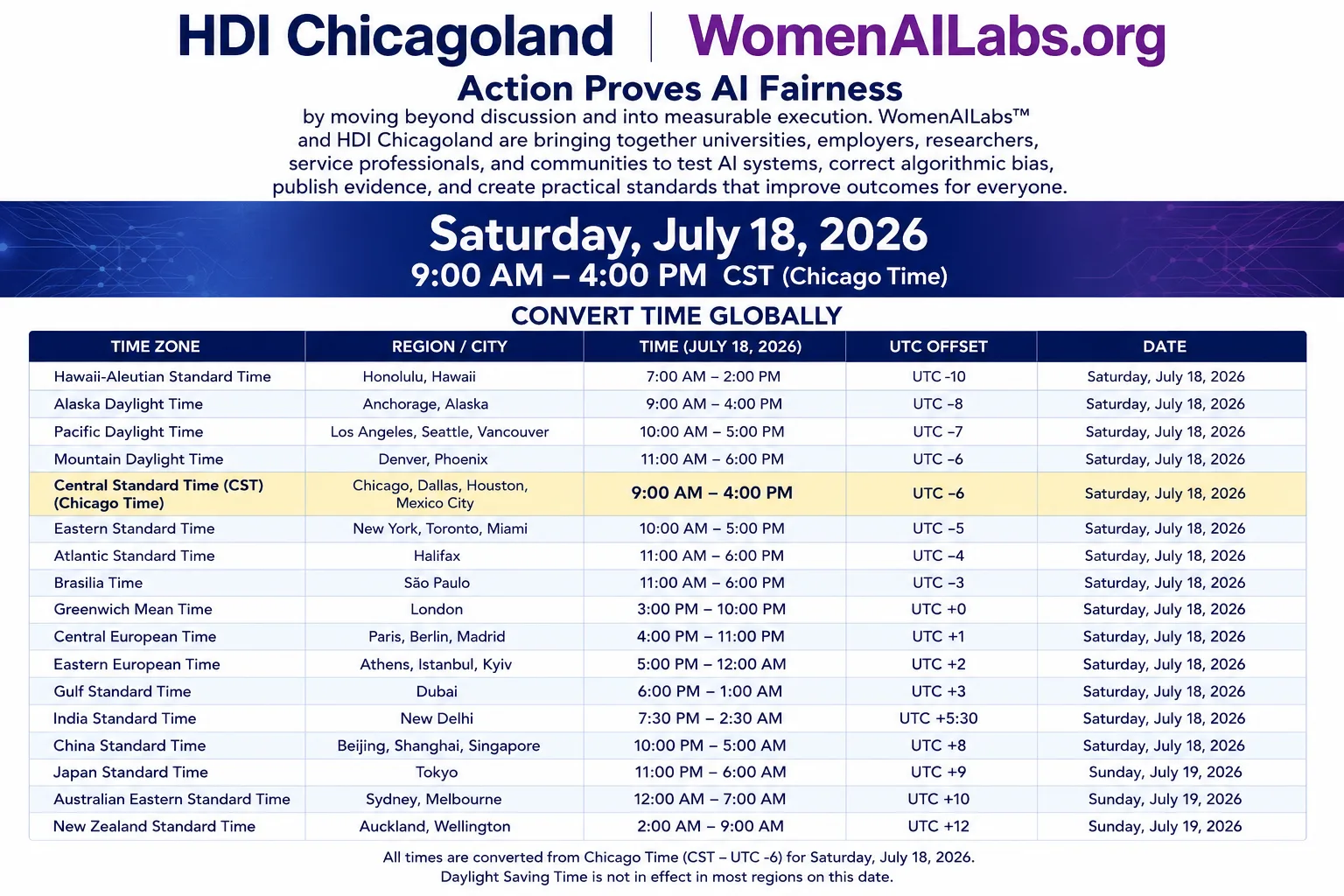
VIBE CODING PILOT KICKOFF: Attend anywhere world wide by zoom. for our first session aimed at tacking Employment and Jobs Challenges.
Saturday July 18, 2026 9:00 am-4:00 pm CST Event Management | LinkedIn