Advancing AI with CMDB, ITSM & ITAM
AI is moving fast. The systems, data, controls, and people behind it must move faster.
Enterprise AI can already summarize incidents, recommend changes, route work, identify risk, analyze assets, and trigger action. However, every one of those capabilities depends on something far less glamorous and far more important: trusted operational data.
If the CMDB is wrong, the AI can be wrong. If CSDM relationships are incomplete, business impact can disappear. If ITAM ownership and licensing are unclear, shadow AI grows. If ITOM cannot confirm what is actually running, automation loses context. If ITSM processes are weak, AI simply accelerates bad decisions.
That is why WomenAILabs™ is launching the Advancing AI with CMDB, ITSM & ITAM Challenge.
Between now and March 2027, we are bringing together leaders, practitioners, best-practice teams, technology partners, researchers, universities, employers, sponsors, and emerging talent to solve one of enterprise AI’s biggest problems:
How do we prove that the data, relationships, ownership, governance, and operational controls behind AI are trustworthy enough to act on?
We are not looking for another white paper.
We want working proof.
Proof that CMDB data can support AI decisions. Proof that CSDM relationships survive real operational pressure. Proof that ITAM can govern AI assets and shadow technology. Proof that ITOM can validate reality. Proof that ITSM can support safer automation, stronger incident response, and clear human authority.
Most importantly, we want to turn that work into skills, tools, methods, jobs, research, and reusable best practices that others can adopt.
If:
- You know CMDB, CSDM, ITAM, ITOM, ITSM, ServiceNow, cybersecurity, data science, governance, or AI, bring what you know.
- Learning, upskill and apply skills for the future, is your aim, come build.
- There is a related hard problem, bring it.
- Ideas to evolve better practice, prove it.
- Process or technology solutions that can help, put it to the test.
Bring the challenge. Build the evidence. Strengthen the data. Advance the AI.
How can CMDB, CSDM, ITAM, ITOM and ITSM improve enterprise AI?
Direct Answer: CMDB, CSDM, ITAM, ITOM and ITSM improve enterprise AI by providing trusted operational context about technology, services, assets, dependencies, owners, lifecycle status, business impact, workflows and governance controls. As a result, organizations can improve AI decision quality, automation safety, cybersecurity response, operational resilience and accountability.
Advancing AI with CMDB, ITSM and ITAM requires more than deploying AI models or agents. Enterprise AI depends on trusted configuration data, accurate service relationships, asset intelligence, operational visibility, governed workflows and clear human accountability.
WomenAILabs™ is bringing together enterprise leaders, ServiceNow practitioners, CMDB and CSDM experts, ITAM and ITOM professionals, ITSM leaders, data scientists, cybersecurity teams, researchers, universities, employers and emerging talent to build, test and publish evidence of the practices that make enterprise AI better, safer and more trustworthy.
Between now and March 2027, the WomenAILabs™ Advancing AI with CMDB, ITSM & ITAM Challenge will turn enterprise best practices into measurable proof.
What Is the Advancing AI Challenge?
The challenge focuses on one practical enterprise AI question:
Can organizations trust the data, relationships, ownership and operational controls that humans and AI use to make decisions?
Teams will stress-test real AI use cases and determine whether CMDB, CSDM, ITAM, ITOM and ITSM provide enough trusted context to support them safely.
- Trusted CMDB data: validate configuration accuracy, ownership, freshness, authoritative sources, reconciliation and decision readiness.
- CSDM service intelligence: prove that business services, applications, infrastructure, vendors and support relationships reflect operational reality.
- ITAM for AI governance: connect AI applications, software, vendors, licenses, ownership, lifecycle, cost and approved use.
- ITOM for AI visibility: compare discovery, observability, telemetry and service mapping against recorded enterprise data.
- ITSM for AI operations: strengthen incident, problem, change, request, knowledge, escalation and recovery before increasing automation.
- AI data governance: establish stewardship, source authority, decision rights, risk controls and human intervention requirements.
- Agentic AI readiness: determine when AI should recommend, automate, escalate, stop or return authority to a person.
- AI information protection: expose shadow AI, unauthorized platforms, sensitive-data handling and licensing risks before they become incidents.
Why CMDB, CSDM, ITAM, ITOM and ITSM Matter for AI
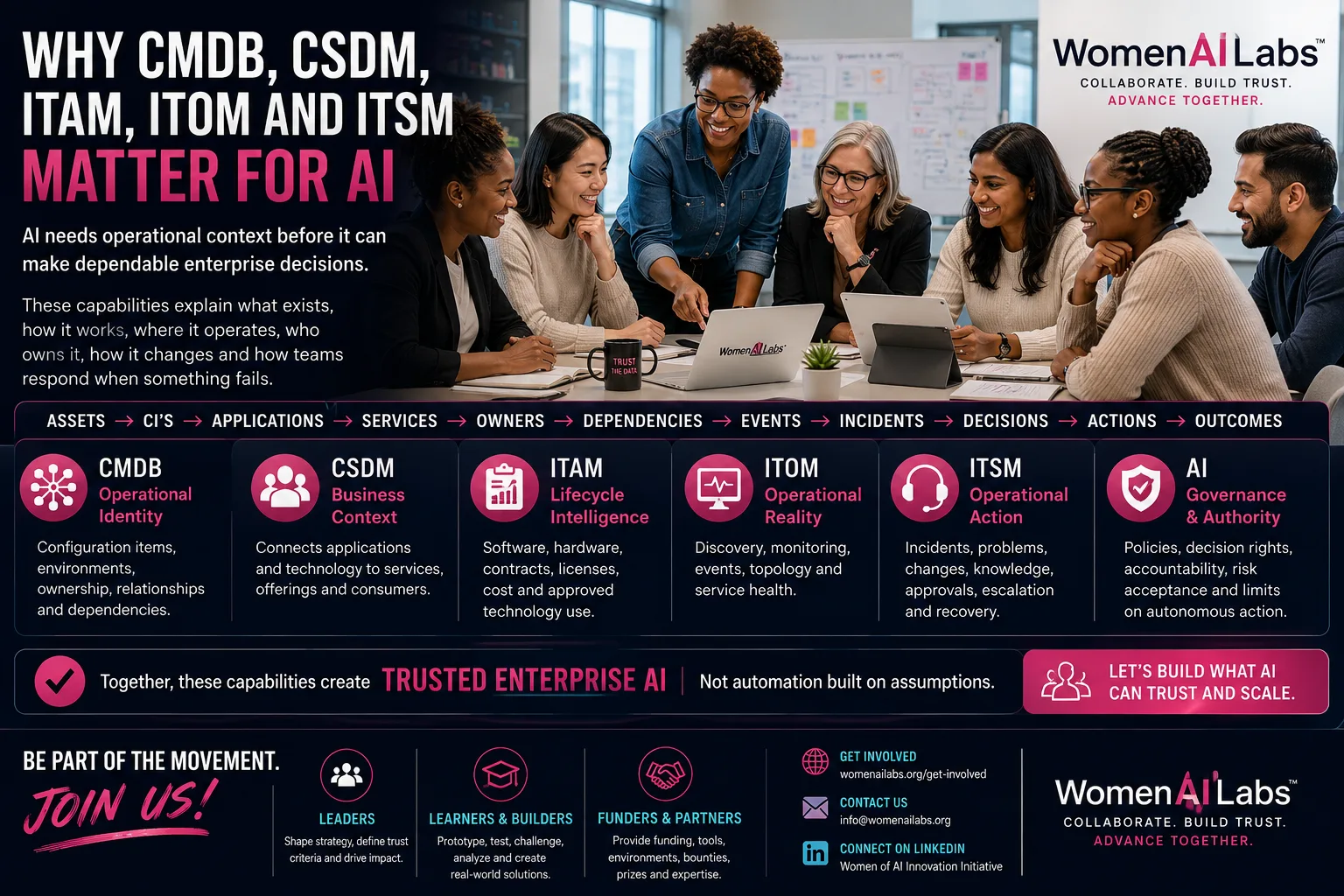
AI needs operational context before it can make dependable enterprise decisions. CMDB, CSDM, ITAM, ITOM and ITSM collectively explain what technology exists, how it supports the business, where it operates, who owns it, how it changes and how teams respond when something fails.
A strong enterprise AI foundation connects:
Assets → Configuration Items → Applications → Services → Owners → Dependencies → Events → Incidents → Decisions → Actions → Outcomes
Each discipline strengthens a different part of the enterprise trust layer:
- CMDB establishes operational identity through configuration items, environments, ownership, dependencies and technical relationships.
- CSDM adds business context by connecting applications and technology to services, offerings and consumers.
- ITAM establishes lifecycle intelligence across software, hardware, vendors, contracts, licenses, cost and approved technology use.
- ITOM validates operational reality through discovery, monitoring, observability, events, topology and service health.
- ITSM governs operational action through incidents, problems, changes, requests, knowledge, approvals, escalation and recovery.
- AI governance defines authority through policies, decision rights, accountability, oversight, risk acceptance and limits on autonomous execution.
Together, these capabilities help create trusted enterprise AI rather than automation built on assumptions.
What Problems Will the Challenge Solve?
The largest enterprise AI risks often begin before the AI model produces an answer. Missing ownership, unreliable configuration data, weak service relationships, unmanaged assets, fragmented knowledge and poorly governed workflows can distort everything AI does afterward.
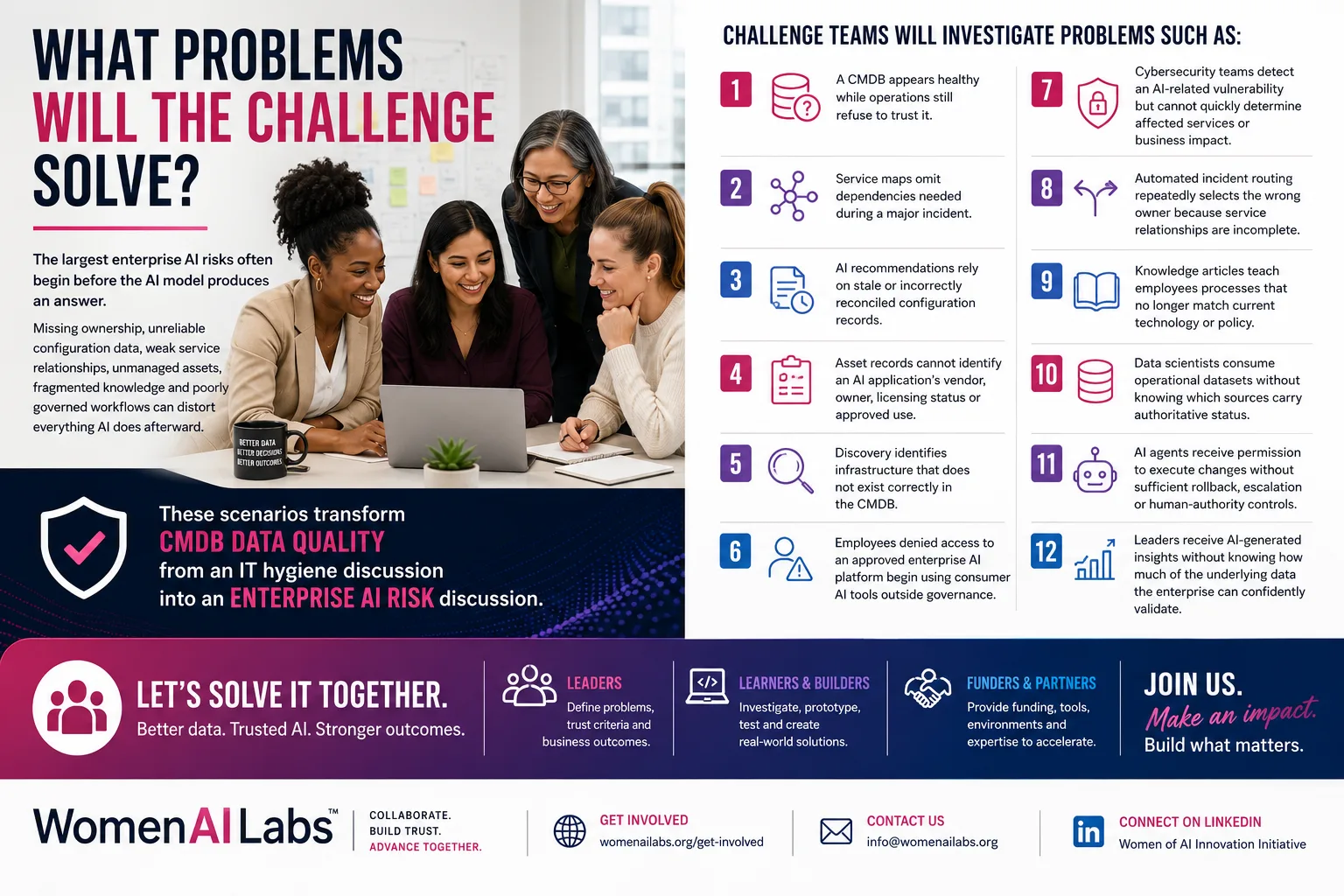
Challenge teams will investigate problems such as:
- A CMDB appears healthy while operations still refuse to trust it.
- Service maps omit dependencies needed during a major incident.
- AI recommendations rely on stale or incorrectly reconciled configuration records.
- Asset records cannot identify an AI application's vendor, owner, licensing status or approved use.
- Discovery identifies infrastructure that does not exist correctly in the CMDB.
- Employees denied access to an approved enterprise AI platform begin using consumer AI tools outside governance.
- Cybersecurity teams detect an AI-related vulnerability but cannot quickly determine affected services or business impact.
- Automated incident routing repeatedly selects the wrong owner because service relationships are incomplete.
- Knowledge articles teach employees processes that no longer match current technology or policy.
- Data scientists consume operational datasets without knowing which sources carry authoritative status.
- AI agents receive permission to execute changes without sufficient rollback, escalation or human-authority controls.
- Leaders receive AI-generated insights without knowing how much of the underlying data the enterprise can confidently validate.
These scenarios transform CMDB data quality from an IT hygiene discussion into an enterprise AI risk discussion.
How Do We Prove Trusted CMDB Data?
WomenAILabs™ will explore a CMDB Trust-Scoring Framework that moves beyond traditional completeness and health measurements.
Rather than asking only whether records contain required fields, teams will evaluate whether information remains reliable enough to support operational decisions.
Evidence can include:
- source authority and lineage
- ownership and stewardship
- discovery validation
- reconciliation performance
- relationship accuracy
- CSDM alignment
- service criticality
- asset intelligence
- operational freshness
- incident usefulness
- change-impact reliability
- security relevance
- continuity dependencies
- AI decision suitability
The executive question becomes:
How much human and AI decision-making currently rests on enterprise data we cannot confidently validate?
That is a business exposure measurement, not simply a CMDB health metric.
What Does AI Readiness Require?
An AI-ready CMDB needs enough context to help AI understand what is running, where it operates, why it matters and who has authority over it.
Before AI acts on operational data, organizations should establish:
- reliable configuration identity
- authoritative sources
- accountable ownership
- accurate service relationships
- lifecycle status
- business criticality
- security classification
- vendor dependencies
- licensing status
- data freshness
- change history
- incident context
- human decision rights
- escalation rules
- rollback capability
- measurable trust thresholds
AI readiness therefore combines data readiness, service readiness, process readiness, governance readiness and human readiness.
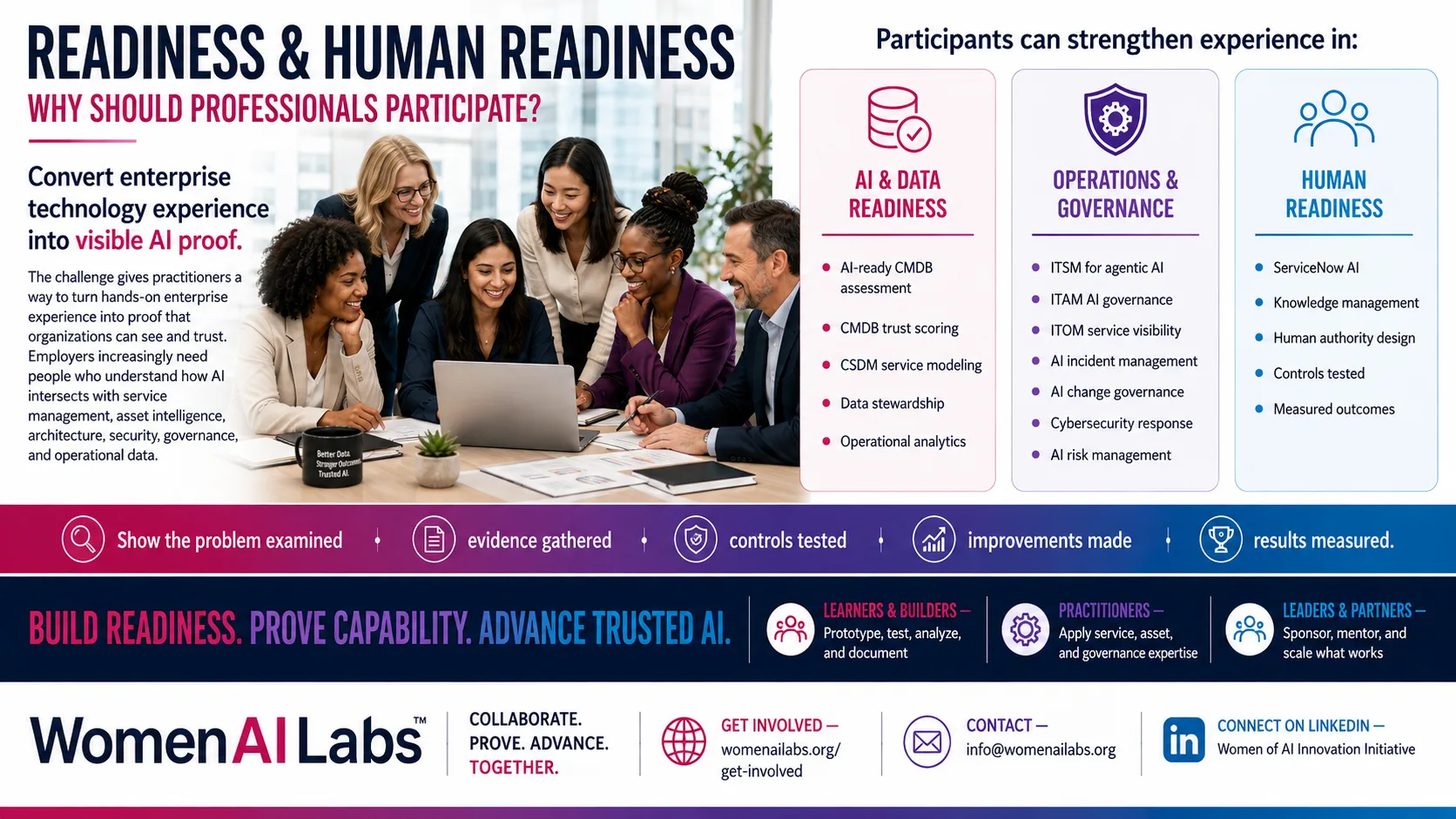
Why Should Professionals Participate?
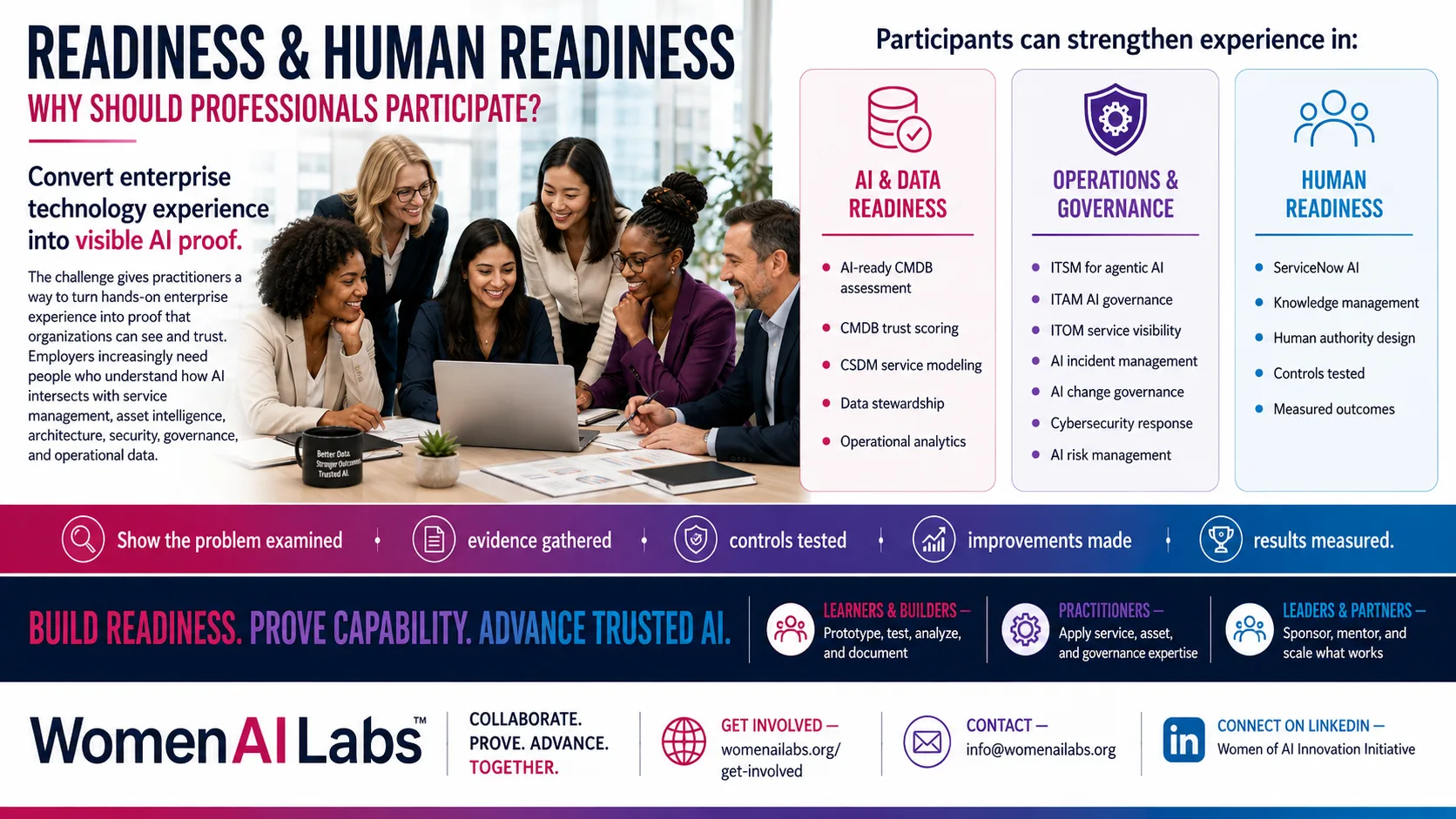
The challenge gives practitioners a way to convert enterprise technology experience into visible AI proof. Employers increasingly need people who understand how AI intersects with service management, asset intelligence, architecture, security, governance and operational data.
Participants can strengthen experience in:
- AI-ready CMDB assessment
- CMDB trust scoring
- CSDM service modeling
- ServiceNow AI
- ITSM for agentic AI
- ITAM AI governance
- ITOM service visibility
- data stewardship
- AI incident management
- AI change governance
- cybersecurity response
- AI risk management
- knowledge management
- operational analytics
- human authority design
Instead of simply claiming knowledge of CMDB or AI, contributors can demonstrate the problem examined, evidence gathered, controls tested, improvements made and results measured.
That creates proof employers can evaluate. Recent Graduates, Laid off AI workers, professionals looking to solve problems better within their teams and for their clients.
Why Should Companies Participate?
Companies gain a practical way to stress-test enterprise AI readiness before weaknesses become production failures. Challenge participation can expose gaps across data, architecture, service management, asset governance, security, knowledge and workforce capability while there is still time to improve them.
Organizations can use the work to:
- uncover trusted-data gaps before expanding AI automation
- identify shadow AI and unmanaged technology
- validate service relationships against operational evidence
- clarify AI application and asset ownership
- improve incident and cybersecurity response
- strengthen change-impact intelligence
- define responsible AI decision rights
- develop data stewardship accountability
- evaluate AI readiness using measurable evidence
- upskill employees through practical delivery
- discover talent through demonstrated capability
- convert lessons learned into repeatable enterprise standards
The result is stronger alignment between AI investment and operational readiness.
Why Should Best-Practice Leaders and Partners Join?
Enterprise best practices create greater value when teams can test, measure and reproduce them. WomenAILabs™ wants methodology leaders, technology partners and experienced practitioners to help convert frameworks into practical evidence.
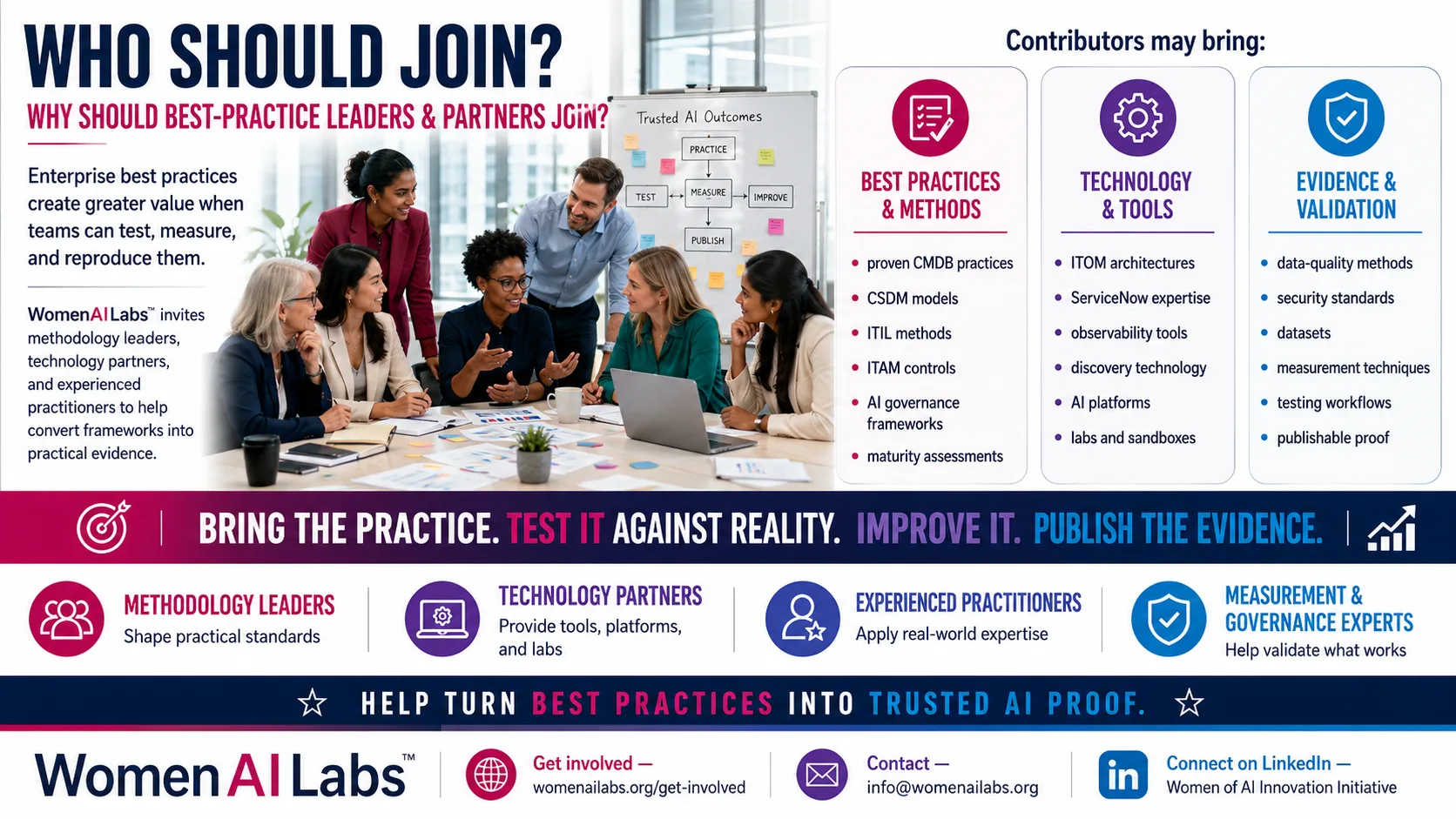
Contributors may bring:
- proven CMDB practices
- CSDM models
- ITIL methods
- ITAM controls
- ITOM architectures
- ServiceNow expertise
- AI governance frameworks
- data-quality methods
- security standards
- maturity assessments
- observability tools
- discovery technology
- AI platforms
- labs and sandboxes
- datasets
- measurement techniques
WomenAILabs™ will focus collaboration on one principle:
Bring the practice. Test it against reality. Improve it. Publish the evidence.
What Is the Opportunity for Students and Emerging Talent?
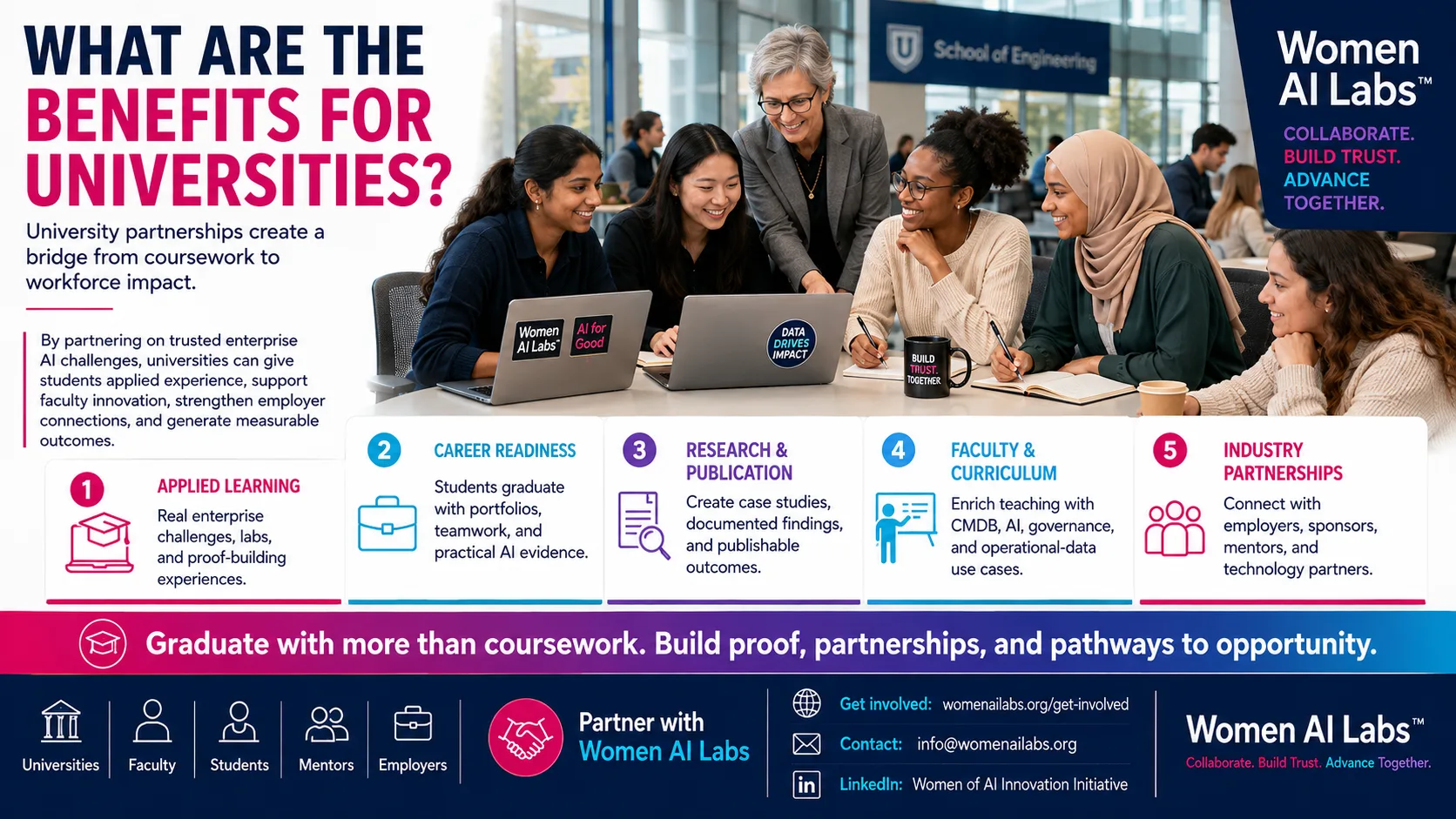
Enterprise AI creates an opportunity to replace the experience paradox with proof-building. Students frequently encounter roles requesting practical experience before they have been given an opportunity to acquire it.
Challenge participation can produce tangible evidence through:
- assessments
- research
- data analysis
- CMDB validation
- CSDM modeling
- AI incident simulations
- governance testing
- data-stewardship exercises
- prototypes
- dashboards
- documented findings
- team delivery
- measurable before-and-after outcomes
A participant can graduate with more than coursework.
They can graduate with evidence of applied enterprise AI experience.
How Can Data Scientists Advance CMDB and CSDM?
AI Data Science Practice — Women AI Labs Data science can strengthen configuration and service-management disciplines by identifying patterns humans cannot efficiently detect at enterprise scale.
High-value applications include:
- anomaly detection across configuration records
- duplicate identification
- stale-data prediction
- relationship-pattern analysis
- reconciliation analysis
- incident-to-CI correlation
- ownership-gap detection
- service dependency inference
- trust-score modeling
- source reliability comparison
- operational risk prediction
- data-quality trend analysis
Analytics should strengthen stewardship rather than replace it.
Data scientists can identify where trust is weak. Data owners and stewards remain accountable for defining, validating and improving the business meaning of the data.
What Will WomenAILabs™ Deliver by March 2027?
The objective is practical proof that organizations, practitioners, educators and employers can reuse.
Potential challenge outputs include:
- CMDB Trust-Scoring Framework
- AI-ready CMDB assessment
- CSDM relationship validation standard
- ITAM AI governance playbook
- ITOM operational-validation patterns
- AI incident-management labs
- shadow AI governance scenarios
- data-stewardship operating models
- AI readiness scorecards
- human-authority frameworks
- trusted-data dashboards
- knowledge-readiness assessments
- cybersecurity case studies
- service-dependency tests
- AI governance stress tests
- working prototypes
- student proof portfolios
- practitioner case studies
- reusable workshops
- reference architectures
- measurable before-and-after evidence
The work should answer one decisive question:
What can we prove works?
Join the WomenAILabs™ Challenge
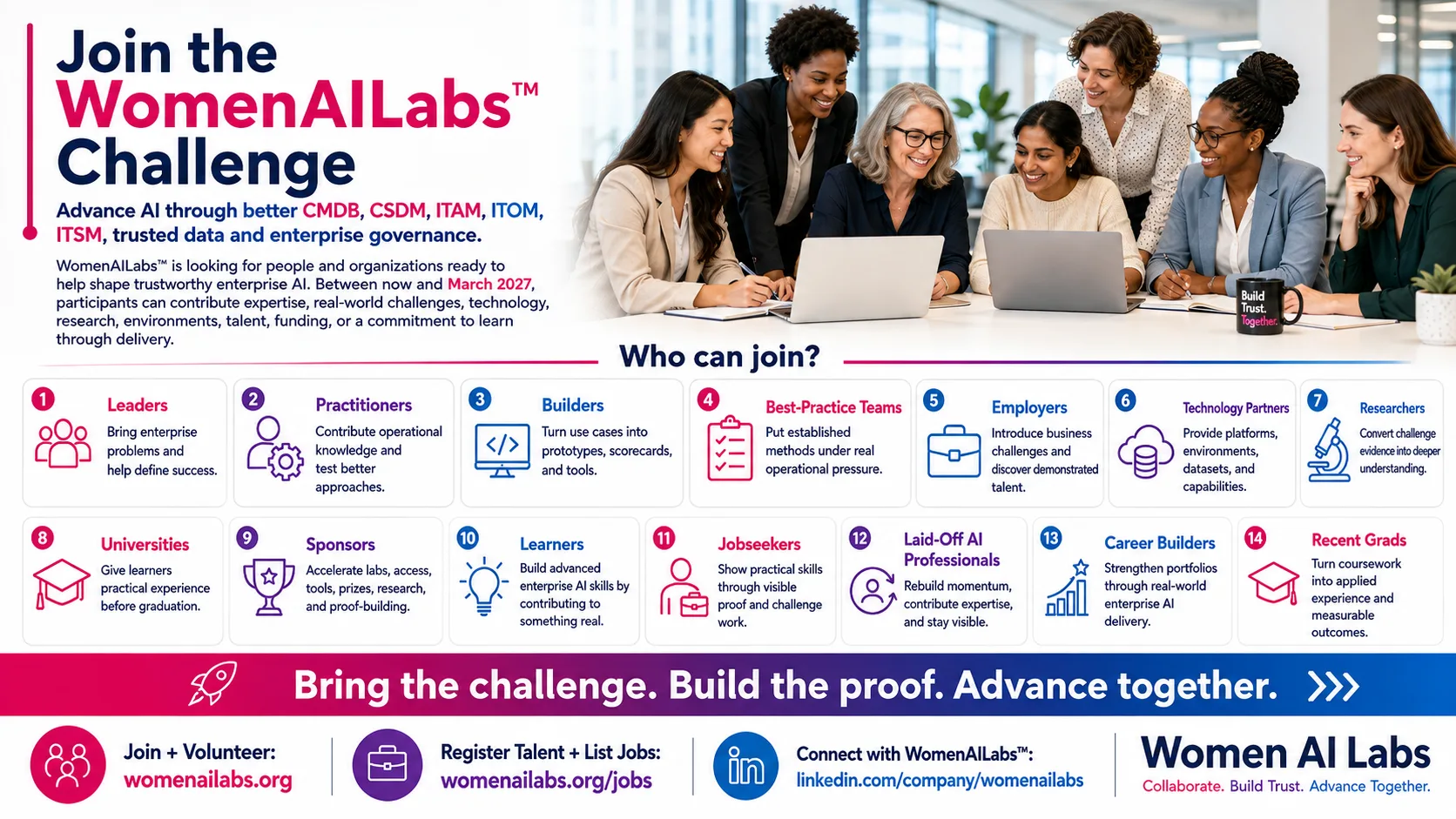
WomenAILabs™ is looking for people and organizations ready to advance AI through better CMDB, CSDM, ITAM, ITOM, ITSM, trusted data and enterprise governance. Between now and March 2027, participants can contribute expertise, real-world challenges, technology, research, environments, talent, funding or a commitment to learn through delivery.
- Leaders: bring enterprise problems worth solving and help define success.
- Practitioners: contribute hard-earned operational knowledge and test better approaches.
- Builders: turn use cases into prototypes, automation, scorecards and tools.
- Best-practice teams: put established methodology under real operational pressure.
- Employers: introduce business challenges while discovering talent through demonstrated skills.
- Technology partners: provide platforms, environments, datasets and capabilities teams can put to work.
- Researchers: convert challenge evidence into deeper understanding of trustworthy enterprise AI.
- Universities: give learners opportunities to create practical experience before graduation.
- Sponsors: accelerate labs, access, tools, prizes, research and proof-building.
- Learners: build advanced enterprise AI skills by contributing to something real.
Join + Volunteer: https://womenailabs.org/
Register Talent + List Jobs: https://womenailabs.org/jobs
Connect with WomenAILabs™: https://www.linkedin.com/company/womenailabs/
Bring the Challenge. Prove Better AI.
Advancing AI with CMDB, ITSM & ITAM means strengthening the trusted data, operational intelligence, governance and human capability behind every enterprise AI decision.
Between now and March 2027, let's build the evidence together.
Join + Volunteer: https://womenailabs.org/
Register Talent + List Jobs: https://womenailabs.org/jobs
Collaborate on LinkedIn: https://www.linkedin.com/company/womenailabs/
Build it. Test it. Prove it. Scale it.
Other Resources:
- 123-Year Gender Parity Defect — Women AI Labs
- AI Career Challenge Cohort WomenAILabs — Women AI Labs
- CHALLENGE: Advanced CMDB/CSDM for AI Initiatives
- CMDB and CSDM
- Global Talent Advantage™ career strategist helping students build proof, timing, and distinction.
- ITIL SACM and ServiceNow CMDB, HAM/SAM
- Measure Invisibility. Create Action. | AI Bias, CMDB, CSDM — Women AI Labs
- Shadow AI and What It Is Really Telling You by Mark Dean
- Underrepresented. Unlisted. Unseen. Erased. Less Talk. — Women AI Labs
- Vibe Coding Fairness Before Bias Becomes Personal - HBR 60 Years of Data — Women AI Labs