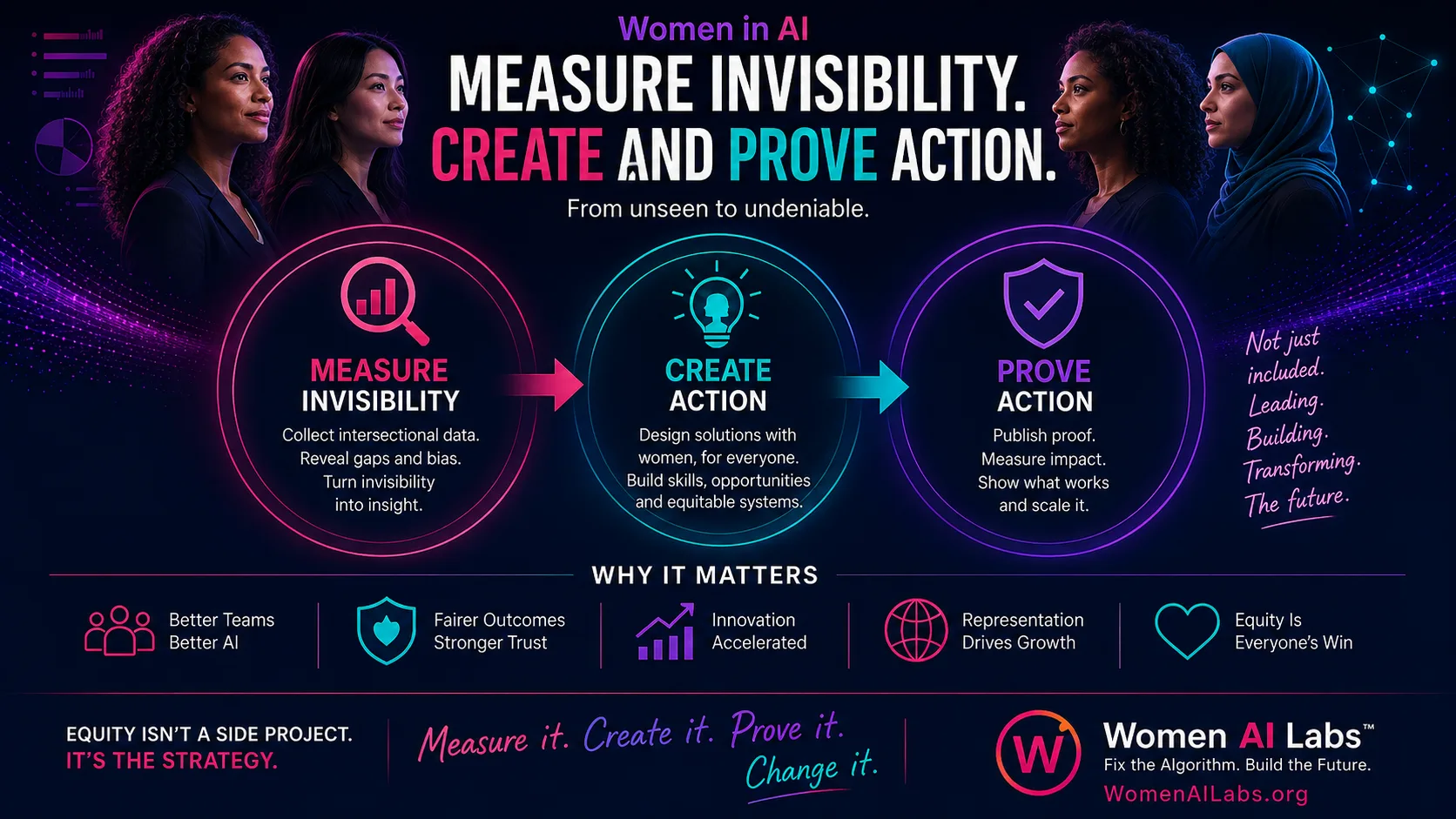
Measure Invisibility. Create Action. Artificial intelligence increasingly determines what people see, whose expertise receives attention, how work gets routed, which services receive priority and when machines can act. Therefore, Measure Invisibility. Create Action. gives WomenAILabs™ a practical framework for identifying the people, knowledge, services, relationships, ownership, risks and outcomes that AI cannot adequately see, measuring where that context drifts and creating a governed path to correction. Beginning August 26, 2026, and continuing through International Women’s Day on March 8, 2027, WomenAILabs™ will connect AI representation, workforce opportunity, AI-ready CMDB, CSDM, ITSM, service-agent governance and human authority through Proof Labs designed to answer one critical question:
Can we prove which practices make AI safer, fairer and more effective?
The opportunity reaches well beyond traditional AI ethics. Women face greater exposure to Generative AI in many occupations while remaining underrepresented in the roles gaining new AI authority and economic value. Meanwhile, enterprises are deploying AI agents that classify Incidents, identify Configuration Items, associate Services and Service Offerings and connect active tickets with Major Incidents or known Problems. Those developments share one underlying requirement:
AI needs accurate context before organizations should trust its decisions.
This work therefore concentrates on six connected priorities:
- Measure representation drift across expertise, hiring, compensation, recommendations, leadership visibility and economic opportunity.
- Strengthen enterprise context through CMDB and CSDM so AI understands what exists, where it runs, who owns it, what depends on it and why it matters.
- Govern AI service delivery through Incident, Major Incident, Problem, Change, Configuration and continual improvement disciplines.
- Develop human authority literacy so people understand when AI may recommend, execute, stop, escalate or require intervention.
- Create reusable AI standards that transform bias findings, operational failures and governance gaps into repeatable remediation techniques.
- Build visible talent proof through Vibe Coding, Proof Labs, demonstrations, standards and employer-ready evidence.
What Does Measure Invisibility. Create Action. Mean for AI?
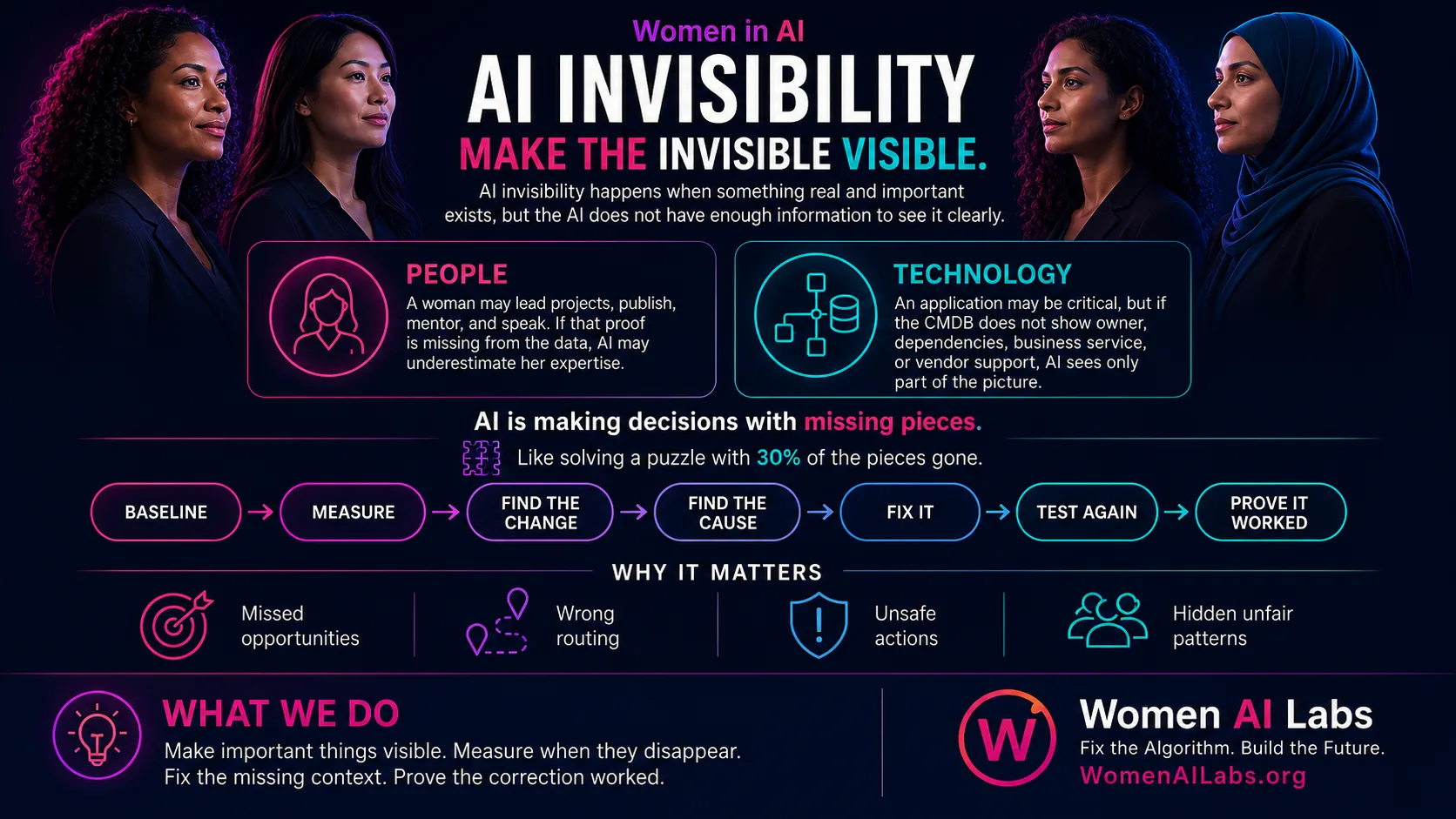
A woman can continue researching, building, writing, speaking, mentoring, solving problems and leading while algorithms increasingly influence whether her expertise appears in recommendations, hiring systems, salary guidance, expert searches or leadership results. Likewise, an application can actively support a critical business service while its ownership, infrastructure dependencies, third-party providers or technical relationships remain incomplete inside a CMDB.
Both conditions create the same risk: the decision-maker sees only part of reality.
Consequently, organizations need a measurable assurance cycle:
BASELINE → MEASURE → DETECT DRIFT → TRACE CAUSE → CORRECT → RETEST → PROVE
Once a baseline exists, invisibility becomes measurable. Once teams can measure the gap, they can investigate why it exists. After intervention, retesting shows whether the correction changed the outcome. Continuous measurement then reveals whether the improvement survives future model, data, organizational or technology changes.
That turns invisibility into actionable data.
Why Is AI Invisibility a Data Quality Problem?
Large AI systems learn and reason from patterns represented in data. As a result, missing information can matter almost as much as incorrect information.
When experienced women appear less frequently in available professional signals, models receive less evidence connecting women with seniority and authority. When a service owner remains missing from CMDB, AI receives less evidence about accountability. Broken dependencies weaken impact analysis. Incomplete CSDM relationships weaken service context. Missing vendor information obscures third-party responsibility.
Therefore, AI assurance should ask a broader set of questions:
- Who or what remains visible, what disappeared, what decision changed, who experienced the consequence and what evidence proves improvement?
Representation becomes a data-quality concern. CMDB health becomes AI-context quality. ITSM governance becomes AI-action governance. Together, they create an operating model for trustworthy AI.
Why Do Women Face Greater Generative AI Employment Exposure?
The International Labour Organization published one of the clearest warnings in March 2026. Female-dominated occupations are almost twice as likely to be exposed to Generative AI as male-dominated occupations, 29% compared with 16%. Moreover, 16% of female-dominated occupations fall into the highest exposure categories compared with only 3% of male-dominated occupations. Women face greater GenAI exposure than men in 88% of the countries analyzed.
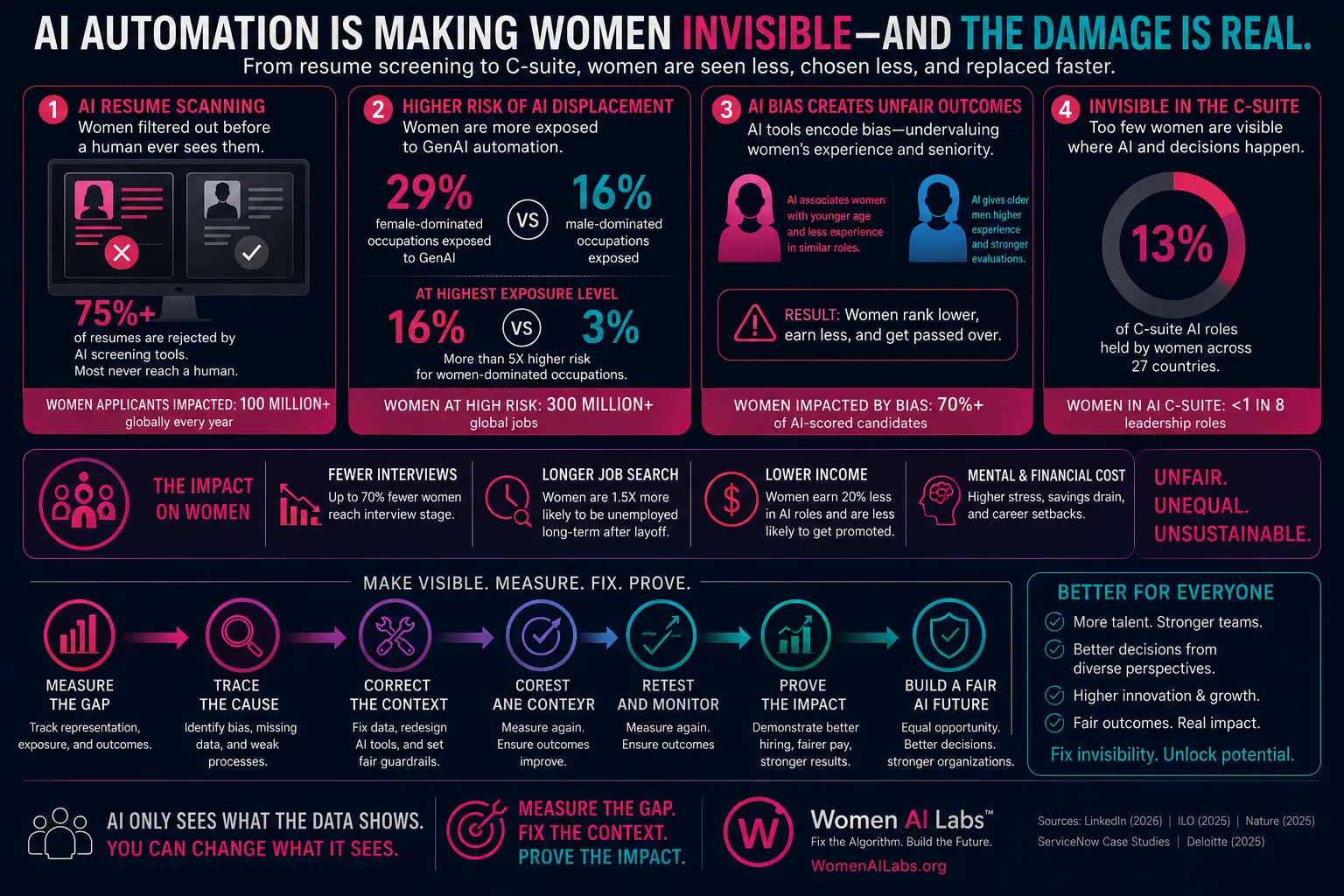
The underlying occupational structure explains much of that disparity. Women remain heavily concentrated in clerical, administrative and business-support roles where routine cognitive activities can be more easily codified and automated. At the same time, the ILO highlights continued underrepresentation of women in AI-related roles, limiting access to emerging opportunities and influence over how AI technologies get designed and deployed.
That creates a significant structural risk: women can experience greater automation exposure while receiving less access to the jobs, compensation, leadership and authority created by AI.
Furthermore, the ILO expects transformation of tasks, skills and working conditions to affect more occupations than outright elimination. That distinction matters because AI disruption may emerge gradually through fewer openings, changed job requirements and compressed career pathways rather than dramatic announcements of direct replacement.
Why Do AI Skills Matter Economically?
PwC’s 2026 Global AI Jobs Barometer reinforces the other side of the opportunity. Jobs requiring specific AI skills are growing 69% faster, compared with 9% growth across the total jobs market, while workers with AI skills command an average 62% wage premium over comparable roles that do not require those skills.
In addition, PwC found that AI-exposed entry-level roles are seven times more likely to require traditionally senior capabilities such as leadership and judgment. That finding suggests an increasingly important divide between routine execution and the human skills required to direct, evaluate and govern AI-enabled work.
Therefore, workforce development must accelerate access to skills that create authority around AI:
DATA + JUDGMENT + GOVERNANCE + SERVICE CONTEXT + RISK + DECISION RIGHTS + AI
That is where WomenAILabs™ Proof Labs can create economic leverage.
How Does Visibility Shape AI-Era Careers?
Visibility starts a chain that eventually creates authority.
WHO GETS SEEN → WHO GETS SELECTED → WHO GETS EXPERIENCE → WHO GETS PAID → WHO GETS PROMOTED → WHO GETS AUTHORITY
An algorithmic recommendation can appear small in isolation. Repeated recommendations create patterns. Those patterns influence hiring, assignments, compensation, promotion, professional visibility and leadership pipelines.
Therefore, measuring AI fairness requires more than reviewing model outputs once. Organizations should monitor the workforce patterns created by repeated AI-assisted decisions.
Similarly, career development needs new ways to create visible experience. When AI reduces routine entry-level work while employers demand more judgment from new hires, professionals need environments where they can build and prove skills outside traditional job ladders.
WomenAILabs™ addresses that challenge through:
PANEL → VIBE CODE → BUILD → TEST → CORRECT → RETEST → PROVE → PUBLISH → GET DISCOVERED
The resulting artifact, demonstration, standard or solution becomes evidence of capability.
Why Does Generative AI Need an AI-Ready CMDB?
For years, many enterprises operated with incomplete CMDBs. Configuration records existed, yet relationships remained weak. Ownership became outdated. Business services remained disconnected from infrastructure. Discovery populated technical records while higher-level service context lagged.
Human teams compensated through experience and tribal knowledge.
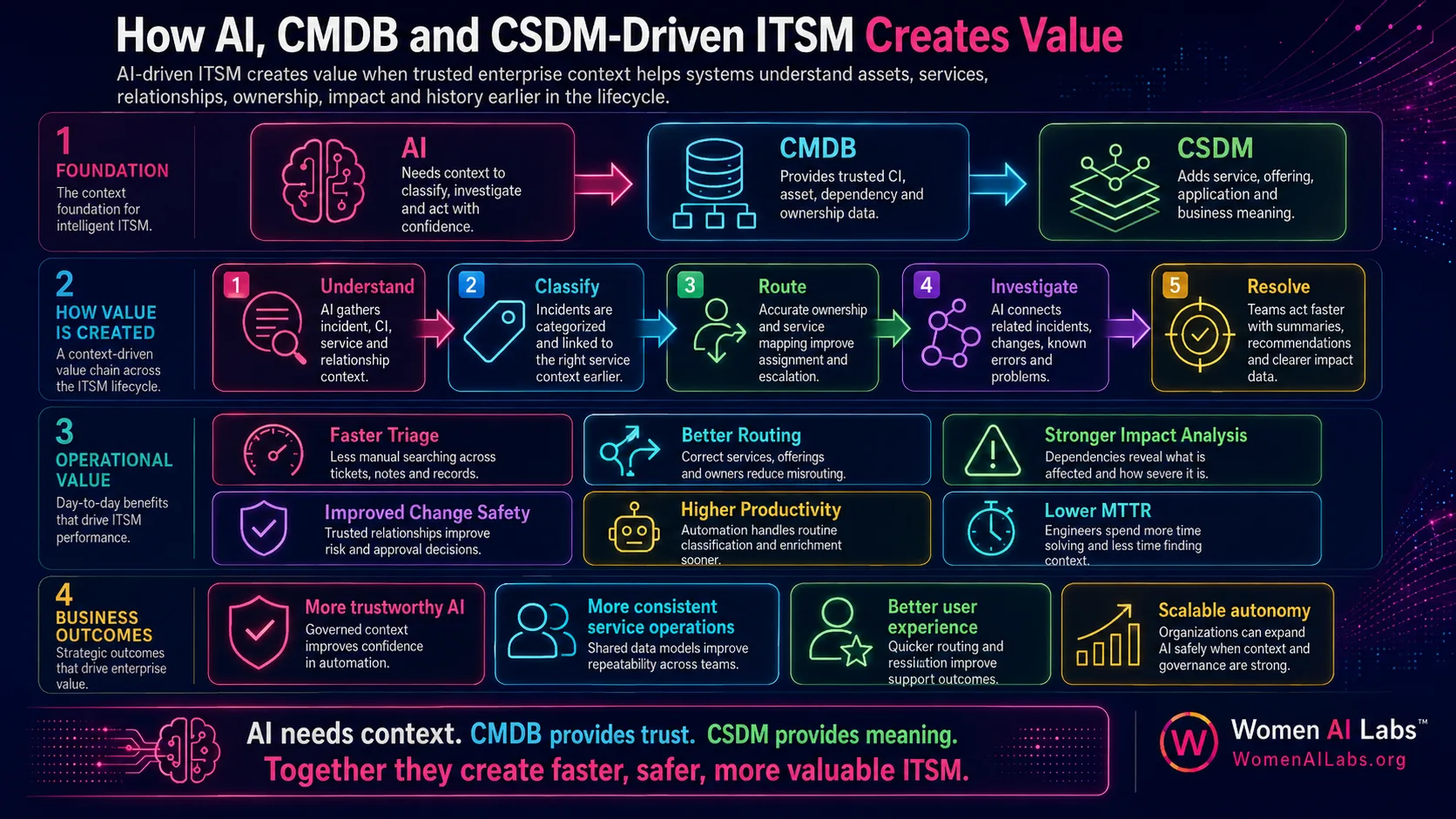
AI agents cannot reliably improvise around missing enterprise context.
When an AI service agent receives an Incident involving a failed component, it needs for more information than a ticket description. Effective triage requires the system to understand what component failed, where it operates, which service depends on it, who owns it, what changed, which upstream or downstream relationships matter, whether a third-party provider participates and whether an active Major Incident or known Problem already explains the condition.
That creates a much higher demand for improved CMDB Reference standards.
A populated CMDB supports lookup of what is running where, who owns it, how to classify and route service.
An AI-ready CMDB supports machine reasoning.
How Are ServiceNow AI Agents Already Using CMDB and CSDM?
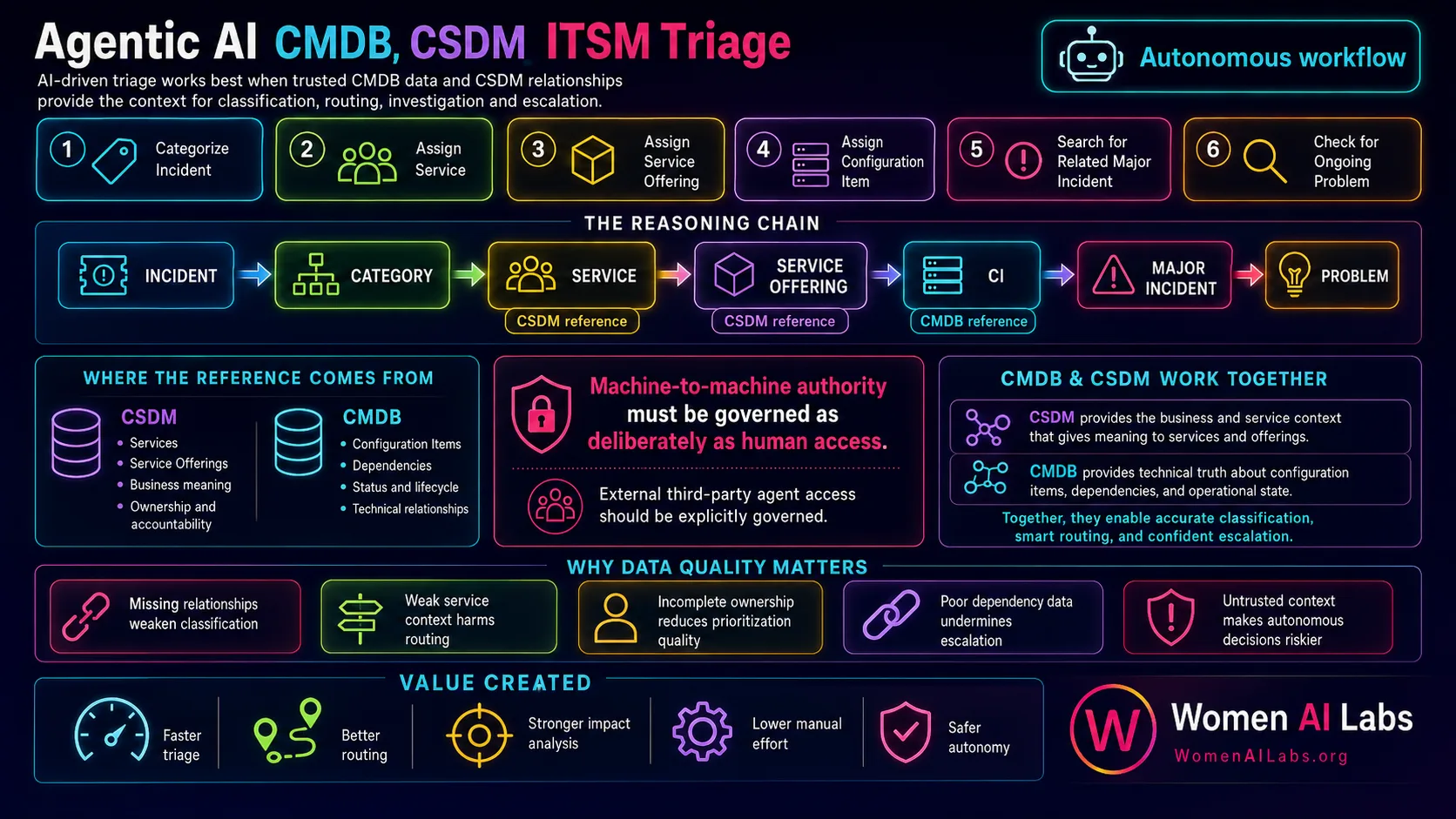
ServiceNow’s current Triage and categorize ITSM incidents agentic workflow makes this requirement concrete. The workflow automatically categorizes an Incident, assigns its Service, Service Offering and Configuration Item, searches for a related Major Incident and, when no Major Incident matches, looks for an ongoing Problem. The workflow can perform those steps autonomously.
The resulting reasoning chain looks like this:
INCIDENT → CATEGORY → SERVICE → SERVICE OFFERING → CI → MAJOR INCIDENT → PROBLEM
ServiceNow also documents a dedicated Classify Service and CI AI agent that identifies an appropriate Service, Offering and Configuration Item. Significantly, ServiceNow exposes explicit configuration governing whether third-party AI agents can access that agent, with external access disabled by default.
That detail points toward a larger AI governance requirement: machine-to-machine authority must be governed as deliberately as human access.
Consequently, poor CMDB and CSDM data now create more than reporting problems. Missing relationships can weaken AI classification, routing, prioritization, escalation and autonomous decision-making.
What Does CSDM Give AI Service Delivery?
The Common Service Data Model gives enterprise technology consistent service meaning.
CMDB identifies Configuration Items and relationships. CSDM organizes those relationships around services, offerings, applications, business consumption and ownership. ServiceNow states that mature CMDB data following CSDM guidelines improves impact analysis, risk analysis and business continuity while supporting reduced tickets and MTTR in ITSM, outage avoidance and environment visibility in ITOM, vulnerability prioritization in SecOps and accurate Incident response in Customer Service Management.
That means AI can progress beyond asking:
What broke?
CSDM helps the system answer:
What business service is affected, who depends on it, who owns it and how significant is the consequence?
Moreover, ServiceNow’s Change Management guidance explains how CSDM enables impact analysis across Services and Service Offerings and supports dynamic Change routing and notification of affected services.
Technical context describes the failure.
Service context explains the consequence.
What Results Have Stronger CMDB and CSDM Produced?
Service-aware CMDB improvement already produces measurable benefits before organizations add autonomous AI.
Wellstar reported that its CMDB transformation reduced root-cause analysis from 30 days to four days while lowering mean time to repair by 25%.
Those results demonstrate the value of connecting technical records to service context. Teams spend less time discovering ownership and dependencies after an outage because the operational model already contains that information.
ServiceNow’s CSDM guidance reinforces the same principle at the platform level. Mature CSDM-aligned CMDB data supports reduced MTTR, fewer tickets, faster vulnerability response, improved impact analysis, outage avoidance and better visibility across environments.
For AI, those foundations matter even more because the machine consumes the context directly.
How Is Generative AI Improving ITSM Service Delivery?
AI-driven ITSM creates value by reducing the manual work required to understand, classify and investigate service issues. ServiceNow currently documents agentic workflows that autonomously triage Incidents and separate workflows that investigate and recommend resolution plans using Knowledge, catalog information and similar previously resolved Incidents.
This changes the service-management operating model. AI can gather context faster, identify patterns across records and perform routine classification before a human becomes involved.
- However, faster automation magnifies both strong and weak data.
- Accurate Service, Offering and CI relationships can improve routing.
- Missing ownership can accelerate misrouting.
- Reliable service mapping can strengthen impact assessment.
- Incorrect dependencies can scale an unsafe action.
Consequently, AI does not reduce the need for Configuration and Service Management discipline. It increases it.
AI-Driven ITSM Is Already Producing Measurable Value
AI-driven ITSM creates value by reducing the manual effort required to understand, classify, investigate and resolve service issues. ServiceNow now documents agentic workflows that can categorize Incidents, assign Services, Service Offerings and Configuration Items, identify related Major Incidents and search for known Problems before a human performs the same analysis manually. That changes the service-management operating model because AI can gather context, connect records and perform routine classification earlier in the lifecycle.
Deloitte ServiceNow AI customer story
The gains are already measurable. Deloitte reports that Now Assist for ITSM helped teams resolve Incidents 45% faster by using Generative AI to summarize case histories and reduce the need to review lengthy chats and multiple notes. Across its broader ServiceNow AI deployment, Deloitte reports approximately 740,000 AI-driven actions per year, while some business units achieved productivity gains of 20% to 60%.
Wellstar AI service management results
Wellstar provides another useful example. After introducing Now Assist for ITSM alongside its employee-support automation, the health system reported a 25% reduction in Incident response time. Average service-desk handling time fell from approximately 25 minutes to nine minutes, representing a 64% improvement. The organization also reports a 300% ROI on ServiceNow automation investments and capacity equivalent to 11 full-time employees created through automation.
Those AI results become even more significant when viewed alongside Wellstar's earlier CMDB improvement. By building a more service-aware CMDB, Wellstar reduced root-cause analysis from 30 days to four days and lowered mean time to repair by 25%. The example demonstrates why AI performance and CMDB quality should be considered together: Generative AI can accelerate the work, while trusted configuration and service relationships improve the context from which teams and agents investigate failures.
Wellstar service-aware CMDB case study
ServiceNow reports similar productivity benefits from its own internal use of Now Assist. After enabling AI-generated resolution notes, IT agents needed only to review and refine the generated content, saving approximately 80% of the time previously required for each resolution note. ServiceNow subsequently expanded the implementation into chat summarization and knowledge generation.
Better Context Improves AI Routing and Investigation
ServiceNow describes Now Assist for ITSM as using Generative AI to understand user intent, synthesize knowledge from Now Platform data, summarize incoming Incidents and prior actions, and suggest next steps toward resolution. The platform also uses AI Search, Incident summarization and resolution-note generation to reduce manual work and help agents focus on complex issues.
That workflow depends heavily on context. Accurate Service, Service Offering and Configuration Item relationships can improve classification, assignment and investigation because the AI can connect a reported failure to the service environment surrounding it.
For example:
- Correct CI relationships help connect a technical failure with upstream and downstream dependencies instead of treating one device or application in isolation.
- Named support ownership gives AI and ITSM workflows an accountable destination for routing and escalation.
- Reliable service mapping strengthens impact analysis by showing which business services, employees or customers depend on affected technology.
- Change history gives investigation workflows additional evidence when a failure begins shortly after a deployment or configuration update.
- Known Major Incidents and Problems allow new tickets to connect with existing service disruptions instead of launching duplicate investigations.
- Third-party relationships help identify when responsibility extends to a SaaS, cloud, integration or external AI provider.
This is where AI-ready CMDB and CSDM become materially different from traditional configuration inventory.
Faster Automation Raises the Data Standard
Faster automation magnifies both strong and weak enterprise context. A reliable Service-to-CI relationship can accelerate correct routing, while missing ownership can accelerate misrouting. Accurate service mapping can strengthen impact assessment, while an incorrect dependency can cause an agent to underestimate consequences or recommend an unsafe action.
Consequently, organizations should measure AI service performance alongside CMDB and CSDM quality. Useful measures include routing accuracy, CI-assignment accuracy, Service and Service Offering classification accuracy, Major Incident linkage quality, Problem correlation, human override frequency, MTTR, repeat Incidents and harmful automation events.
ServiceNow's broader ITSM evidence reinforces the relationship between service context and operational performance. In one solution brief, ServiceNow cites Accenture results including a 45% reduction in MTTR, Incident creation in under one minute from an alert, and management of 97% of discoverable assets. The same document cites broader Service Operations findings of a 30% increase in Incident resolution productivity and a 30% reduction in Incident volume.
ServiceNow ITSM solution brief and customer metrics
The AI Service Management Improvement Chain
Taken together, these use cases point toward a new service-management value chain:
DISCOVERY → TRUSTED CMDB → CSDM SERVICE CONTEXT → AI CLASSIFICATION → CORRELATION → ROUTING → INVESTIGATION → HUMAN AUTHORITY → RESOLUTION → PROBLEM LEARNING → CONTINUAL IMPROVEMENT
AI accelerates the middle of that chain. CMDB and CSDM strengthen the context feeding it. ITSM establishes the processes, accountability and escalation required when decisions become consequential.
That is why AI does not reduce the importance of Configuration Management and Service Management discipline. Agentic AI raises the standard those disciplines must meet.
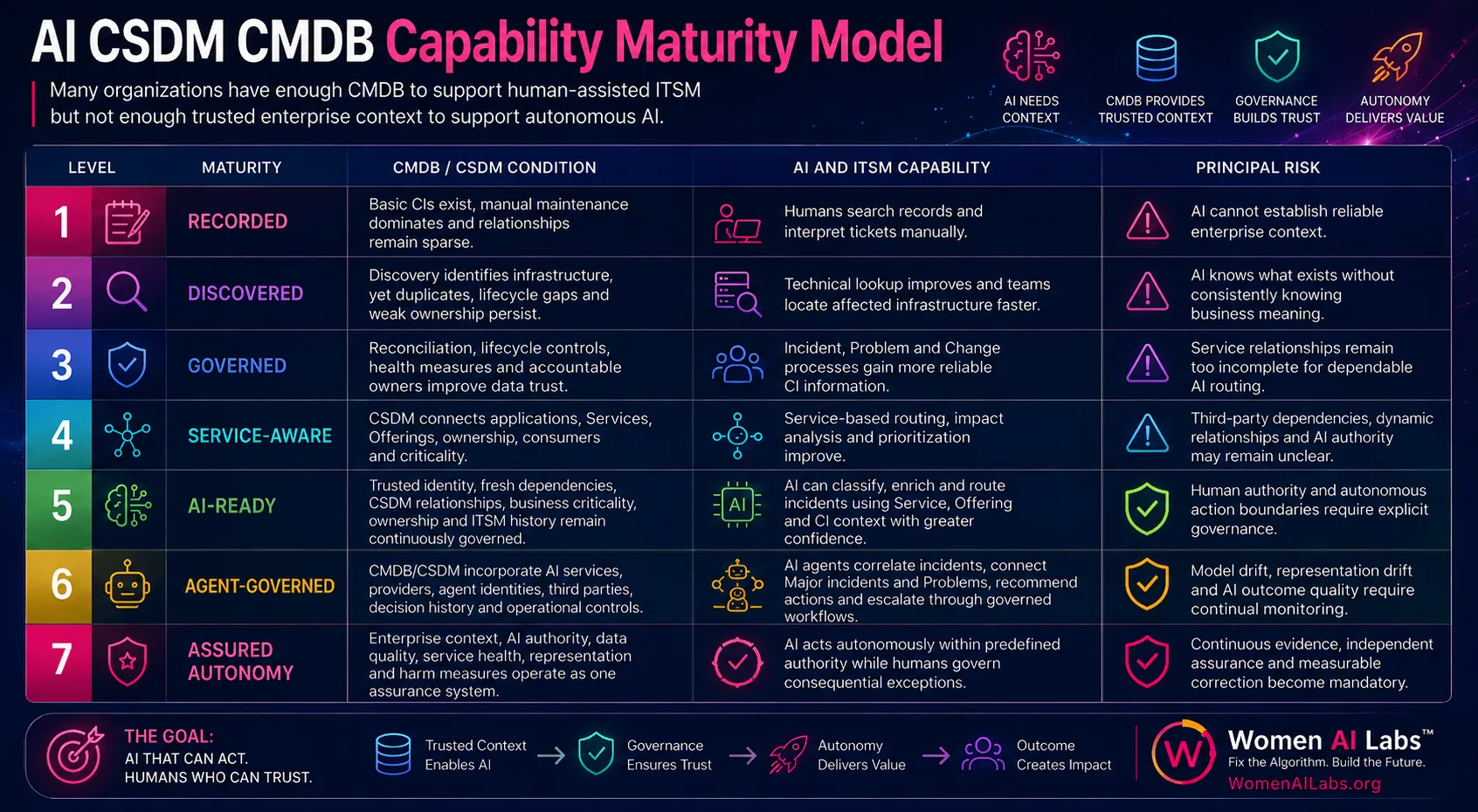
What Does an AI CSDM CMDB Capability Maturity Model Look Like?
Many organizations have enough CMDB to support human-assisted ITSM but not enough trusted enterprise context to support autonomous AI.
The following AI CSDM CMDB Capability Maturity Model creates a practical distinction.
Why Are Most CMDB Foundations Insufficient for AI?
Many organizations currently sit between Levels 2 and 4.
They may have Discovery, thousands of Configuration Items, acceptable health dashboards, named owners and some CSDM relationships. Those capabilities improve traditional ITSM. However, autonomous routing requires more.
ServiceNow’s own CSDM Data Foundations dashboard illustrates the importance of relationship completeness. For example, the platform identifies Technology Management Offerings without support groups as a risk because missing support-group relationships can lengthen downtime remediation. The dashboard treats more than 90% conformance as green, 50% to 90% as yellow and less than 50% as red for foundational indicators.
Now apply that requirement to an AI agent making routing decisions.
An AI agent needs confidence in the relationship between:
INCIDENT → SERVICE → OFFERING → CI → OWNER → SUPPORT GROUP → DEPENDENCY → BUSINESS IMPACT
If those relationships remain incomplete, the agent may produce a technically plausible answer that lacks operational authority.
Therefore, the critical maturity transition occurs at Level 5.
AI readiness begins when enterprise context becomes trustworthy enough to influence machine decisions.
What Does an AI-Ready CMDB Require?
An AI-ready enterprise context engine requires trusted CI identity, reliable reconciliation, complete ownership, CSDM-aligned service relationships, current dependency data, business criticality, third-party visibility, integrated ITSM history, explicit AI authority and continuous outcome measurement.
Additionally, organizations need to measure the quality of the decisions produced from that context. Routing accuracy, human overrides, false correlations, incorrect Major Incident links, Problem recurrence and service impact should become part of the AI assurance scorecard.
That is how CMDB evolves from infrastructure recordkeeping into decision infrastructure for AI.
How Can ITSM Manage AI Bias and Algorithmic Harm?
AI bias becomes much more actionable when organizations connect a consequential finding to an operating process.
Consider an AI recruiting service that starts recommending different salary levels for equivalent experience. Perhaps a third-party model begins producing discriminatory content after an update. Maybe an AI service agent repeatedly routes users from one population incorrectly, or a model begins making decisions that conflict with established governance.
Instead of leaving the finding inside an audit report, organizations can operationalize the response:
DETECT → RECORD → IDENTIFY SERVICE → ASSIGN OWNER → ASSESS IMPACT → ESCALATE → INVESTIGATE → CORRECT → RETEST → MONITOR
An Incident captures the immediate failure and preserves evidence.
A Major Incident coordinates the response when AI harm creates widespread business, workforce, regulatory, safety or reputational consequences.
A Problem investigates recurring algorithmic causes, including source data, model behavior, prompts, retrieval context, vendor changes, CSDM relationships or governance weaknesses.
A controlled Change governs remediation when teams modify data sources, prompts, models, integrations, guardrails, automation or production decision logic.
Continual Improvement then measures whether recurrence declines.
That gives Responsible AI a service-management operating model.
How Do CMDB, CSDM and ITSM Reduce AI Harm?
CMDB, CSDM and ITSM cannot guarantee a bias-free model. Their value lies in making AI behavior more visible, attributable, contextual, governed and correctable.
The end-to-end control chain becomes:
AI OUTPUT → INCIDENT → CMDB CONTEXT → CSDM BUSINESS IMPACT → HUMAN AUTHORITY → MAJOR INCIDENT / PROBLEM → CONTROLLED CHANGE → RETEST → PROVEN CORRECTION
CMDB identifies the affected technology and ownership.
CSDM establishes which services and consumers experience the consequence.
ITSM determines who acts, how escalation occurs and how recurring causes receive investigation.
AI assurance determines whether remediation changed the outcome.
Together, they create measurable accountability.
What Happens When the AI Service Comes From a Third Party?
Enterprise AI increasingly crosses company boundaries. A business service may depend on an external LLM, SaaS provider, cloud platform, embedded AI feature, ServiceNow capability or another AI agent.
Therefore, organizations need service models that represent relationships such as:
BUSINESS SERVICE → APPLICATION → AI SERVICE → PROVIDER → OWNER → SUPPORT GROUP → INCIDENT → PROBLEM → CHANGE
CSDM and CMDB give those relationships structure, while ITSM keeps ownership attached to the service even when the technical failure originates elsewhere.
This becomes particularly important when a vendor changes its model, introduces new behavior or degrades a capability while the enterprise continues to own the customer or employee experience.
Third-party technology does not remove internal accountability.
How Can Representation Drift Use the Same Discipline as CMDB Drift?
Service Management professionals already understand that enterprise data changes constantly. Applications move. Cloud resources appear and disappear. Ownership changes. Dependencies break. Configuration Items duplicate. Support groups reorganize.
CMDB governance monitors those changes because yesterday’s accurate context may become tomorrow’s inaccurate decision data.
Representation deserves similar discipline.
Organizations can establish baselines for AI-generated recommendations, salary outputs, expert identification, leadership associations, hiring decisions and promotion outcomes. After model or data changes, teams can repeat the same controlled tests and measure whether outcomes drift.
The shared assurance model becomes:
VISIBILITY → CONTEXT → DECISION → AUTHORITY → ACTION → OUTCOME → CORRECTION
When something goes wrong, teams can trace backward.
- Was something invisible?
- Did the context change?
- Was ownership missing?
- Did the model drift?
- Did AI exceed its authority?
- Was human intervention delayed?
- Did the correction actually improve the result?
- Now fairness becomes measurable operations.
What Is Human Authority Literacy?
As AI takes on more work, people need to understand the notion and importance of AI Human Centered Design, Support, and governance where AI authority ends and human responsibility begins.
Human Authority Literacy means knowing:
- what AI can recommend
- what AI can do automatically
- when AI must stop and ask for help
- who can override an AI decision
- who can declare a Major Incident
- who accepts business risk
- who approves a rollback or major change
- who remains accountable for the final outcome
ServiceNow already supports parts of this model through agent identities, roles, permissions and access controls.
The key lesson is simple:
- The human in the loop should know why they are there and understand their role as a decision-maker, not just an approver.
- Clicking Approve does not create governance.
- Incident, Major Incident and Problem Management standards before, must have ownership after AI.
- Clear authority, ownership and decision rights do.
What AI Standards Should WomenAILabs™ Build?
WomenAILabs™ can convert these questions into focused Proof Labs and reusable standards. The portfolio should include CMDB AI Readiness Standards, CSDM AI Context Standards, AI Incident Management Standards, AI Major Incident criteria, AI Problem Management techniques, Human Authority models, Third-Party AI Accountability standards, Representation Drift measures, AI Decision Traceability requirements and AI Correction Proof methods.
Those assets can move through a practical knowledge pipeline:
FOCUS BOOKS → STANDARDS → PLAYBOOKS → LAB SOLUTIONS → REUSABLE TECHNIQUES → DEMOS → PROOF → TALENT → JOBS
Instead of simply teaching participants how AI works, WomenAILabs™ can give them real enterprise problems to solve and evidence to publish.
Which AI Service Management Skills Will Employers Need?
The emerging AI trust workforce will span traditional technology disciplines and new assurance capabilities.
Employers increasingly need people who can connect:
CMDB + CSDM + ITOM + ITSM + DATA + SECURITY + GOVERNANCE + AUTOMATION + AI
That intersection creates expanding opportunities for CMDB analysts, CSDM architects, data stewards, ServiceNow professionals, ITOM specialists, Major Incident Managers, Problem Managers, AI Operations professionals, AI Assurance analysts, governance leaders, automation engineers, AI service owners and algorithmic risk specialists.
These professionals will hold an important responsibility.
They will determine whether AI has enough trusted context and authority to act.
How Do WomenAILabs™ Proof Labs Create Future-Ready Experience?
WomenAILabs™ Proof Labs turn AI assurance challenges into experience-producing work.
Participants can assess CMDB integrity, map CSDM service relationships, identify missing AI context, design escalation models, test representation drift, define AI Incident criteria, investigate recurring Problems, govern remediation and demonstrate measurable improvement.
That process creates a new experience pipeline:
CHALLENGE → BUILD → TEST → ARTIFACT → PROOF → VISIBILITY → OPPORTUNITY
For women, students, displaced professionals, career changers and experienced professionals entering AI roles, this approach creates a way to demonstrate capabilities before traditional employers grant the title.
As AI compresses some entry-level activities, proof-based experience becomes increasingly valuable.
How Should Companies Prove Responsible AI?
Responsible AI should produce evidence across the full decision lifecycle.
Companies, countries, universities, governments and AI providers should be able to identify who designed and tested a system, which populations appeared in the evidence, what data informed the decision, which business service used the AI, who owned that service, what authority the AI possessed, how humans intervened, which Incidents occurred, what systemic Problems emerged and whether remediation measurably improved outcomes.
The standard should become:
PROVE THE PEOPLE → PROVE THE DATA → PROVE THE CONTEXT → PROVE THE DECISION → PROVE THE AUTHORITY → PROVE THE OUTCOME → PROVE THE CORRECTION → PROVE THE ECONOMY
Economic proof matters because AI success cannot be measured exclusively through productivity.
Organizations should also ask who received new skills, experience, compensation, leadership, authority and economic value.
That is how Responsible AI becomes measurable AI Best Practice.
Why Do Gender Equity, CMDB and AI Governance Belong Together?
These subjects converge around one fundamental problem:
AI cannot reason well about context it cannot see.
When women’s expertise remains underrepresented, AI loses human context.
- service ownership remains missing, AI loses accountability context.
- Configuration Item relationships break, AI loses technical context.
- CSDM relationships remain immature, AI loses business context.
- third-party dependencies remain undocumented, AI loses provider context.
- human authority remains undefined, AI loses governance context.
Therefore, invisibility creates risk across both people and technology:
INVISIBILITY → INCOMPLETE CONTEXT → WEAKER DECISION → GREATER HARM
The response follows the same pattern:
MEASURE → CONNECT → GOVERN → CORRECT → PROVE → SCALE
That shared operating model is why WomenAILabs™ can connect representation, workforce development, AI assurance, CMDB, CSDM and ITSM without treating them as separate initiatives.
Measure Invisibility. Create Action.
Beginning August 26, 2026, WomenAILabs™ starts a proof period that runs through March 8, 2027. Panels can define the questions. Vibe Coding challenges can turn ideas into working solutions. Proof Labs can test standards against real problems. Talent programs can make capability visible. Employers can identify skills they need. Published evidence can show which corrections actually work.
Most importantly, we can stop limiting the conversation to what AI might do.
When women lose algorithmic visibility, measure the drift and restore the evidence. When employers compress entry-level pathways, create new experience infrastructure. When CMDB relationships remain incomplete, repair the context before machines depend on it. When AI misroutes an Incident, trace the Service, Offering, CI and ownership chain. When algorithmic harm appears repeatedly, open the Problem and investigate the cause. When remediation changes data, models or decision logic, govern the Change and retest the outcome.
Then publish what worked for that is how:
- invisibility becomes actionable data.
- CMDB becomes AI context.
- CSDM converts technology into service meaning.
- ITSM creates accountable AI operations.
- Women AI Labs turn popup innovation lab based learning into visible experience.
And that is how organizations move from promising Responsible AI to proving fairer, safer and more effective AI outcomes.
Measure Invisibility. Create Action.
MEASURE → CONNECT → GOVERN → CORRECT → PROVE → SCALE