Violent Assault Recovery Guide
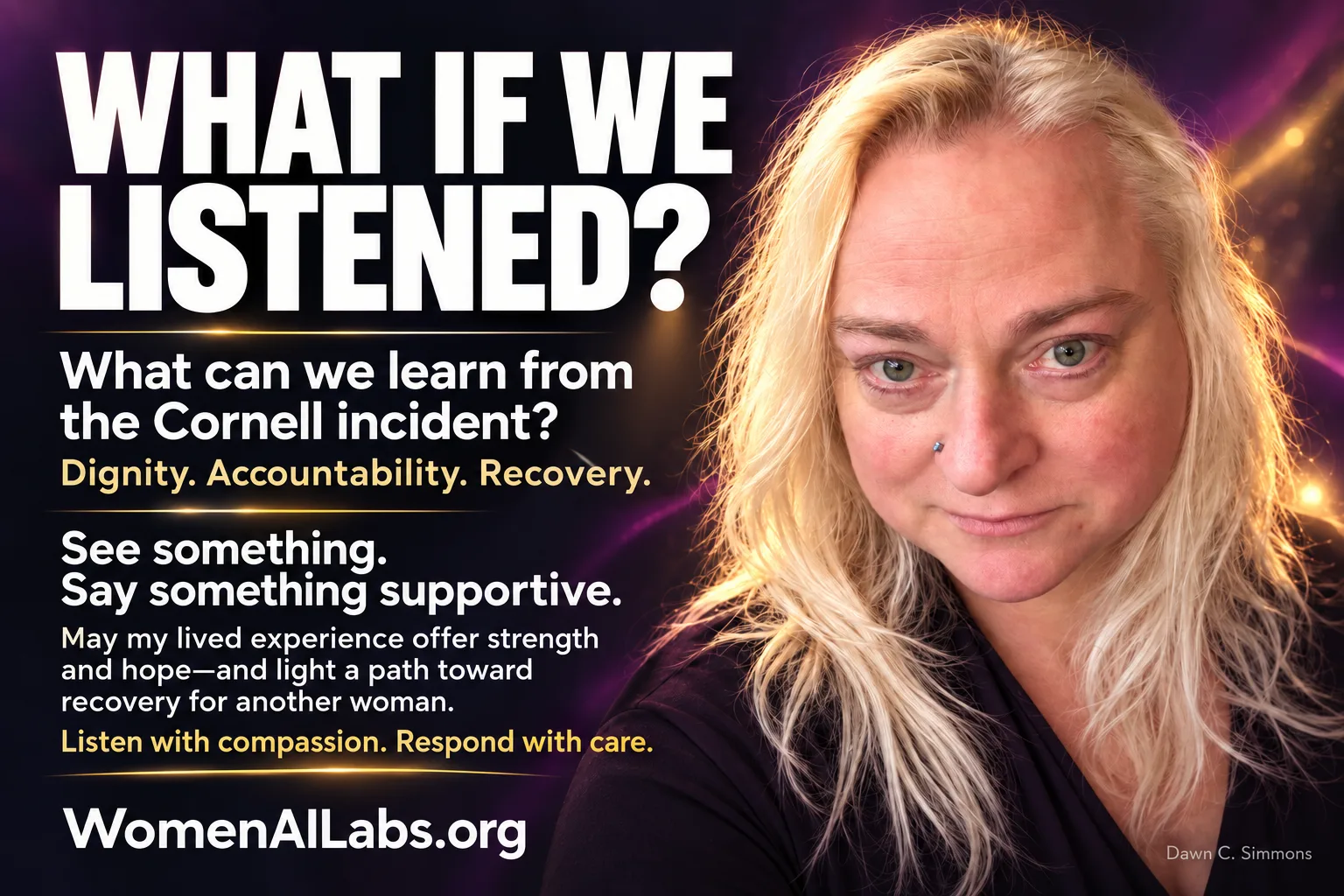
What If We Listened? What We Learned from Cornell
By Dawn C. Simmons, Founder of Women AI Labs. Published October 2, 2026.
Content note: This article discusses violent assault, sexual violence, and victim blaming without graphic descriptions.
What happened at Cornell, and why does it matter?
No woman deserves to be assaulted. Survivors deserve safety, compassionate support, access to justice, and the freedom to rebuild their lives.
A former Cornell University student, identified publicly as Jane Doe, filed a lawsuit alleging that fraternity members sexually assaulted her in 2024. The case has drawn renewed scrutiny of how authorities and the university responded. Cornell acknowledges conducting a Title IX investigation. Because proceedings continue, we must keep the criminal investigation and the civil allegations distinct (Reuters).
Behind those legal processes stands a woman whose life extends far beyond a headline. As public attention grows, we must examine our own response. Do we listen with care? Do we question the conduct of those accused? Do we expect institutions to explain their actions? After the news cycle moves on, do we keep supporting the person living with the consequences?
Why do I speak about this?
For me, these questions reach into something deeply personal. Like Susan Coluantuono, I view this news with analytic and transformation mind set. We are wired to see an opportunity, identify the business logic, and create the service design systems that solve it.
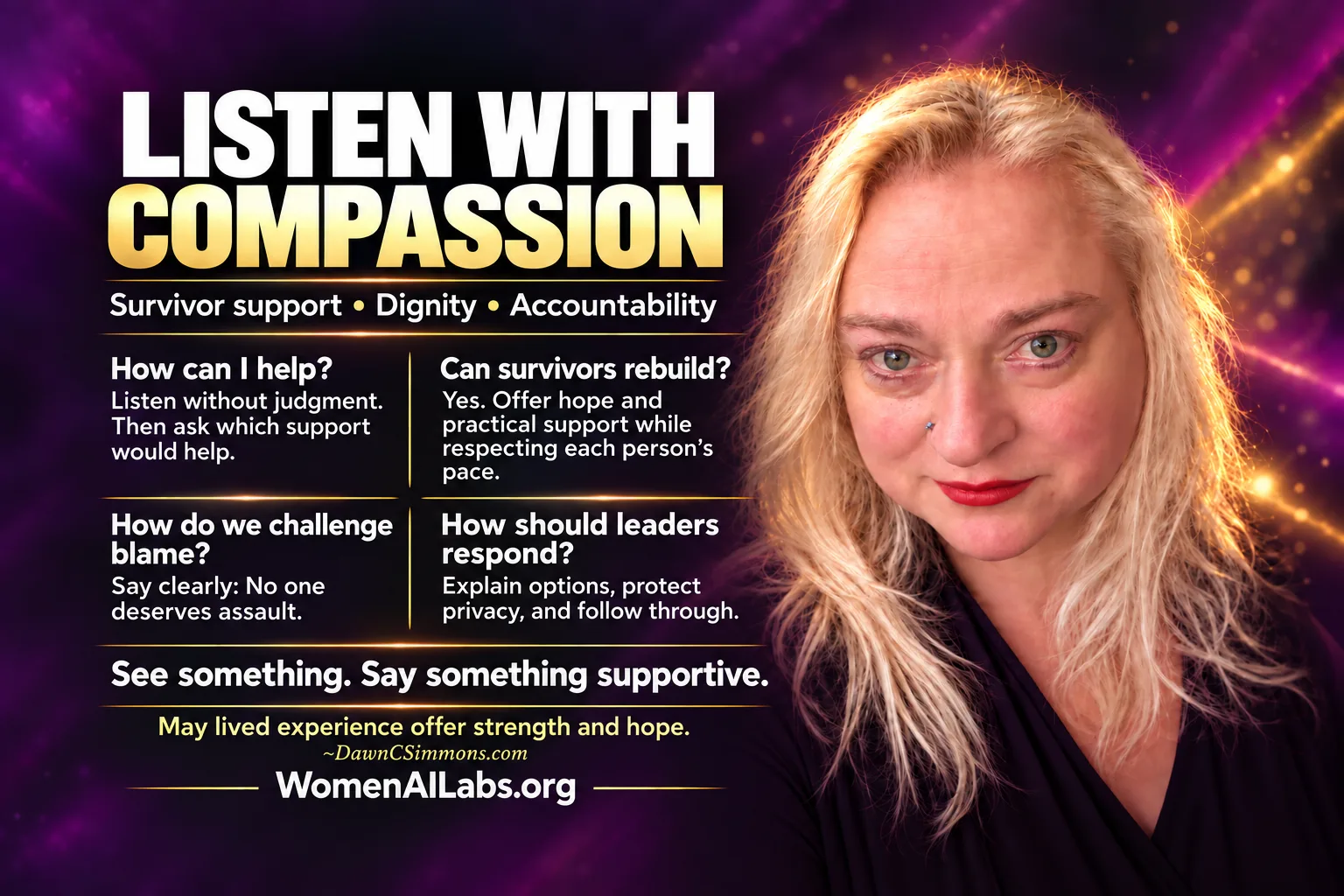
I am a professional woman. I am also a survivor of violent assault.
I share that truth because I want a word of hope, encouragement and strength to be there for another who may feel gossiped, mocked, ridiculed marginalized and misrepresented may need to hear it from someone who continues to work, lead, contribute, and imagine a future. You can survive unthinkable violence. You deserve help getting there.
My professional identity and my survival exist together, and I bring both into the way I understand people, responsibility, and leadership. I also know how deeply it wounds when people make a survivor feel she deserved what happened or try to suggest that she must be doing something wrong and somehow deserved it. That response places another burden on someone already carrying harm. It asks her to defend her dignity when she needs people to protect it.
So let me say this plainly: I did not deserve to be assaulted. Neither did you. Our humanity never depended on being perfect, and our right to safety never required us to earn it.
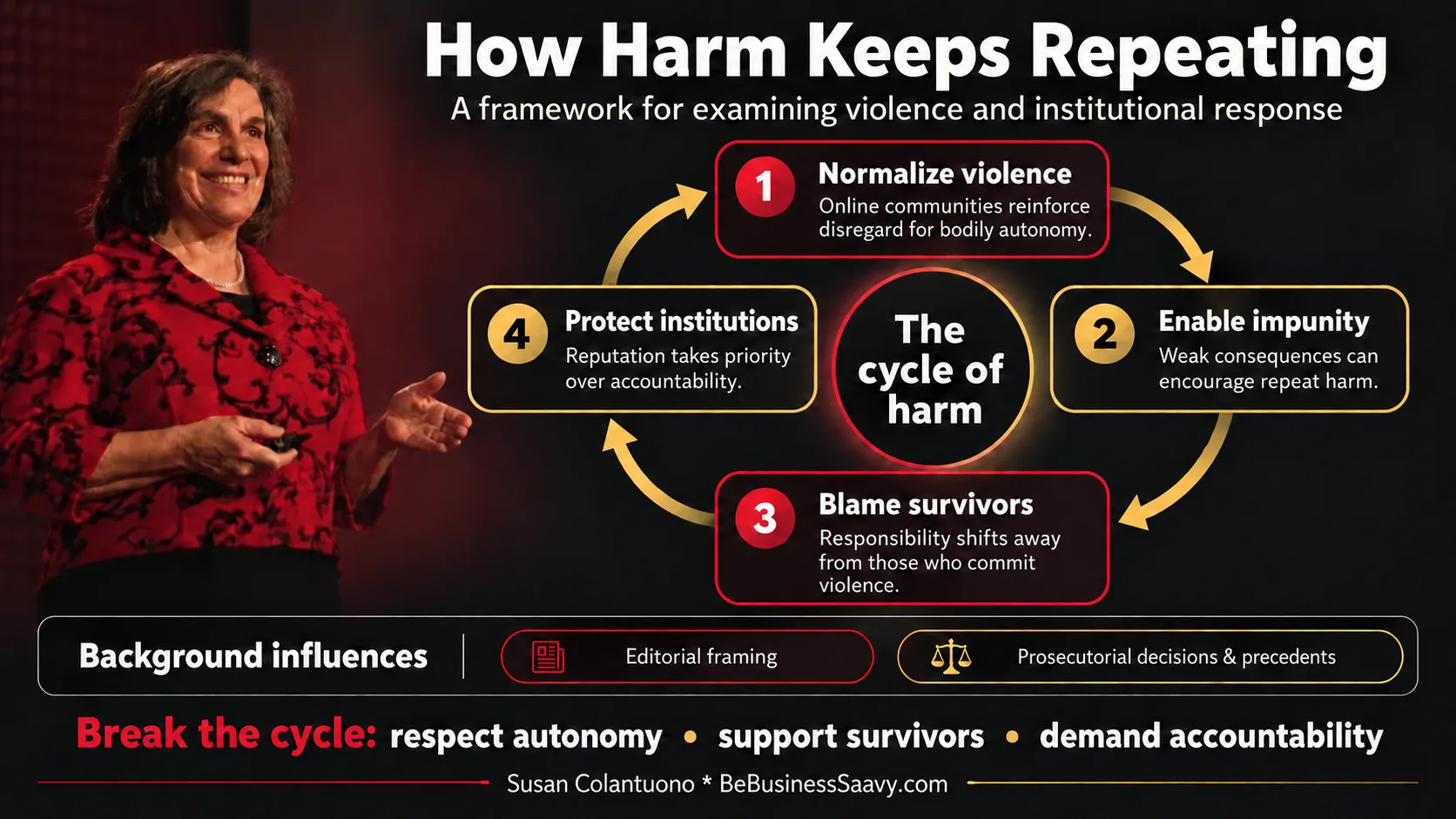
The systems map by Susan Colantuono
In Cornell, Rape Culture...over and over and over and the Systems that Need Naming, Susan names four interlocking doom loops, two background loops, and a Patriarchy Flywheel that technology and AI accelerate.
Her work frames the case as a systems story, and systems can be redesigned.
What does violent assault do to survivors? The statistics
Statistics turn private pain into a public responsibility. Every figure below links to its source.
| Statistic | Figure | Source |
|---|---|---|
| Women who experienced completed or attempted rape in their lifetime | 26.8% | CDC National Intimate Partner and Sexual Violence Survey (NISVS), release summary |
| Female victims injured | 1 in 3 | NISVS, same release |
| Female victims concerned for safety, and fearful | 2 in 3 each | NISVS, same release |
| Female victims who contracted a sexually transmitted infection, and who became pregnant | 1 in 7 each | NISVS, same release |
| Survivors meeting PTSD criteria one month after sexual assault | 75% | Meta-analysis of prospective studies |
| Survivors meeting PTSD criteria twelve months after sexual assault | 41% | Same meta-analysis |
| Sexual assault survivors who meet criteria for lifetime PTSD | 36% | Same meta-analysis |
| Women who are raped and contemplate suicide | 33% | Data reported to RAINN, as cited by Charlie Health (verify against RAINN before citing) |
| Rapes and sexual assaults never reported to police | 73% | RAINN, using National Crime Victimization Survey data |
| Reported rape cases cleared by law enforcement | 26% | RAINN, using FBI data |
| Reported cases judged "founded" by police | 89% | RAINN, 20-year review |
| Perpetrators who walk free per 1,000 assaults | 975 | RAINN, FBI NIBRS 2012 to 2016 |
| How often public degradation follows a report | No sourced data found | Data gap. The challenge exists partly to build this evidence. |
What damages do survivors carry? The damage register
Susan Colantuono identifies the harms that fall on survivors: physical, emotional, long-term health, mental health, financial costs, responsibility for legal action, identity exposure, a violated self-concept, and loss of standing as a person to be respected. The register below pairs each harm with the evidence available today.
| Damage | What the evidence shows |
|---|---|
| Physical harm | Among female victims in NISVS data, 1 in 3 were injured, 1 in 7 contracted an infection, and 1 in 7 became pregnant. |
| Emotional and mental health | Two in 3 female victims were fearful. PTSD affected 75% of survivors at one month and 41% at twelve months. RAINN-reported data indicate 33% of raped women contemplate suicide. |
| Long-term health | The CDC lists depression, anxiety, substance misuse, and long-term physical health concerns among the risks for survivors. |
| Work, school, relationships, and money | The CDC identifies difficulty maintaining relationships, returning to work or school, and sustaining economic well-being. Dollar figures: data gap. |
| Legal burden | Susan reports that Jane Doe filed a 101-page civil suit at her own expense. Nationally, law enforcement clears 26% of reported rapes. |
| Identity exposure and public degradation | Susan documents victim shaming within days of the Cornell news. Prevalence: data gap. |
| Standing as a person | Susan's coverage review found about 80% of headlines and opening sentences framed the survivor as the story, and about 20% named the perpetrators as active subjects. |
How do survivors recover and move forward?
Recovery follows a pattern. In the meta-analysis above, PTSD prevalence dropped from 75% at one month to 41% at twelve months, and most of that recovery happened in the first three months. Early, steady support therefore changes outcomes. Effective treatments exist, including Cognitive Processing Therapy, Prolonged Exposure Therapy, and EMDR (Psychology Today). Research also shows psychological interventions reduce PTSD symptoms and distress for sexual assault victims regardless of gender (PMC scoping review).
Every survivor sets her own pace. These steps offer options, not obligations.
- Reach safety first. Move to a safe place, and call 911 if danger is immediate.
- Contact support at any hour. The RAINN National Sexual Assault Hotline (800-656-HOPE, or online.rainn.org) connects you with a trained advocate.
- Consider a medical exam. A provider can treat injuries, discuss time-sensitive health options, and, if you choose, collect forensic evidence.
- Choose your reporting path. You may report, speak publicly, or stay private. Support stays available in every case.
- Seek a trauma-focused therapist. Ask specifically about CPT, Prolonged Exposure, or EMDR.
- Rebuild routines gradually. Sleep, movement, trusted people, and small daily wins give recovery a foundation.
- Request accommodations. Employers and schools can adjust workloads, schedules, and privacy protections.
- Release the performance. Recovery belongs to you, and you owe the world no display of strength.
Women who survive extraordinary violence can become deeply compassionate, capable, and focused leaders. Still, every survivor deserves support regardless of what she achieves afterward.
Why now? The AmplifyHER moment
AmplifyHER is the Women AI Labs storytelling and newsroom platform where solutions get told, not just discussed. The window to act is open today, for five reasons.
- Systems are under review right now. Susan Colantuono reports, citing NPR, that the local district attorney is reopening the investigation, the New York Attorney General is reviewing Cornell's response, and the governor has called for a review.
- Public degradation has already started. Susan documents victim shaming and "poor young men" framing in the days after the case broke.
- The systems now have names. Susan's structural analysis gives builders, advocates, and leaders a map to work from.
- The coverage template needs a fix. Susan's review of national coverage found roughly 80% of headlines and opening sentences used passive framing that centers the survivor, and about 20% named the perpetrators as active subjects. Newsrooms can change that today.
- Attention fades quickly. Survivors need support long after headlines disappear, so we build the tools while people still pay attention.
That counter-move belongs in our newsrooms, our workplaces, and our campuses.
How can you make a difference? The action kit
What if the first response helped a woman breathe more freely? What if someone said, "You did not deserve this. I am here. What would help?" Our response can add pain or offer support, and RAINN warns that questions about clothing, drinking, or delayed reporting shift blame onto survivors (RAINN). Use this kit to act this week.
| If you are | Do this week | Where to go |
|---|---|---|
| A friend, colleague, or neighbor | Listen without demanding details, affirm that the assault was not her fault, and follow her lead (RAINN guidance). Challenge victim blaming with one sentence: "No one deserves assault. Responsibility belongs to the person who commits it." | womenailabs.org |
| An employer or HR leader | Name a confidential support contact, protect privacy, and offer accommodations. Then check whether people actually receive the help your policy promises. | womenailabs.org |
| A university or Title IX professional | Publish a plain-language support guide with consistent updates and protection from retaliation. Track response times and completed corrective actions. | womenailabs.org |
| A builder or AI practitioner | Join a challenge track and design tools for evidence preservation, support navigation, and safe reporting workflows. Survivors hold the veto on any design that affects them. | info@womenailabs.org |
| A journalist or storyteller | Write the perpetrator as the active subject of the sentence. Submit solutions, consented stories, or sourced explainers to the AmplifyHER newsroom. | AmplifyHER at womenailabs.org |
| A reader who wants more | Read the practitioner perspective, and follow the work as it develops. | dawncsimmons.com |
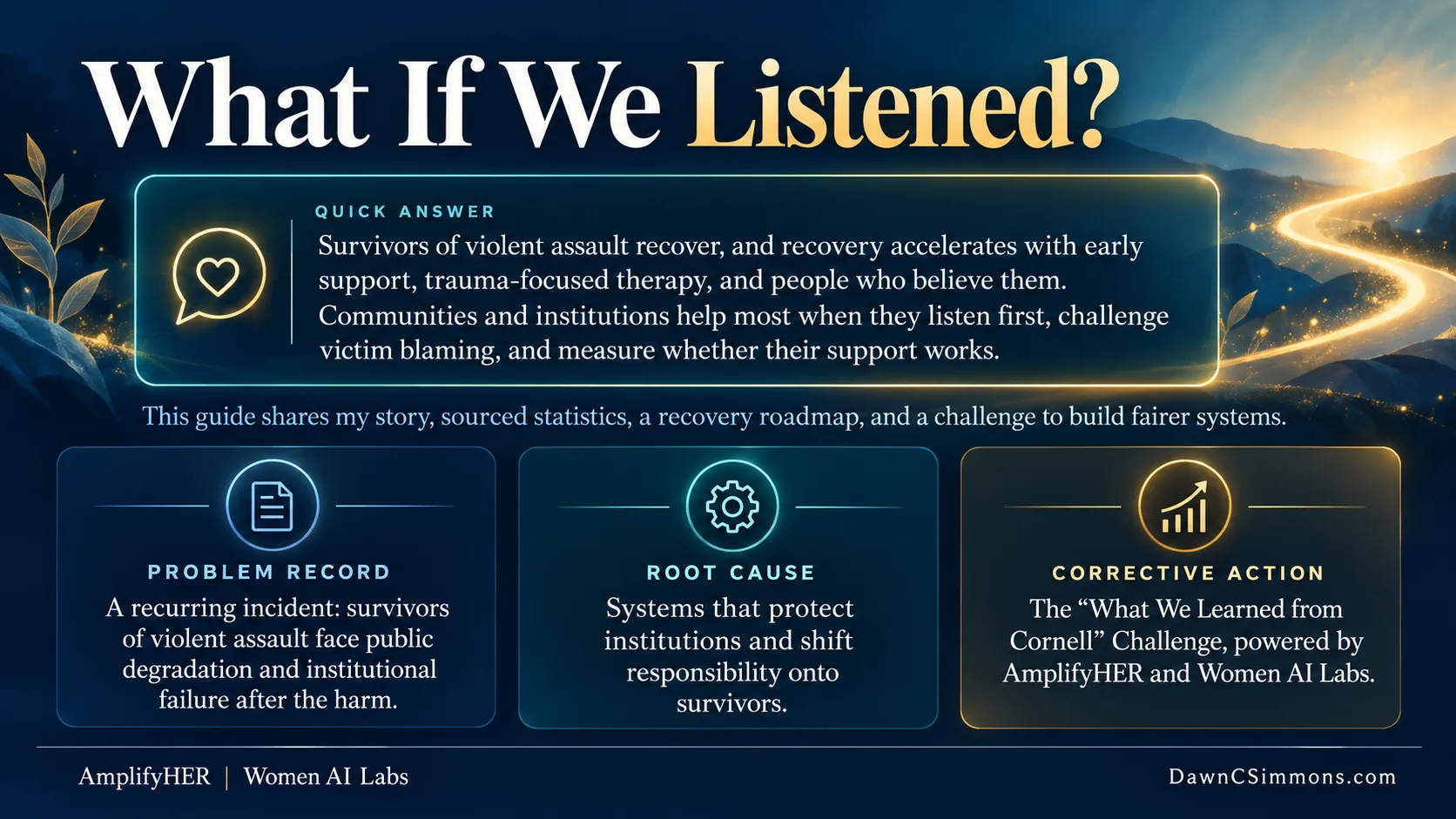
What is the "What We Learned from Cornell" Challenge?
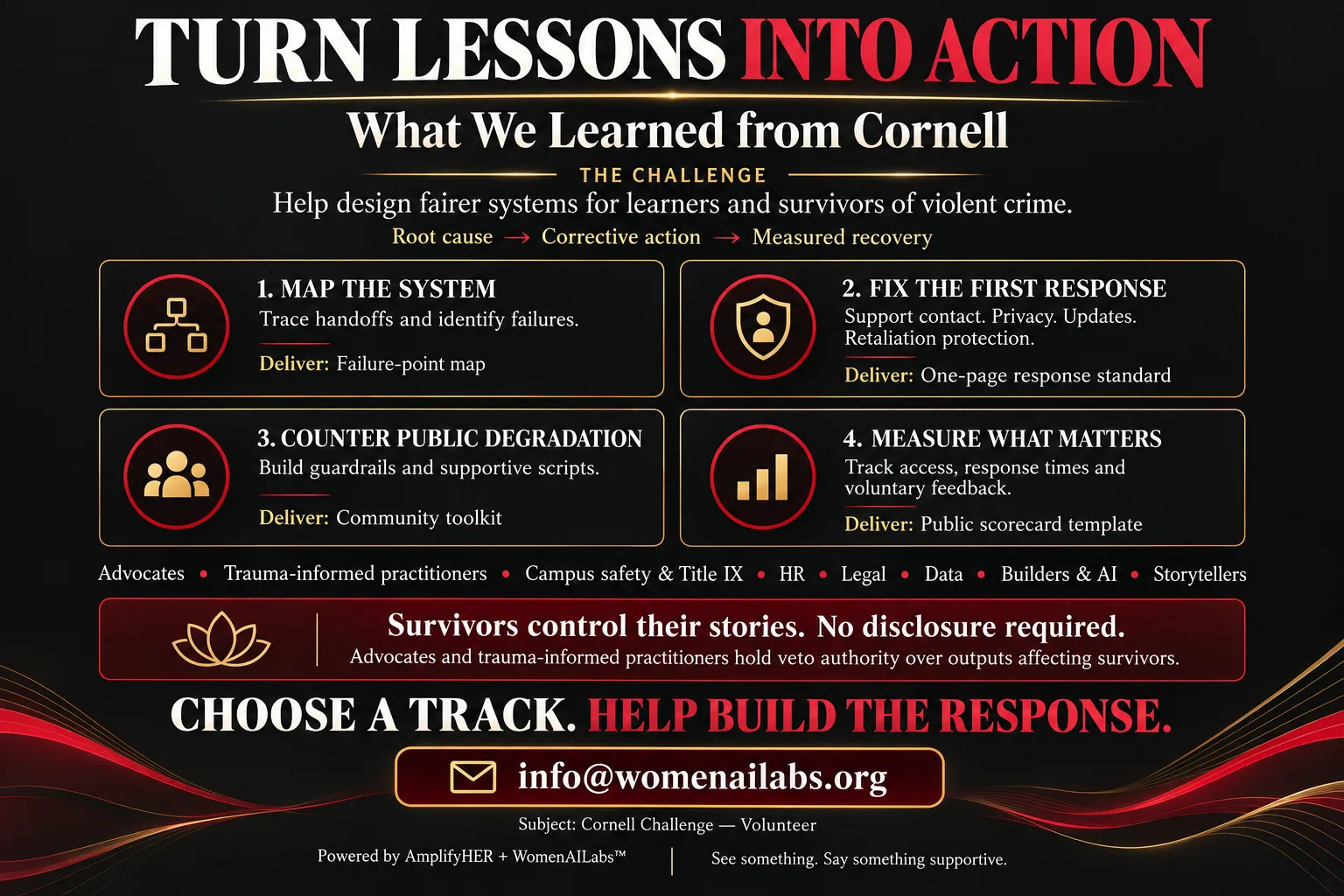
When the same incident recurs, a good service desk stops closing tickets and opens a problem record. Cornell is a recurring incident, and this challenge is the problem record. We are assembling a cross-functional team to design fairer systems for learners and for victims of violent crime, including protection from the public degradation that so often follows. We will run it like an outage review: root cause, corrective action, measured recovery.
The team: survivor advocates and trauma-informed practitioners (who hold the veto on anything affecting survivors), Title IX and campus safety professionals, employer HR leaders, legal reviewers, data and measurement leads, builders and AI practitioners, and AmplifyHER storytellers.
Four tracks, four deliverables
- Map the system. Build on Susan Colantuono's loops and trace every handoff from first disclosure to recovery. Deliverable: a failure-point map.
- Fix the first response. Design a one-page protocol with a named support contact, privacy protection, consistent updates, and retaliation protection. Deliverable: a plug-in response standard.
- Counter public degradation. Create guardrails and scripts for institutions, platforms, and communities. Deliverable: a community toolkit.
- Measure what matters. Track response times, access to support, completed corrective actions, and voluntary survivor feedback. Deliverable: a public scorecard template.
Safeguards: Survivors control their stories, and participation never requires disclosure. We use no identifying details about individuals in any case. Every statistic carries a source, and every gap carries a label.
Frequently asked questions
How long does PTSD last after sexual assault?
In a meta-analysis of prospective studies, 75% of survivors met PTSD criteria at one month and 41% at twelve months. Most recovery happened within the first three months. Timelines vary, so a trauma-focused therapist can assess your needs and build a plan with you.
What should I do right after a violent assault?
Move to safety, and call 911 if danger continues. Then contact the RAINN National Sexual Assault Hotline at 800-656-HOPE (4673) or online.rainn.org for confidential support. Consider a medical exam, which can include forensic evidence collection if you choose. You decide whether to report to police.
Which therapies work for sexual assault trauma?
Trauma-focused therapies show strong results, including Cognitive Processing Therapy, Prolonged Exposure Therapy, and EMDR. Research finds psychological interventions reduce PTSD symptoms and distress for sexual assault survivors regardless of gender. Ask any provider whether they specialize in these approaches before you begin.
How many sexual assaults are reported to police?
RAINN reports that an estimated 73% of rapes and sexual assaults never reach police, and law enforcement clears 26% of reported rape cases. Survivors skip reporting for many reasons. Support remains available whether or not you report, speak publicly, or choose privacy.
How can I support a survivor?
Listen without demanding details, affirm that the assault was not her fault, and ask what support she wants. Follow her lead on every decision. Avoid questions about clothing, drinking, or reporting delays, because RAINN warns that these questions shift blame onto survivors and cause further harm.
What is victim blaming, and why does it cause harm?
Victim blaming shifts responsibility for violence from the person who commits it to the person who survived it. Questions about what she wore, whether she drank, or why she waited to report add pain to someone already carrying harm. Responsibility belongs to the person who commits the assault.
How can survivors return to work or school?
Request accommodations such as adjusted schedules, workloads, and privacy protections from your employer or school. The CDC notes that sexual violence can make returning to work or school difficult, so asking for support is reasonable. Rebuild routines gradually and lean on trusted people.
What is the What We Learned from Cornell Challenge?
It is a Women AI Labs challenge that brings together survivor advocates, Title IX professionals, employers, legal reviewers, data leads, and builders to design fairer systems for learners and victims of violent crime. Four tracks produce a failure-point map, a first-response standard, a community toolkit, and a public scorecard.
What is the AmplifyHER newsroom call?
Submit one of three things: a solution (a policy, tool, protocol, or program that closes a failure point, with a plan to measure it), a story or perspective (shared with consent, anonymous if you prefer), or an investigation or explainer (sourced reporting on how the system works and where it breaks). The strongest submissions publish through the AmplifyHER newsroom and feed directly into the challenge tracks.
Join the challenge Submit to AmplifyHER

If you see something, say something. Then help light the path.
If you need support now:
Call the RAINN National Sexual Assault Hotline at 800-656-HOPE (4673), or visit online.rainn.org.
Call or text 988 for crisis support. Call 911 in an emergency.
Other Resources:
- 123 Years to Gender Parity Analytics (Claude) — Women AI Labs
- AI Incident Management Careers | WomenAILabs — Women AI Labs
- Be Business Savvy™ by Susan Colantuono | Substack
- Can Trauma Cause Memory Loss? | Charlie Health
- City of Chicago : Help on Domestic Violence
- Common Reactions After Trauma – PTSD: National Center for PTSD
- Digital Bullying Tool — Women AI Labs
- Domestic Violence Support | National Domestic Violence Hotline
- Domestic Violence | Psychology Today
- Global Executive Womens Network | Groups | LinkedIn
- OODA Domestic Violence Survival
- Surviving Domestic Violence
- UChicago Medicine, Legal Aid Chicago launch bedside program to provide in-hospital legal support for trauma patients injured by violence – UChicago Medicine
Last updated October 2, 2026. Statistics come from the CDC, RAINN, and peer-reviewed research linked above. Claims about Cornell and the systems analysis are attributed to Susan Colantuono and her published article. Legal proceedings continue, and this guide studies systems and does not judge guilt or innocence.
© Dawn C. Simmons | dawncsimmons.com | Women AI Labs