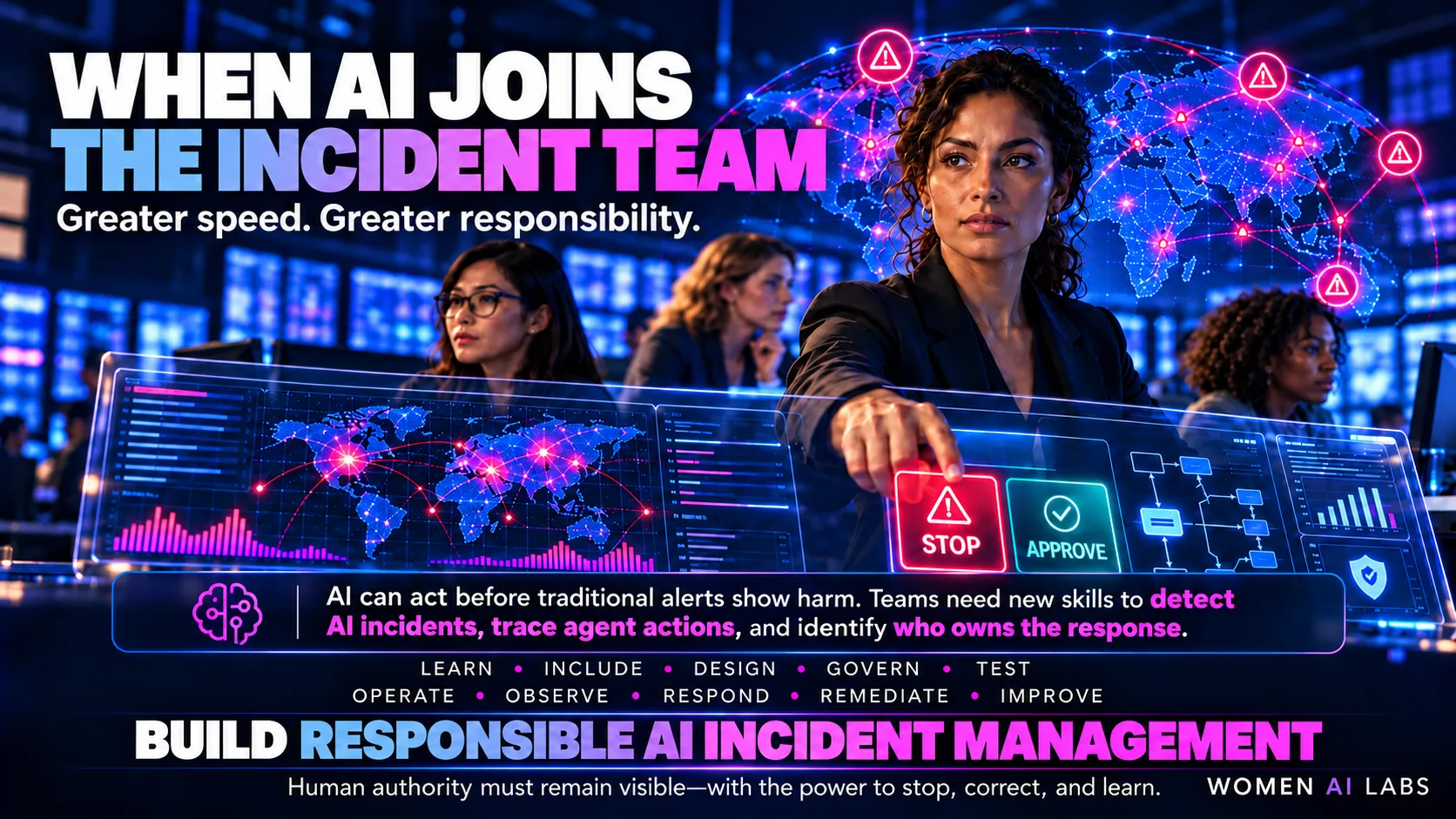
AI incident management careers are expanding beyond ticket resolution. As organizations introduce generative AI, AI assisted work, and autonomous agents into service delivery, they need people who can restore services, recognize when AI causes harm, and prevent failures from recurring. This guide explains the process, the career opportunities, and how WomenAILabs can help people build visible proof of their skills.
AI Incident Management Process
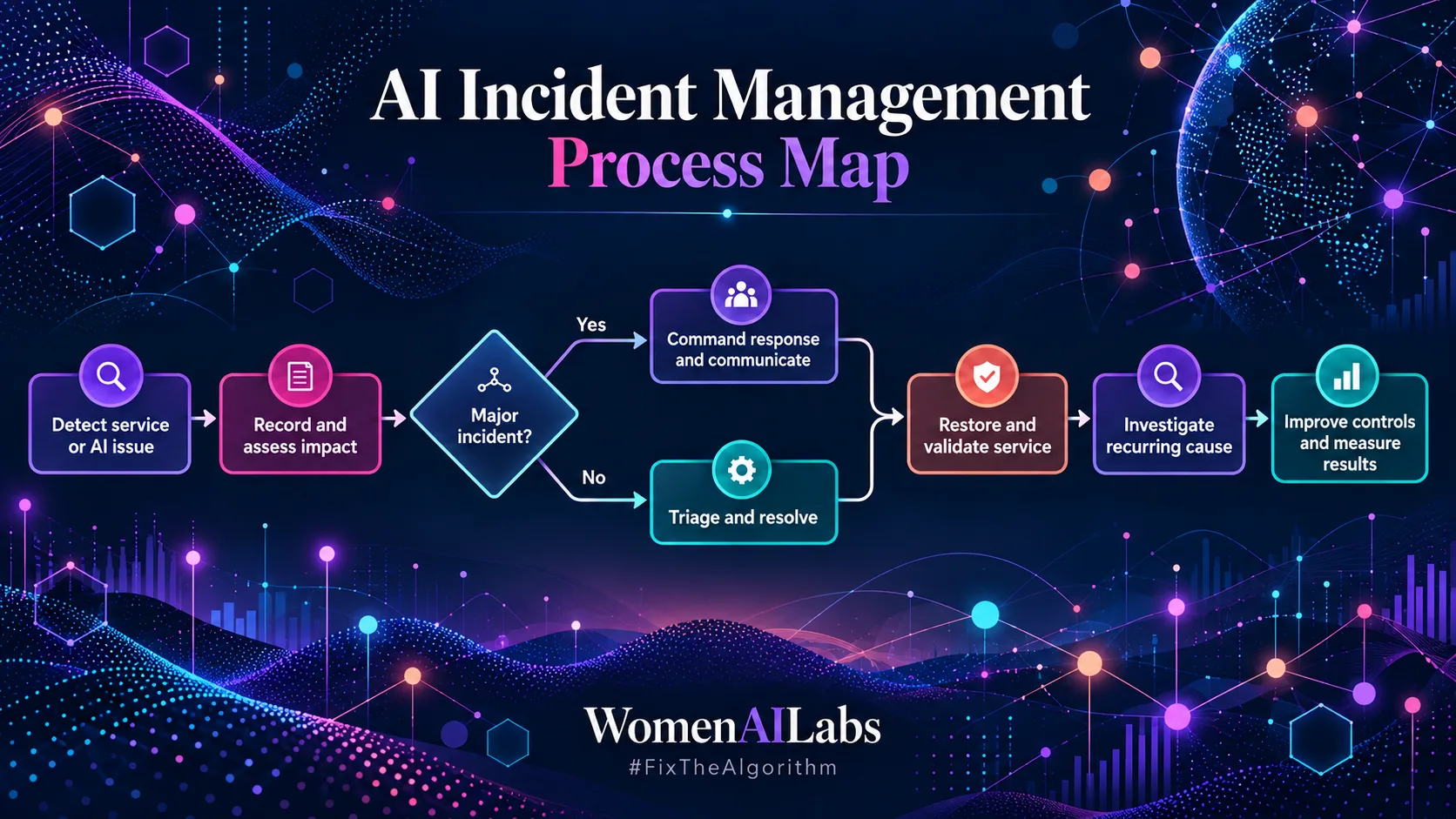
The process starts when a customer, employee, monitoring tool, or AI system identifies a disruption. The team records the symptoms, identifies the affected service and people, sets priority, and assigns a response owner.
When the impact meets major incident criteria, an incident commander coordinates recovery and communications. Finally, the team validates restoration and investigates any underlying problem. ServiceNow describes incident management as restoring services while helping employees remain productive; its major incident process includes identifying and reviewing potential major incidents.
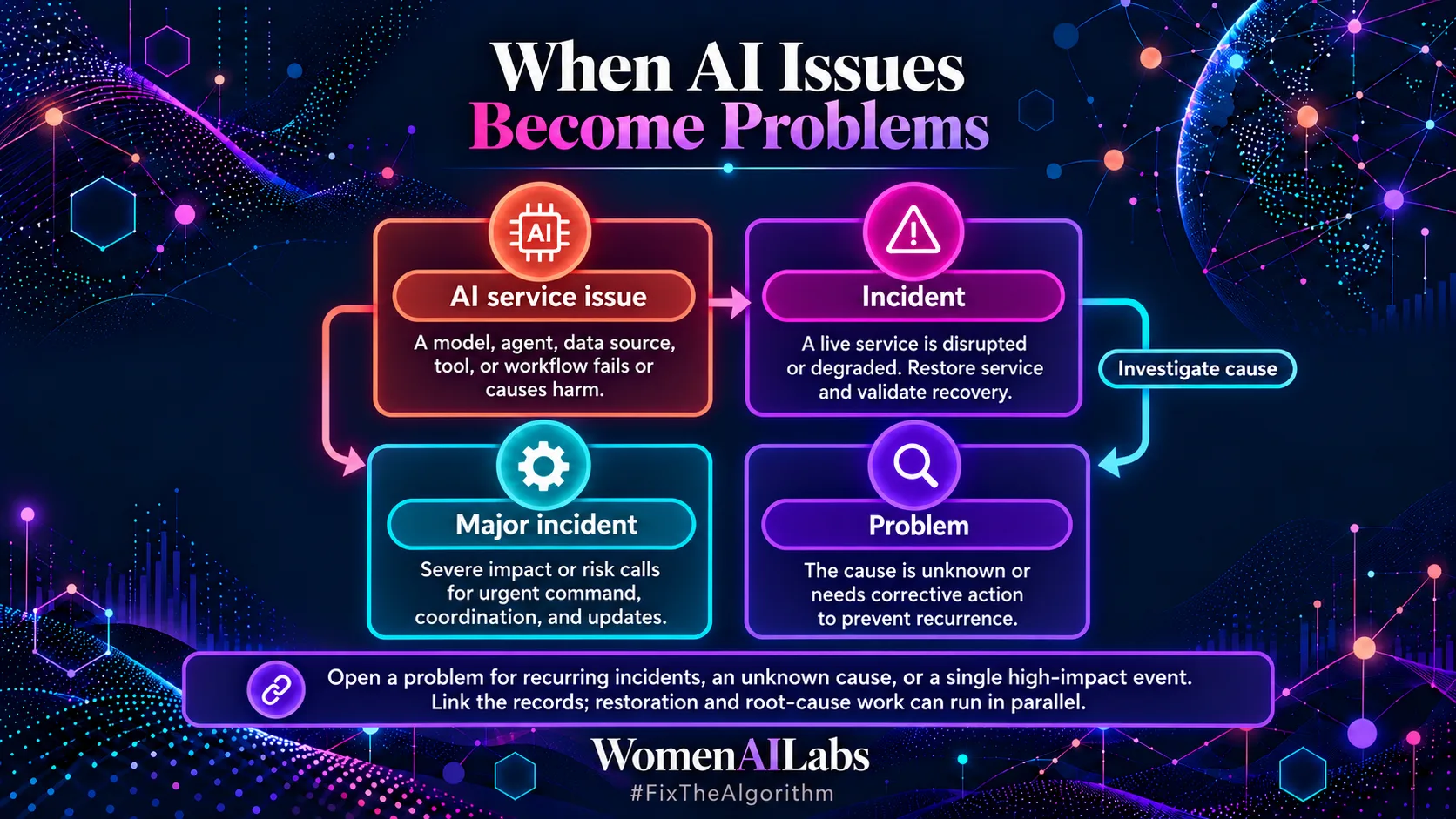
An AI service issue may also be an incident or major incident. These labels describe different aspects of the same event; teams should connect the records and response.
Why AI Incident Management Matters
When an employee support agent gives incorrect instructions, people may lose productive time. When a customer service agent fails to complete a transaction, customers may lose access or trust. When an autonomous agent makes an incorrect change, its actions can spread across connected services before a person notices.
Therefore, incident management must measure more than whether a ticket closed. Teams need to know who was affected, what the AI did, which service depended on it, whether recovery worked, and what changed afterward. Problem management then turns recurring incidents into prevention work. ITIL’s incident and problem practices emphasize timely resolution, measurement, and continual improvement.
How AI Changes Incident Management Jobs
AI can summarize incident history, suggest next steps, correlate signals, and assist with resolution notes. ServiceNow documents incident summarization and agentic workflows. Its documentation also warns that an AI generated summary can omit important details, which makes human verification part of the job.
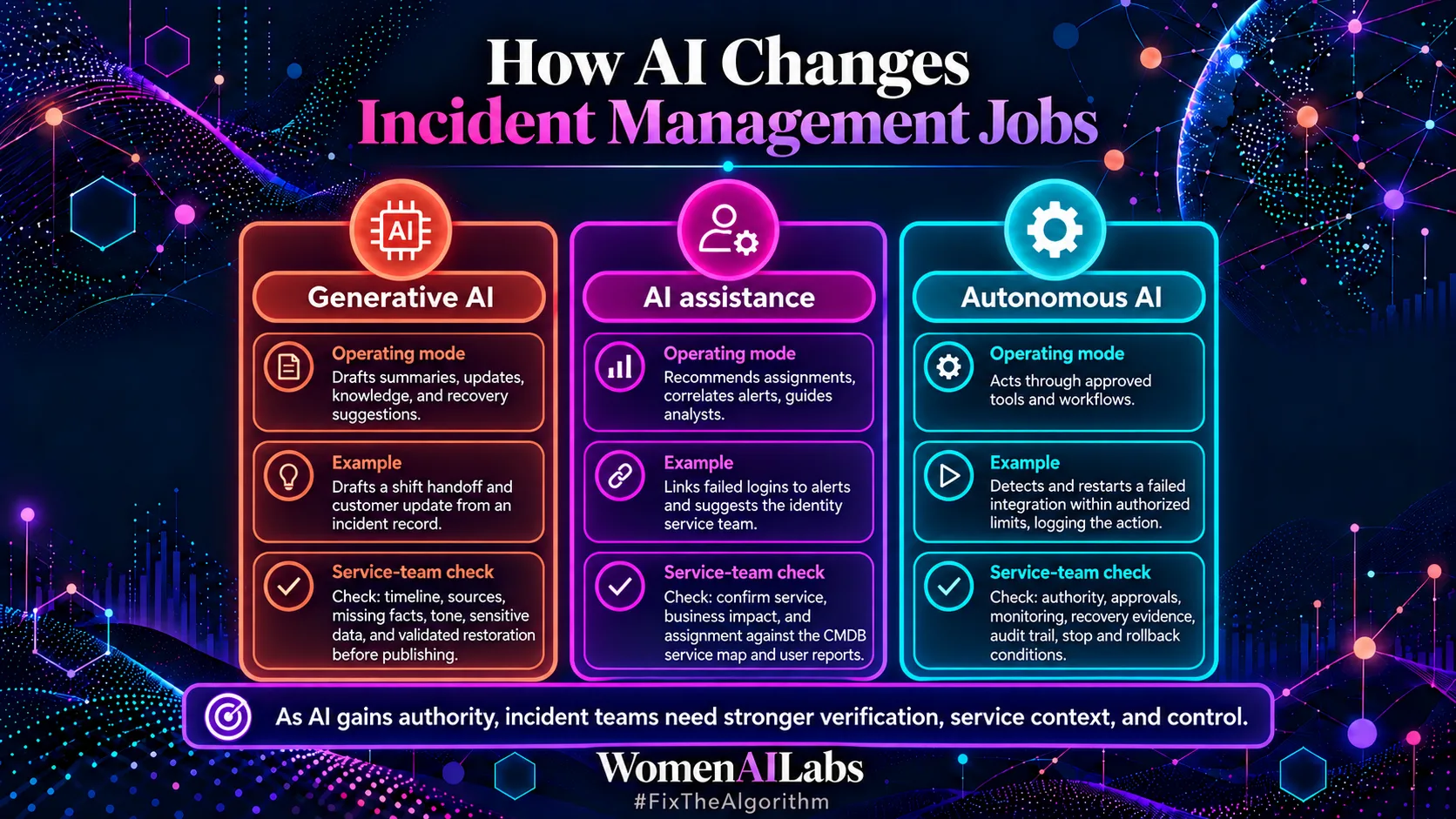
The work now includes investigating the AI itself. A responder may need to determine whether the failure came from a prompt, model, retrieval source, access rule, integration, automation, or underlying service. They must also know when to pause an agent and bring a human decision maker into the response.
AI Incident Management Careers And Job Titles
These titles provide search terms; employers may use different names for similar work.
| Career area | Titles to search | Value delivered |
|---|---|---|
| Service leadership | Incident Management Process Owner, Service Operations Manager, Director of IT Service Management | Sets the process, measures results, and improves accountability |
| Critical response | Major Incident Manager, Incident Commander, Crisis Response Lead | Coordinates recovery, decisions, and stakeholder updates |
| Prevention | Problem Manager, Service Quality Lead, Continual Improvement Lead | Investigates recurrence and verifies corrective action |
| AI operations | AI Service Manager, AIOps Lead, AI Operations Manager | Monitors AI enabled services and manages operational risk |
| Platform and context | ServiceNow ITSM Product Owner, CMDB Lead, Service Operations Architect | Connects incidents to services, owners, and dependencies |
| Experience | Digital Employee Experience Manager, Customer Service Operations Lead | Measures the effect on people and improves service journeys |
| Assurance | AI Governance Lead, AI Incident Response Lead, Security Incident Manager | Sets controls and escalates harmful or unsafe outcomes |
These are promising career paths, although there is no government growth forecast for each title. As indicators of adjacent demand, the U.S. Bureau of Labor Statistics projects employment growth from 2025 to 2035 of 16% for computer and information systems managers, 9% for computer systems analysts, and 21% for information security analysts. Those figures should not be presented as forecasts for incident managers specifically.
AI Service Delivery Skills To Grow Next
Learn the process, then demonstrate how you would operate it when AI participates in delivery.
| Skill | Grow from | Grow toward for AI service delivery |
|---|---|---|
| Incident triage | Categorizing and assigning tickets | Distinguishing a service outage from a bad answer, unsafe agent action, data issue, or integration failure |
| Major incident command | Escalating high priority tickets | Declaring impact, assigning response roles, coordinating recovery, setting update times, and stopping harmful automation |
| CMDB and CSDM context | Looking up a configuration item | Following the affected business service through applications, infrastructure, integrations, AI components, owners, and users to guide resolution |
| AI literacy | Writing prompts | Using generative AI, AI assistance, and autonomous agents appropriately; checking output and understanding each tool’s authority |
| Observability | Reading individual alerts | Correlating service health, agent actions, model behavior, logs, user reports, and customer or employee journeys |
| Problem management | Recording a root cause after an outage | Finding patterns across incidents, testing suspected causes, and confirming that corrective actions reduce recurrence |
| Automation control | Running a predefined script | Setting approval thresholds, testing actions, monitoring outcomes, and rehearsing rollback |
| Knowledge and communication | Publishing a resolution note | Producing verified guidance for analysts, employees, customers, executives, and future AI retrieval |
| Measurement | Reporting ticket volume and restoration time | Tracking affected people, repeat incidents, task completion, failed AI actions, recovery quality, and experience |
A practical learning exercise starts with a simulated employee support agent incident. Map the agent and its dependencies in a sample CMDB, identify affected employees, examine its recent actions, pause the risky workflow, restore the service, and document a linked problem investigation. The finished playbook becomes evidence of job readiness.
Women In Incident Management: What The Data Shows
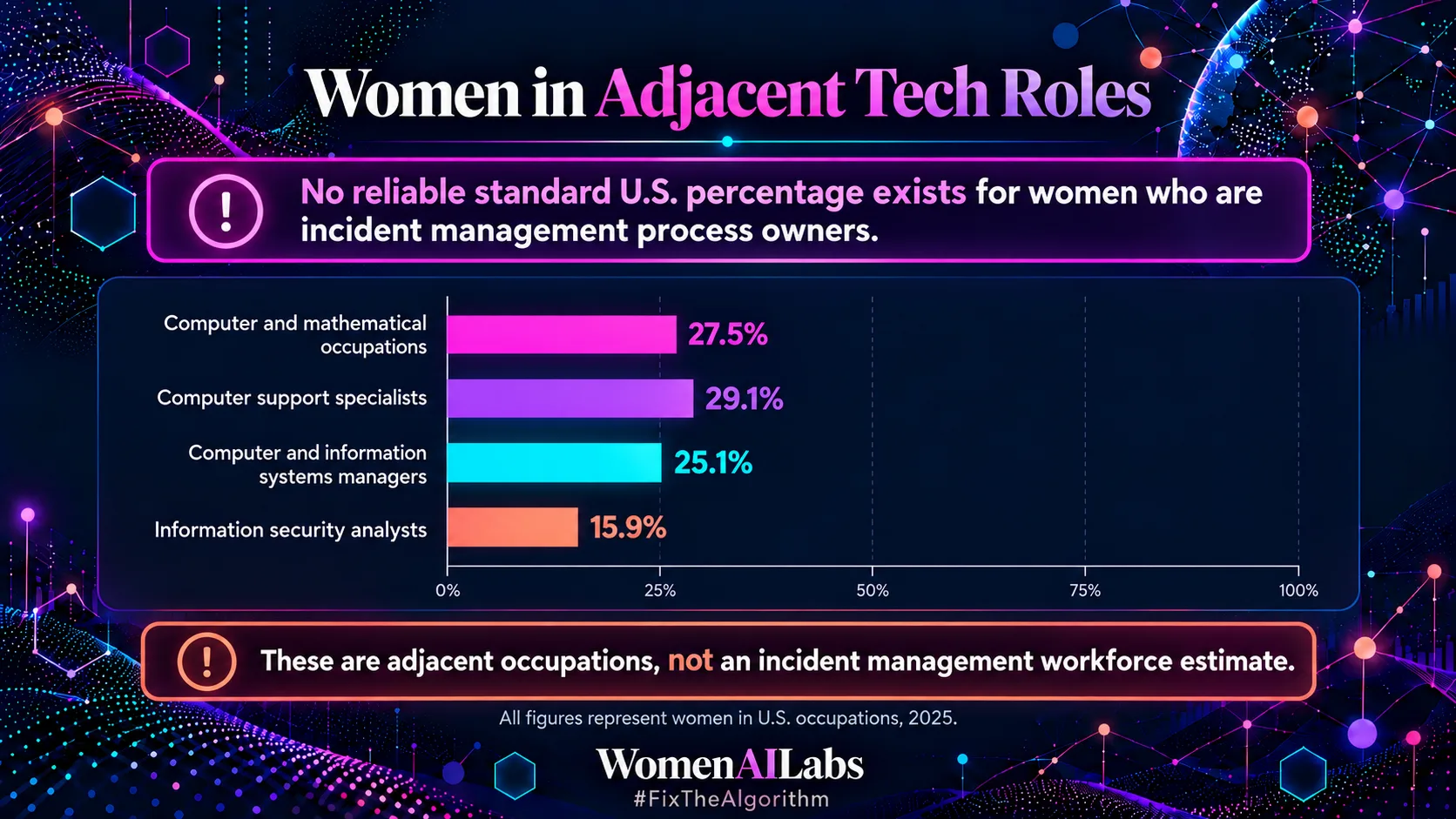
There is no reliable, standard U.S. statistic for the percentage of incident management process owners who are women. Incident manager and process owner are job titles used across several occupational categories. Reporting one precise percentage for this field would misstate what the data measures.
The closest published comparisons show why representation deserves attention. In 2025, women held 27.5% of U.S. computer and mathematical occupations, 29.1% of computer support specialist jobs, 25.1% of computer and information systems manager jobs, and 15.9% of information security analyst jobs. These are adjacent occupations, not an incident management workforce estimate.
Why Gender Parity Improves Service Response
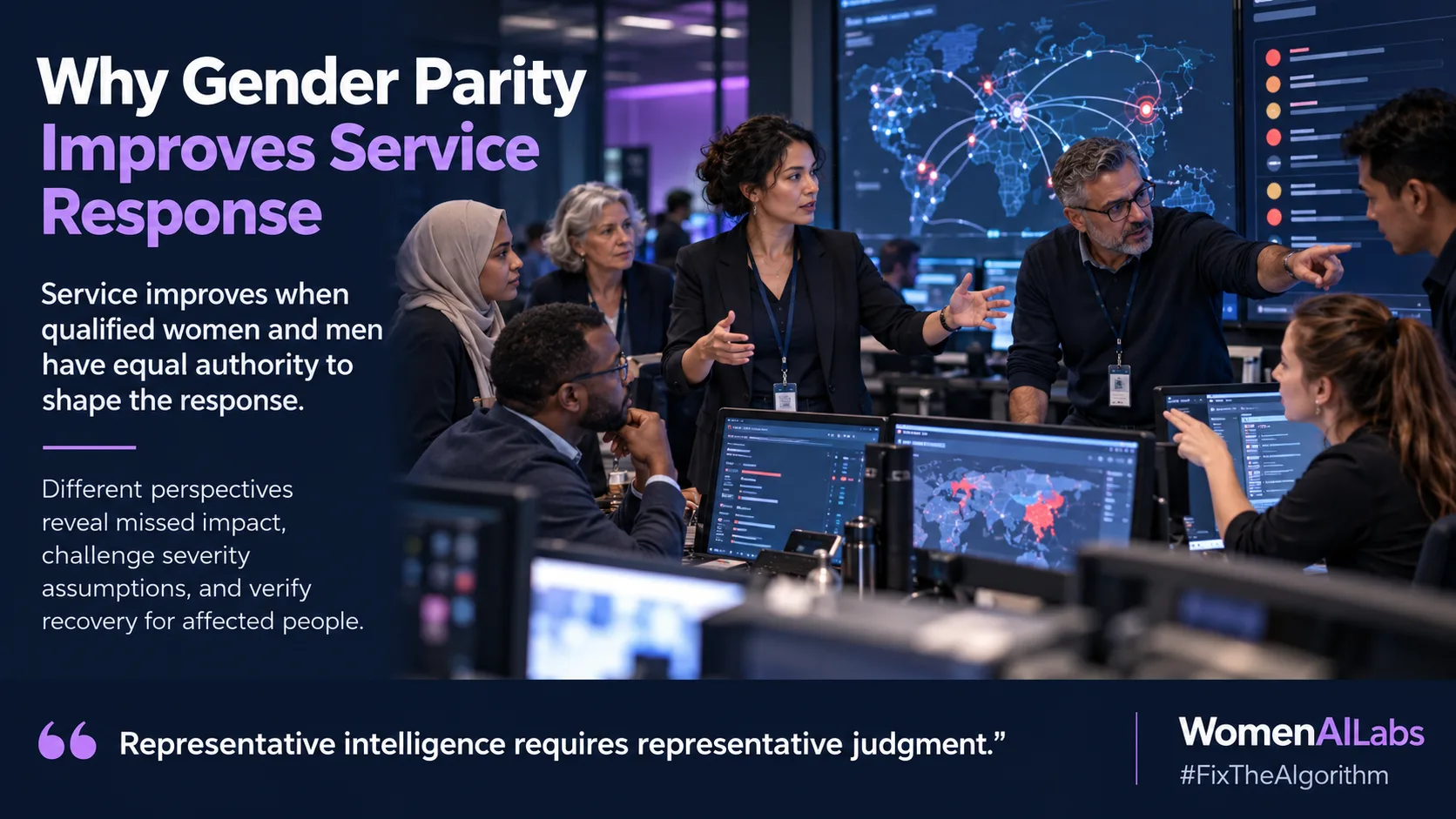
Representative intelligence requires representative judgment. Teams can gain a wider set of observations, find overlooked service harms, improve the questions asked during an incident, and create leadership opportunities for people whose expertise may otherwise remain invisible. These are reasons to design inclusive response teams and test their outcomes; representation alone does not guarantee a better incident result.
To create measurable growth, organizations and communities can:
- Publish clear pathways from service desk, customer operations, security, CMDB, and governance into incident leadership.
- Give women opportunities to command simulations and real responses with appropriate support.
- Pair mentors with sponsors who recommend qualified participants for visible assignments.
- Credit incident command, prevention, documentation, and customer communication as leadership work.
- Review hiring, promotion, pay, speaking invitations, and major incident assignments for disparities.
- Measure participation and outcomes: who led, who was promoted, whose recommendations changed the process, and whether the service improved.
How WomenAILabs Tools Build Career Proof
The WomenAILabs AI Tools Directory provides several starting points that anyone can use to learn, demonstrate capability, and connect to opportunity. Its current listings include career, equity, research, and storytelling tools.
| Tool or resource | Practical use for an AI incident management career |
|---|---|
| Career Proof Lab | Turn a simulated incident, service map, playbook, or improvement project into a portfolio example. |
| Jobs N Career Success Loop Board | Explore roles, career resources, and connections that match demonstrated skills. |
| Calming Career Coach | Prepare for interviews and plan a transition during a difficult job search. |
| ITSM Gender Bias Study | Examine where bias may enter service management workflows and design a better evaluation. |
| AI Harms Risk Register | Practice documenting an AI related harm, assigning an owner, and showing evidence of a fix. |
| DAUGHTER Equity Analyzer | Explore fairness questions in customer and employee journeys. |
| AmplifyHER Tell Your Story | Explain the problem you addressed, what you built, and what changed. |
A repeatable career proof sequence: choose a target role → build one realistic incident scenario → map the service and AI dependencies → lead a response simulation → publish a playbook and outcome measures → use WomenAILabs tools to present the work → seek feedback, mentorship, and introductions.
The Top 100 Women And Gender Equity Advocates
WomenAILabs will build a Top 100 AI Service Management Advocates directory that recognizes people, publications, authors and leaders and people of any gender with documented work supporting women’s growth in incident management, major incident response, problem management, AIOps, CMDB, and AI service assurance.
Editorial selection criteria: demonstrated process leadership; useful research, teaching, or published work; measurable service improvement; mentorship or sponsorship; and contributions to inclusive decision making. The directory can feature practitioners, authors, researchers, educators, customer leaders, and allies. Publish only verified profiles, invite corrections, and refresh links and roles regularly.
Editorial status: The Top 100 directory is a proposed WomenAILabs research and recognition project.
Build The Next Response Team
AI service management needs people who can restore a service, understand what an AI system did, connect that event to the services and people affected, and prevent the failure from repeating. Learn the process. Practice the response. Build the proof. Then help someone else enter the field.
Explore the WomenAILabs tools, create an AI incident response portfolio example, and contribute a leader, mentor, or research lead to the Top 100 directory. Together, we can make service delivery more dependable and open more paths into the work that shapes it.