There is a particular kind of quiet that settles over a meeting when someone says "we'll just RAG it against the knowledge base and see if the validation loss holds."
If you have sat in that quiet, weighing up whether asking costs more than not knowing — you are not behind. Nobody handed you the vocabulary.
Here it is. But not as a list, because lists do not stick. Twelve terms arranged around one simple story, so that a week from now you can still recall them.
The story
An AI is like a person who goes to school and then gets a job.
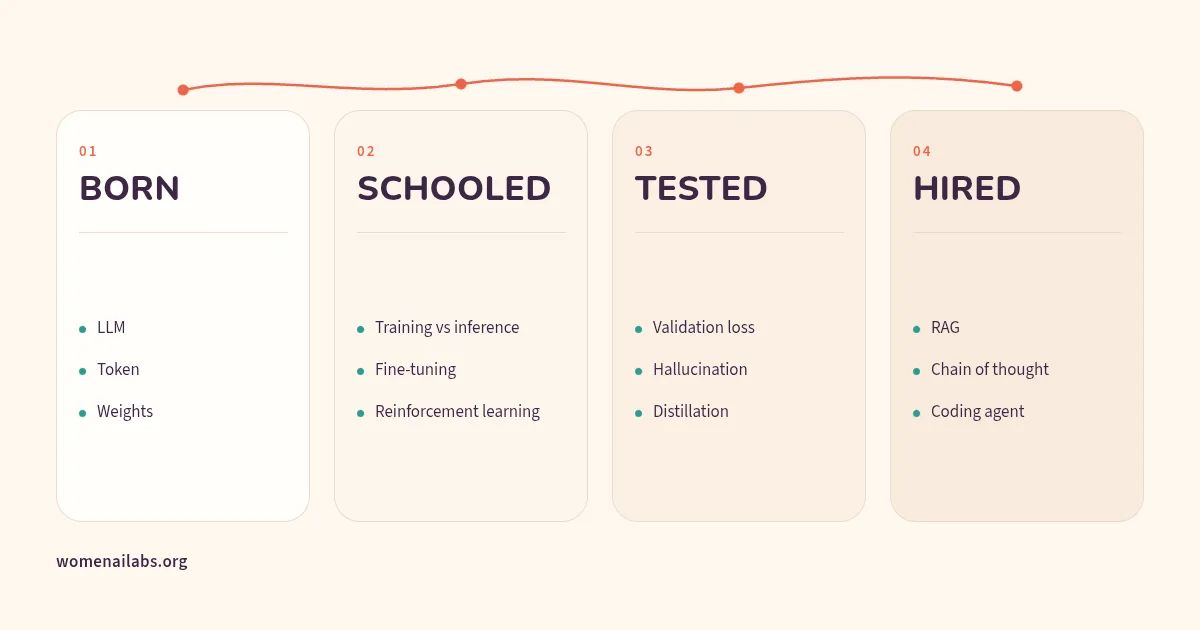
That is the whole trick. Every term below is one moment in that life, in order:
- Born — what it is made of
- Schooled — how it learned
- Tested — how anyone knows it learned
- Hired — what it does for you
Four stages. Three words each. Read them in order once, and the story will pull the vocabulary along with it.
Stage 1 — Born
1. LLM (Large Language Model)
This is the type of AI behind the tools you have used — ChatGPT, Claude, Gemini and the rest.
In plain English: it read a staggering amount of text and learned one skill very well: guessing what word most likely comes next. Everything else it appears to do grows out of that one skill.
The bit worth keeping: it is not looking anything up. There is no encyclopaedia inside it. That single fact explains almost every odd thing you have seen an AI do.
Remember: a guessing machine, not a library.
2. Token
In plain English: the AI does not read whole words. It reads small pieces — un, believ, able. Those pieces are called tokens.
Why it matters to you: tokens are how these tools are priced, so long documents and long conversations cost more. And here is something most glossaries never mention — languages that were less common in the training data, including Bengali, Urdu, Hindi and Swahili, get chopped into more tokens for the same sentence. The same paragraph literally costs more to process in your language than in English. When people talk about unequal access to AI, some of that inequality sits quietly in the billing.
Remember: it reads in bites, and you pay per bite.
3. Weights
In plain English: if training was the education, weights are everything that education left behind — stored as billions of numbers rather than memories.
Why it matters to you: you will hear "open weights" often. It means a company published those numbers so anyone can download the model and run it on their own computers. For people, organisations and countries that cannot afford — or are not allowed — to send their data to someone else's servers, that is the difference between having access and not.
Remember: everything school left behind, kept as numbers.
Stage 2 — Schooled
4. Training vs inference
In plain English: training is the years at school. Inference is a day at work. Training happened once, cost an enormous amount, and is finished. Inference is what happens every time you press enter.
Why it matters to you: this is why the AI does not remember your last conversation, and why "it learned that from me yesterday" is almost never true. Anything that feels like memory was deliberately built by someone — it is not the model growing.
Remember: school once, work forever.
5. Fine-tuning
In plain English: a new colleague who already writes well, then spends a month reading your team's old reports until they write in your house style.
Why it matters to you: fine-tuning is good at teaching style and behaviour and surprisingly poor at teaching facts, because facts change and retraining is expensive. So when someone in a meeting says "we'll fine-tune it on our documents," a genuinely useful question is: does that information change often? If yes, the answer is usually the open-book approach further down this page.
Remember: it changes how the AI speaks, not what it knows.
6. Reinforcement learning
In plain English: learning by reward. It tries, gets a score, adjusts, tries again.
The dog-training comparison works, with one addition: the dog learns exactly what you rewarded, not what you meant. Reward the sit and you get a sit. Reward the rustle of the treat bag and you get a dog that ignores you until it hears plastic.
Why it matters to you: whatever gets measured is what gets optimised — in AI systems, and in organisations. An AI rewarded for answers people rate highly becomes agreeable, which is not the same as becoming correct.
Remember: it learns what you reward, not what you meant.
Stage 3 — Tested
7. Validation loss
In plain English: a practice exam built from questions that were deliberately kept out of the revision notes. If the score improves there, real learning happened. If it only improves on the revision notes, the model memorised instead of learning — that is called overfitting.
Why it matters to you: you never have to calculate this. You only have to recognise it, because "our loss looks great" is a different claim from "it works for our users." Knowing that difference is what makes a question sound senior.
Remember: the practice test from unseen questions.
8. Hallucination
In plain English: when an AI states something false with complete confidence.
Picture a student who was never taught that "I don't know" is an allowed answer. On every exam, a blank scores zero for certain, while a guess might earn marks. So they always guess — and they guess in a confident voice. AI systems are trained and scored in a way that produces exactly that habit.
Why it matters to you: it means AI output is never verified output. Names, numbers, dates, quotes and citations need checking every single time. That is not distrust. That is competent use, and it is the single most valuable habit on this page.
Remember: it guesses because a blank scores zero.
9. Distillation
In plain English: the star graduate writes out thousands of worked examples, and a junior studies them until they can handle most of the same work far faster and cheaper.
Why it matters to you: this is why capable AI now runs on an ordinary phone, and why a "small model" is not automatically a weak one. It is also why the small one still stumbles on unusual cases the junior never saw.
Remember: the top student training a cheaper junior.
Stage 4 — Hired
10. RAG (Retrieval-Augmented Generation)
In plain English: an open-book exam instead of a memory test. Before answering, the system searches a specific set of documents, pulls out the relevant passages, and hands them to the AI along with your question.
Why it matters to you: this is how most organisations use AI on their own information, and it appears in a huge share of AI job listings. One caveat worth saying out loud in an interview: RAG only helps if the search step finds the right passage. If it fetches the wrong document, you get a wrong answer that now looks sourced — harder to catch, not easier.
Remember: an open-book exam — the documents are handed to it, not remembered by it.
11. Chain of thought
In plain English: asking the AI to show its working, like in a maths exam. It genuinely helps on problems with several steps, and does nothing for "what is the capital of France."
Why it matters to you: this is the easiest upgrade to your own prompting — ask it to work through the problem step by step. Just know that the steps it prints are its explanation of an answer, not a recording of how the answer was produced.
Remember: showing the working.
12. Coding agent
In plain English: the difference between a colleague who tells you what to type and one who takes the keyboard. A coding agent writes the code, runs it, reads the error, fixes it, and tests it again.
Why it matters to you: this is the term reshaping what entry-level technical work looks like. The valuable skill is moving from writing every line to describing the task precisely, reviewing critically, and spotting when the output is wrong. That shift favours people who are careful, sceptical and good at defining what "done" means — a far wider group than those who spent a decade memorising syntax.
Remember: it takes the keyboard.
Test yourself
Cover the right-hand column. Work down the list. If the story gives you the phrase, the term is yours.
| Term | Remember it as |
|---|---|
| LLM | A guessing machine, not a library |
| Token | It reads in bites, and you pay per bite |
| Weights | What school left behind, kept as numbers |
| Training vs inference | School once, work forever |
| Fine-tuning | Changes how it speaks, not what it knows |
| Reinforcement learning | It learns what you reward, not what you meant |
| Validation loss | The practice test from unseen questions |
| Hallucination | It guesses because a blank scores zero |
| Distillation | The top student training a cheaper junior |
| RAG | An open-book exam |
| Chain of thought | Showing the working |
| Coding agent | It takes the keyboard |
Three ways to make this permanent
- Use one term correctly this week. Say "that sounds like a search problem, not a model problem" in a real meeting. Using beats revising, every time.
- Ask the follow-up. Someone says fine-tuning → ask whether the information changes. Someone says the AI is wrong → ask whether it found the right document. The follow-up is where understanding shows.
- Learn the stage, not just the word. When something goes wrong, name the stage. Wrong facts are usually stage four, a search problem. Wrong tone is stage two. A great-looking score with a disappointing result is stage three. Naming the stage is most of the answer.
You do not need a maths background to belong in these conversations. You need the vocabulary and the nerve to ask the sharper question — and the vocabulary is now yours.
FAQ
Do I need to code to work in AI? No. Product, policy, design, operations, governance, training and research-adjacent roles all need fluency with these concepts and no code at all. Understanding what a system can and cannot do is the core requirement.
What is the difference between AI, machine learning and an LLM? AI is the broad field. Machine learning is the approach where a system learns patterns from data instead of following written rules. A large language model is one type of machine learning system, specialised in text.
Which AI terms come up most in job interviews? Hallucination, RAG, fine-tuning, tokens and prompting come up most in non-research roles. Being able to name one failure for each puts you ahead of most candidates.
Is it safe to put work documents into an AI tool? It depends on the tool's data policy and your employer's rules, which differ sharply between free consumer tools and enterprise agreements. Check your organisation's policy before uploading anything confidential.
How do I keep up when AI changes so quickly? Learn the concepts rather than the product names. Tokens, training, retrieval and evaluation have been stable ideas for years, while the branded tools around them change every few months.
What should I learn after this glossary? Prompting well, then retrieval. Those two carry most of the practical value for non-engineering roles, and both build directly on the story above.