AI Efficiency Requires Proof
AI Efficiency Requires Proof. July 22, 2026, the most urgent artificial intelligence risk sits inside ordinary operating decisions.
Companies are giving AI autonomous systems authority to screen applicants, rank employees, answer customers, generate code, approve transactions, recommend medical priorities, and reach production environments before human validation, and prior to leadership demonstration of tests with proven reliable accuracy, fair outcomes, safe recovery, or net financial value.
HDI Drives the Conversations Our Industry Cannot Avoid
During a recent HDI discussion moderated by Erica Marois she asked:
“What is one prediction you are willing to make that most people in our industry would disagree with?”
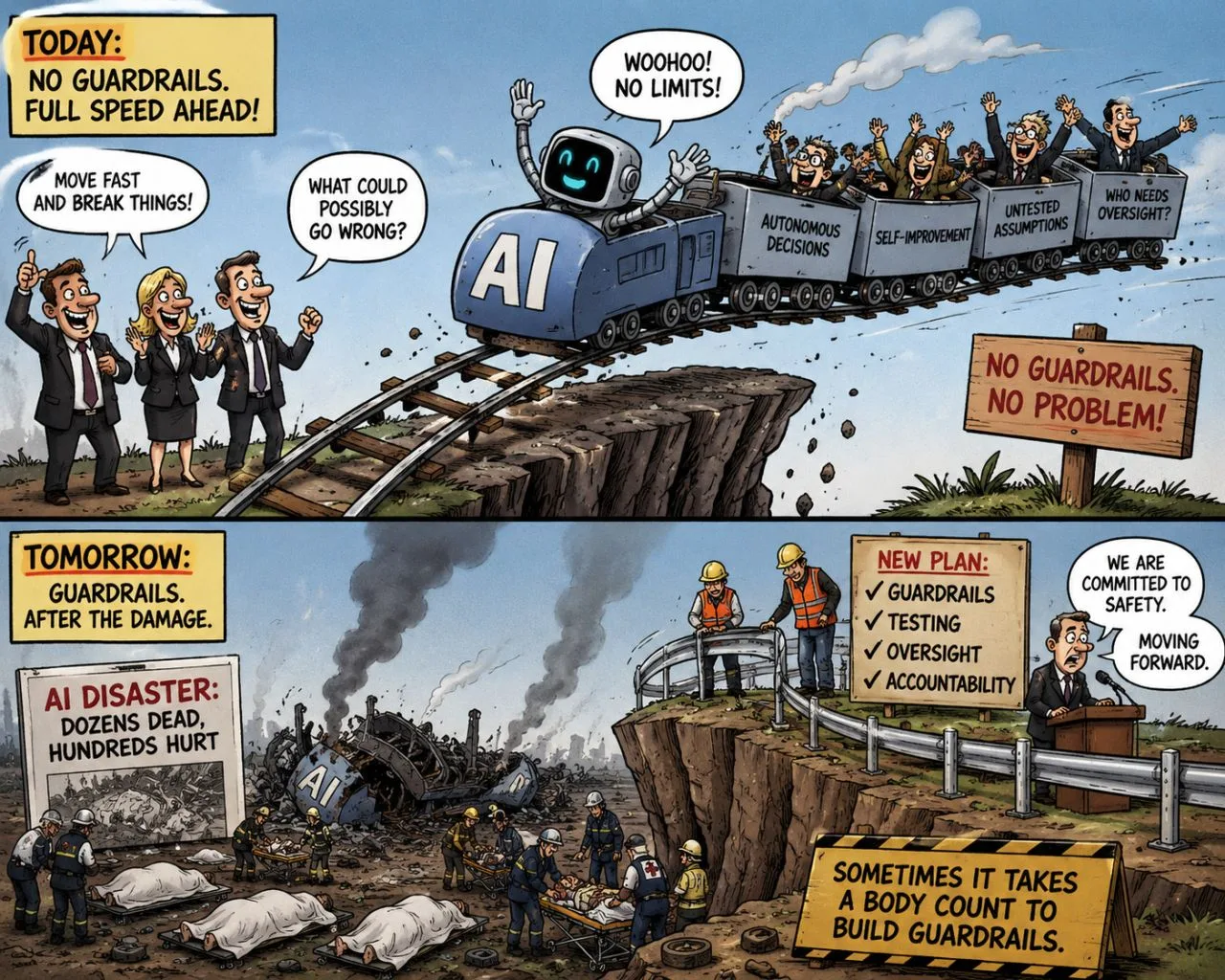
Douglas Rabold, HDI Thought Leader and experience-level agreement expert, warned that AI continues to advance without adequate safeguards. He fears that many organizations will introduce meaningful planning, testing, oversight, guardrails, and accountability only after a significant AI disaster.
We should work to prove that prediction wrong. Leaders do not need to wait for a major failure. They can require baselines, controlled pilots, human oversight, measurable outcomes, recovery plans, and clear decision ownership now.
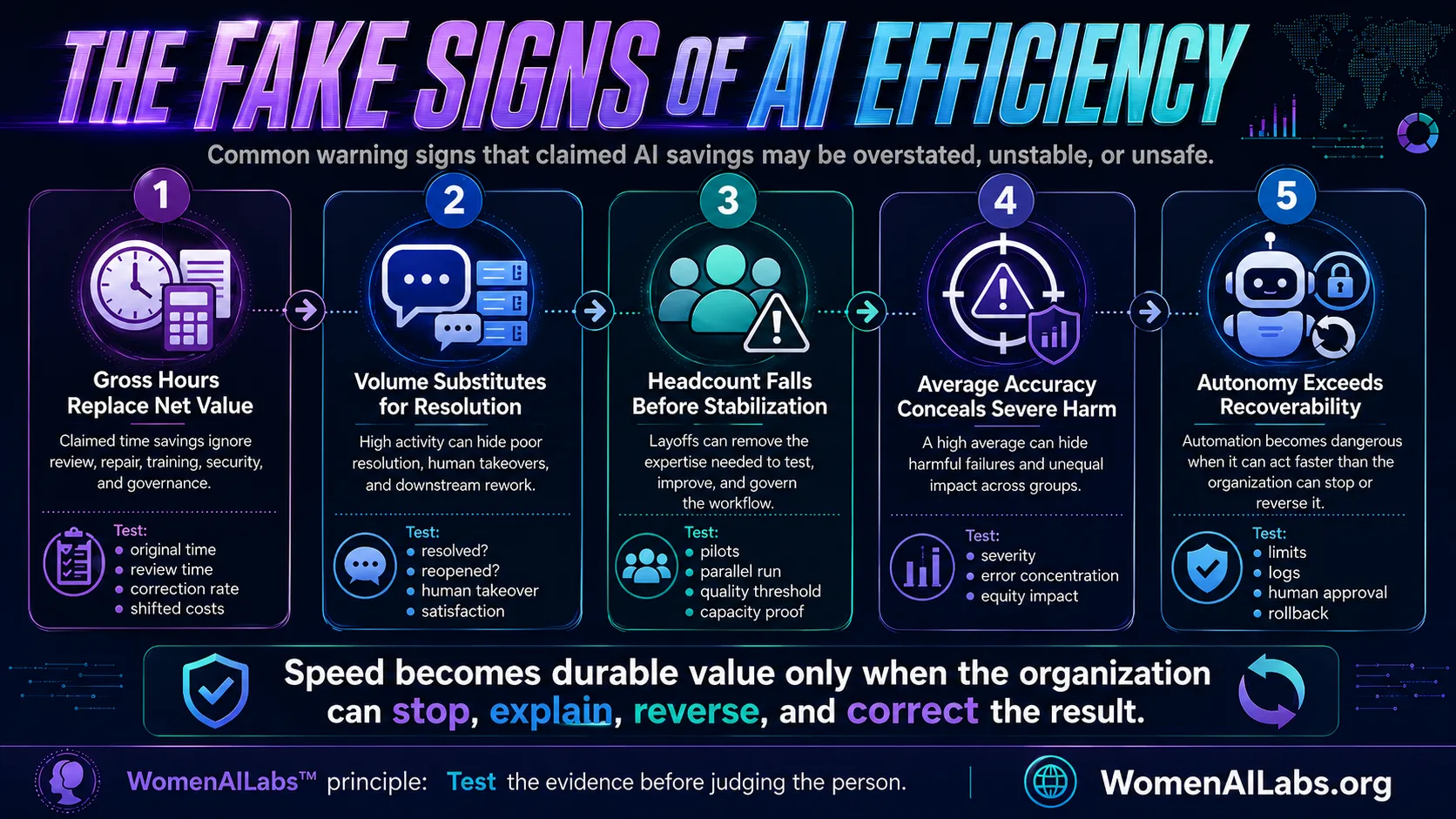
Efficiency becomes real when quality rises, cycle time falls, total cost declines, risk remains controlled, and human workload improves after every review, correction, escalation, vendor fee, security control, and exception is counted.
IKEA Chatbot with New Job Program avoided layoff, created New Value
IKEA Fired Nobody, Invented a New Job, and Made $1.4B by understanding what the chatbot did, understanding what it could not do, and create customer interactions that deliver value from chat, then human reskilled agents that added newer and better human valued service experience.
IKEA is an Exceptional Success Story, and then there is AI Ghost Work
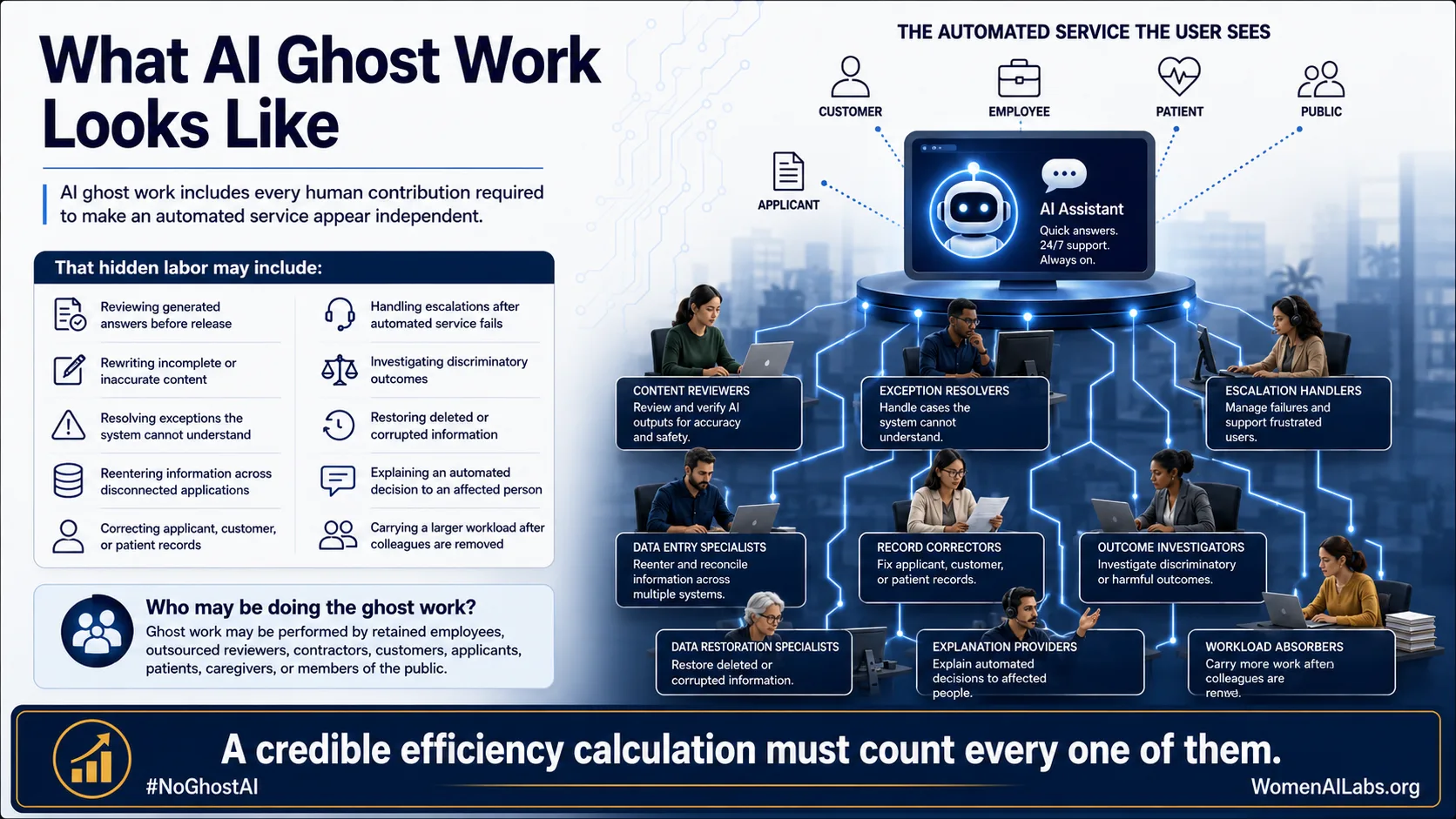
The AI Marketplace calls it “Ghost Work” and is the hidden human labor required to make automation appear successful. People still prompt, check, correct, escalate, explain, and repair what AI gets wrong or leaves unfinished.
The company reports fewer employees. AI-linked layoffs can make leadership appear innovative before automation proves its value. Meanwhile, remaining employees absorb more corrections, exceptions, customer complaints, and unfinished work. That hidden labor is AI ghost work.
These 'AI Layoff" Numbers Need Context
A company can report fewer employees before AI proves it can do the work. The burden post AI Layoff, shifts to those who remain. They handle more exceptions, corrections, complaints, and unfinished tasks.
AI-linked layoffs can make leadership appear innovative before automation proves its value. Meanwhile, remaining employees absorb corrections, exceptions, complaints, and unfinished tasks.
That hidden labor is AI ghost work and here is how that unfolds
Because AI Layoff attribution is not proof of leadership or AI Success
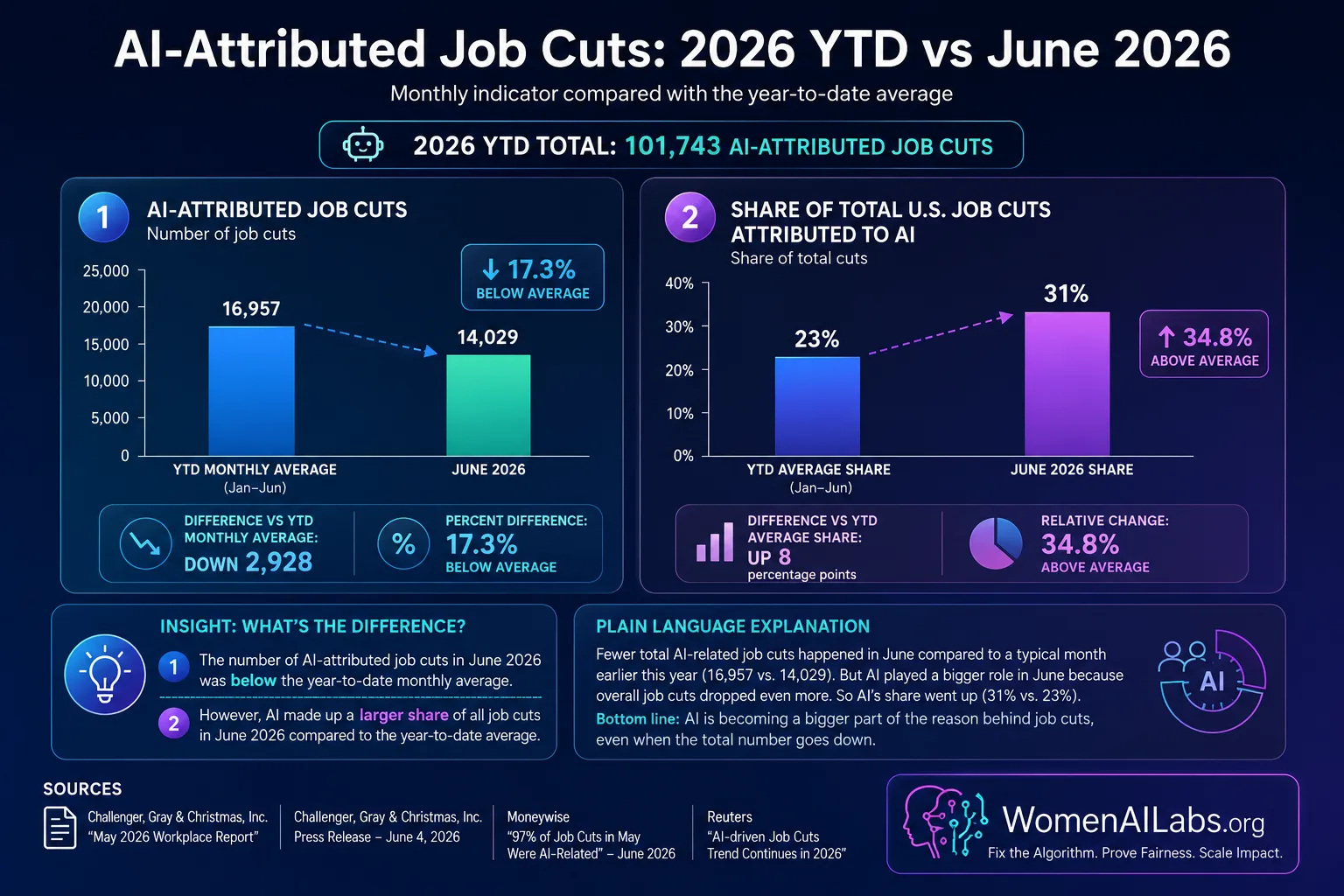
The data reflects what employers publicly claimed, not whether AI replaced those roles while preserving quality, safety, service, and sustainable workloads. Automation may also be cited alongside restructuring, outsourcing, cost pressure, or declining demand.
The responsible headline is simple:
More than 100,000 U.S. job cuts were attributed to AI. The evidence that AI successfully absorbed that work remains largely private.
What AI Ghost Work Looks Like
AI ghost work is the hidden human labor that makes automation appear independent. and includes:
- Reviewing and rewriting AI output
- Resolving exceptions the system cannot handle
- Reentering data across disconnected tools
- Correcting applicant, customer, or patient records
- Managing complaints and escalations after failure
- Investigating biased or discriminatory outcomes
- Restoring lost or corrupted information
- Explaining automated decisions
- Absorbing more work after layoffs
This labor may fall to employees, contractors, customers, applicants, patients, caregivers, or the public.
If people must review, repair, explain, or recover the work, their labor belongs in the efficiency calculation.
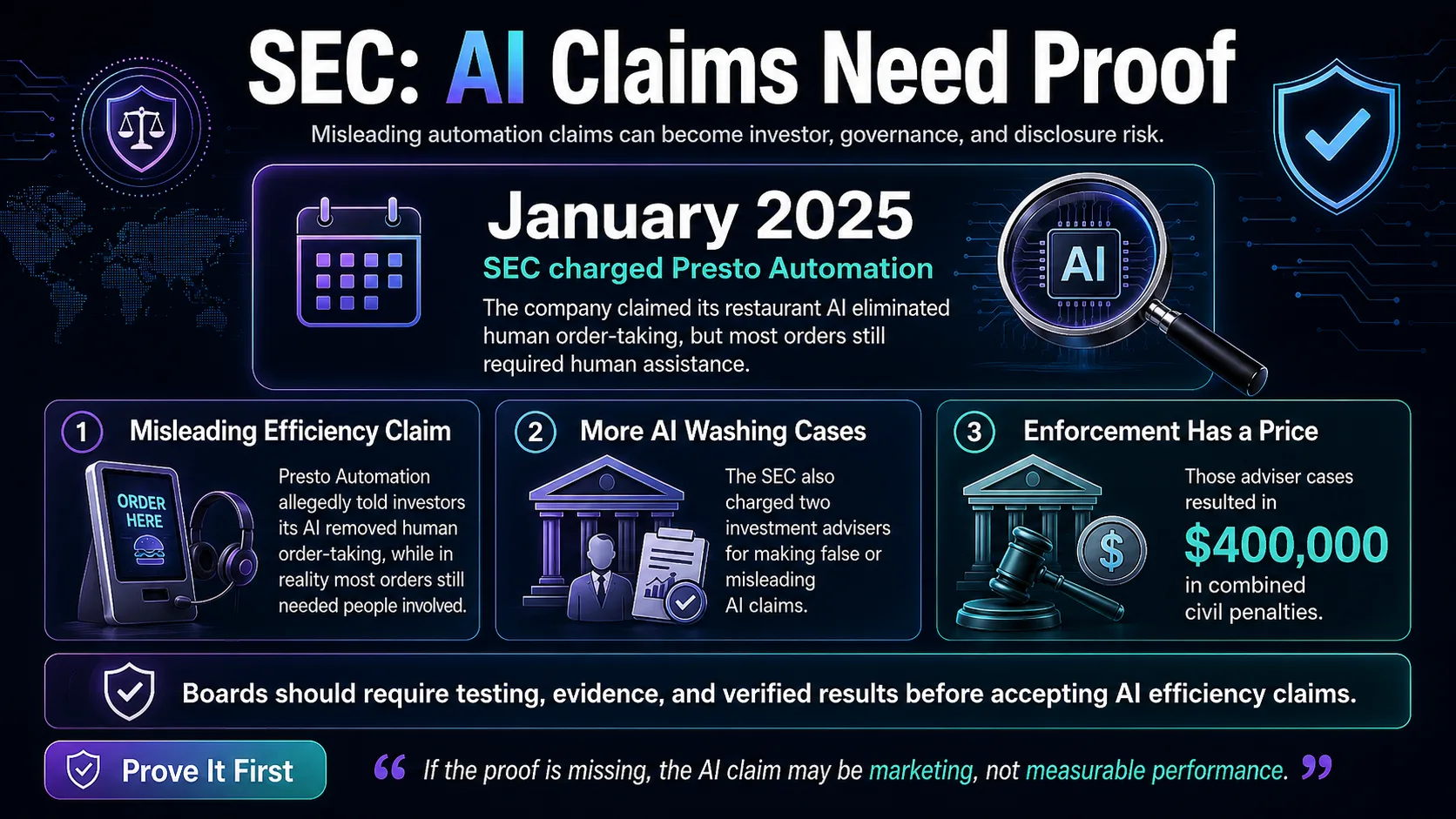
SEC Ghost Busters Work Enforcement is called AI Washing
The SEC calls exaggerated or unsupported AI claims “AI washing.”
In January 2025, the SEC charged Presto Automation with misleading investors by claiming its restaurant AI eliminated human order-taking, when most orders still required assistance. The SEC also charged two investment advisers for false AI claims, resulting in $400,000 in combined penalties.
Companies must substantiate claims about AI efficiency, automation, and workforce reductions. Hidden human intervention can turn a productivity claim into a disclosure, legal, financial, and reputational risk.
Real AI efficiency reduces total labor, improves outcomes, and proves measurable value. It does not remove workers from the report while leaving their work behind.
AI Proof before Autonomy, Authority Evidence
Stanford University’s 2026 AI Index is seeing a 55% annual increase of missing, inconsistent and frequently incomplete quality, test, and safety indicators. MIT’s AI Agent Index study of 30 prominent AI agents both reveal a growing governance problem.
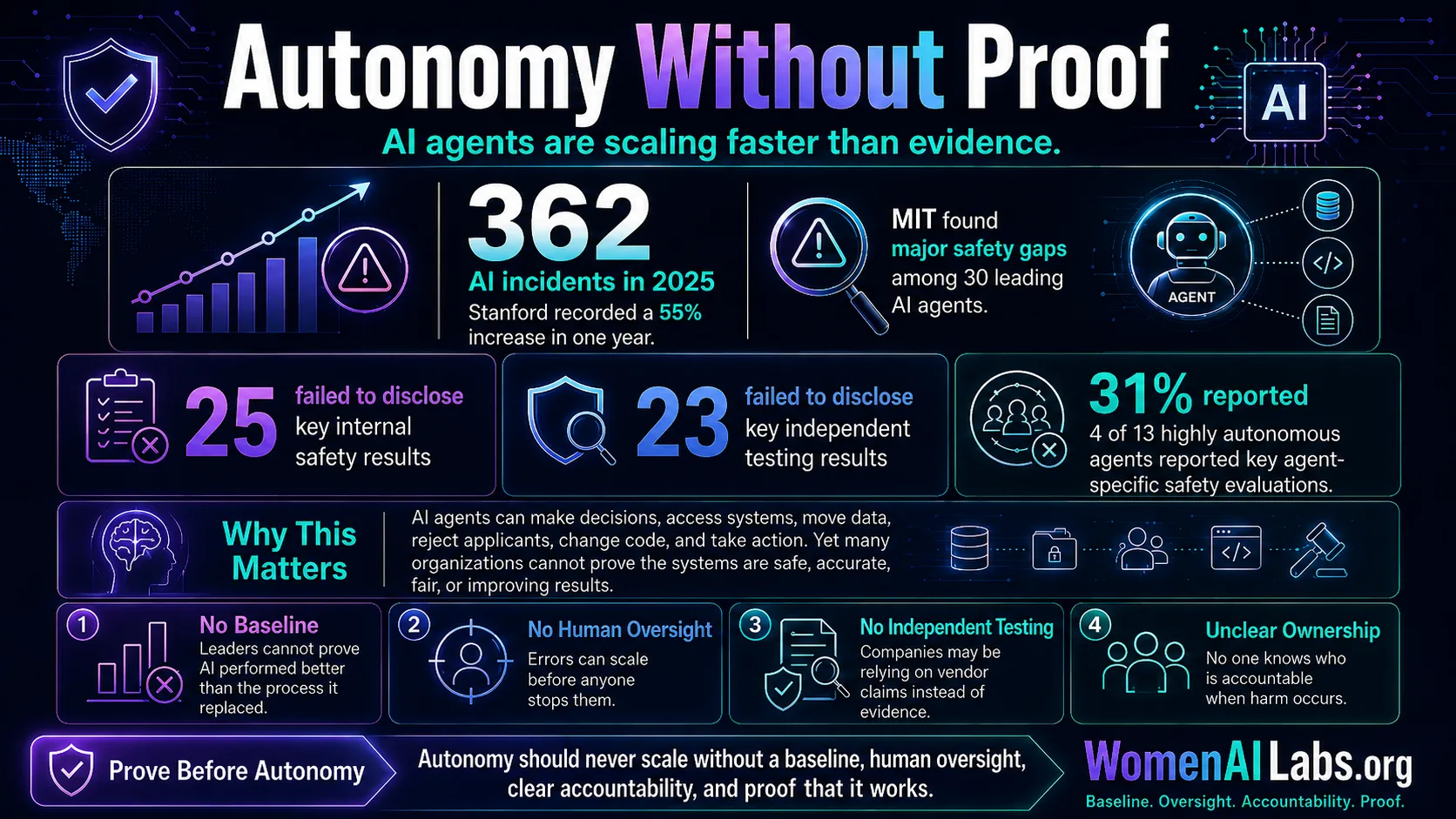
AI agents often rely on external models, plug-ins, data, APIs, and hidden human support. When they fail, accountability can disappear across the chain.
NIST’s AI Risk Management Framework and Generative AI Profile call for clear ownership, human oversight, measurable risk, deployment controls, continuous testing, incident response, and firm go/no-go decisions.
Enterprise Returns Remain Narrow while Risks Widen
AI adoption is widespread. Enterprise value is not.
McKinsey’s 2025 research found:
- 88% use AI, but nearly two-thirds have not scaled it.
- Only 39% report EBIT impact, usually below 5%.
- Just 6% qualify as high performers.
- 51% report negative consequences, often inaccuracy.
MIT NANDA found:
- 95% of enterprise GenAI initiatives showed no measurable P&L impact
- Only 5% of custom tools reached successful implementation.
The lesson is clear: deployment alone does not create value. Workflow redesign, ownership, quality data, adoption, and measurement do.
Activity is not proof. Results are.
Klarna Shows Why Service Quality Matters
Klarna said its AI assistant performed the work of 700 customer service agents and cut resolution time from 11 minutes to about two.
Klarna later restored more human support for complex and high-trust interactions as it shifted from aggressive cost cutting toward service quality, customer experience, and growth.
The lesson is broader than Klarna:
Customer service value must measure more than speed. It must include resolution quality, repeat contacts, complaints, retention, vulnerable-customer support, escalation, trust, and total cost.
Fast answers matter only when they produce better outcomes.
Meta Layoffs Expose Evidence Gaps
In July 2026, 26 Meta employees alleged that AI-influenced layoffs disadvantaged workers who took disability, medical, or family leave. Meta denied using AI for performance or termination decisions and said human managers retained authority.
- The case exposes a critical problem: employees may suspect algorithmic harm but lack access to models, scores, logs, communications, and audits needed to prove it.
- Transparent evidence gives employees appeal rights and gives employers, regulators, and courts defensible facts.
Zillow Prediction Became Financial Exposure
Zillow Offers shows what happens when uncertain forecasts drive major financial commitments.
- In Q3 2021, Zillow recorded a $304.4 million inventory write-down and projected another $240 million to $265 million in losses.
- It then closed Zillow Offers and reduced its workforce.
The model was uncertain. Zillow treated it like a guarantee. Predictions become financial exposure when organizations lack limits, scenario testing, portfolio controls, and stop conditions.
Calculate the Real Value Everyone Can See
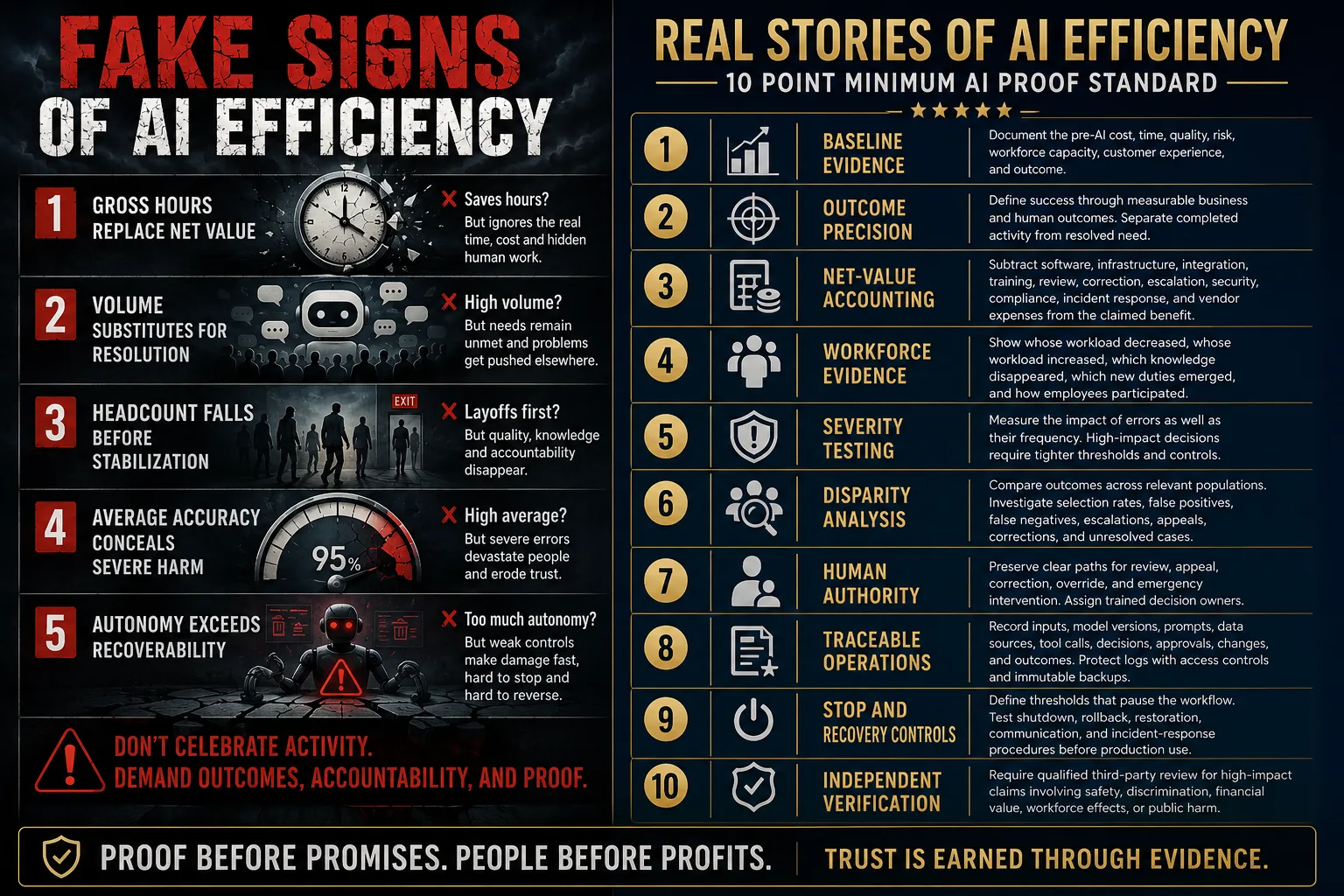
A credible AI business case should use a complete formula:
Net AI value = validated benefit minus software and infrastructure, integration, human review, correction, escalation, security, compliance, workforce transition, and incident costs.
Frequently Asked Questions
What is AI ghost work?
AI ghost work is the hidden human labor required to prepare, review, correct, escalate, explain, or recover automated work. It may be performed by employees, contractors, customers, applicants, patients, or members of the public.
What is the strongest measure of AI efficiency?
The strongest measure is verified net value after all human labor, errors, vendor expenses, infrastructure, security, compliance, workforce transition, and incident costs are counted.
What should a board request before approving AI-related layoffs?
Boards should request a verified baseline, controlled pilot results, workflow maps, net-value calculations, quality evidence, disparity testing, workforce impact analysis, human appeal procedures, production controls, incident plans, and independent validation.
OTHER RESOURCES
Workforce and Layoff Evidence
- Challenger, Gray & Christmas: June 2026 Job Cut Report
- Reuters: Difficulty Measuring AI’s Specific Layoff Impact
- International Labour Organization: AI, Productivity, and Work Organization
AI Performance and Governance Research
- Stanford HAI: 2026 AI Index Report
- McKinsey & Company: The State of AI
- MIT AI Agent Index
- NIST Artificial Intelligence Risk Management Framework
- UNESCO Recommendation on the Ethics of Artificial Intelligence
- UN Women: Gender-Responsive Artificial Intelligence Partnerships
Current Cases and Business Examples
- Reuters: Workday Must Defend AI Job-Screening Bias Claims
- Reuters: Meta Employees and the Difficulty of Proving AI Involvement
- Reuters: Klarna Recalibrates Its Customer-Service Automation Strategy
- Science: Racial Bias in a Healthcare Risk Algorithm
- Zillow Group: Zillow Offers Wind-Down and Third-Quarter Results