Support Fair Labor Today learn worker history, understand employment rights, support ethical businesses, discuss pay openly, recognize unpaid care, invest in career access, challenge workplace bias and audit employment AI.
Women Always Built Work
To support fair labor, we must first tell the whole story.
Women were never absent from the workforce. They worked in homes, fields, factories, hospitals, schools, offices and communities. They raised families, organized workers, built businesses and strengthened entire economies. Yet history did not always record, reward or value their labor equally.
History itself does not choose whom to marginalize. However, the institutions that documented work, assigned pay, selected leaders and defined valuable labor often made women less visible. Some exclusions were deliberate. Others grew through inherited practices, incomplete data, unequal access and decisions nobody stopped to question.
Either way, the outcome matters.
Women have made extraordinary progress. Nevertheless, the world remains far from parity. At the current pace, the World Economic Forum estimates that achieving full global gender parity will take another 123 years, or approximately five generations. Economic participation and opportunity could take even longer. Review the Global Gender Gap Report 2025.
WomenAILabs refuses to wait 123 years.
We are building a five-year action plan to identify, name, measure and remediate the intentional and unintentional harms that restrict women’s pay, visibility, advancement, safety and access to opportunity.
That means moving beyond awareness.
We must find where inequity enters the system. We must listen to the people experiencing it. Then, we must correct the process, test the result and prove that lives improved.
Labor Day gives us the perfect place to begin. It honors the workers who made progress possible while challenging us to continue the work they started.
Remember the women. Recognize the gap. Repair the system. Accelerate parity.
What Is Labor Day?
Labor Day is a federal holiday observed on the first Monday in September. It recognizes the social and economic contributions workers make to the United States.
The first recognized Labor Day celebration occurred in New York City on September 5, 1882. Thousands of workers marched together before gathering for speeches, music and community events. Congress eventually established Labor Day as a federal holiday in 1894. Explore the history of Labor Day.
However, the holiday emerged from hardship.
Many people worked long hours in unsafe factories, mines, railroads and mills. Children worked beside adults. Employers could dismiss people for organizing or demanding better conditions.
Therefore, Labor Day did not begin as a sale or the unofficial end of summer. Workers created it to make their labor, humanity and demands visible.
How Did Women Build Labor History?
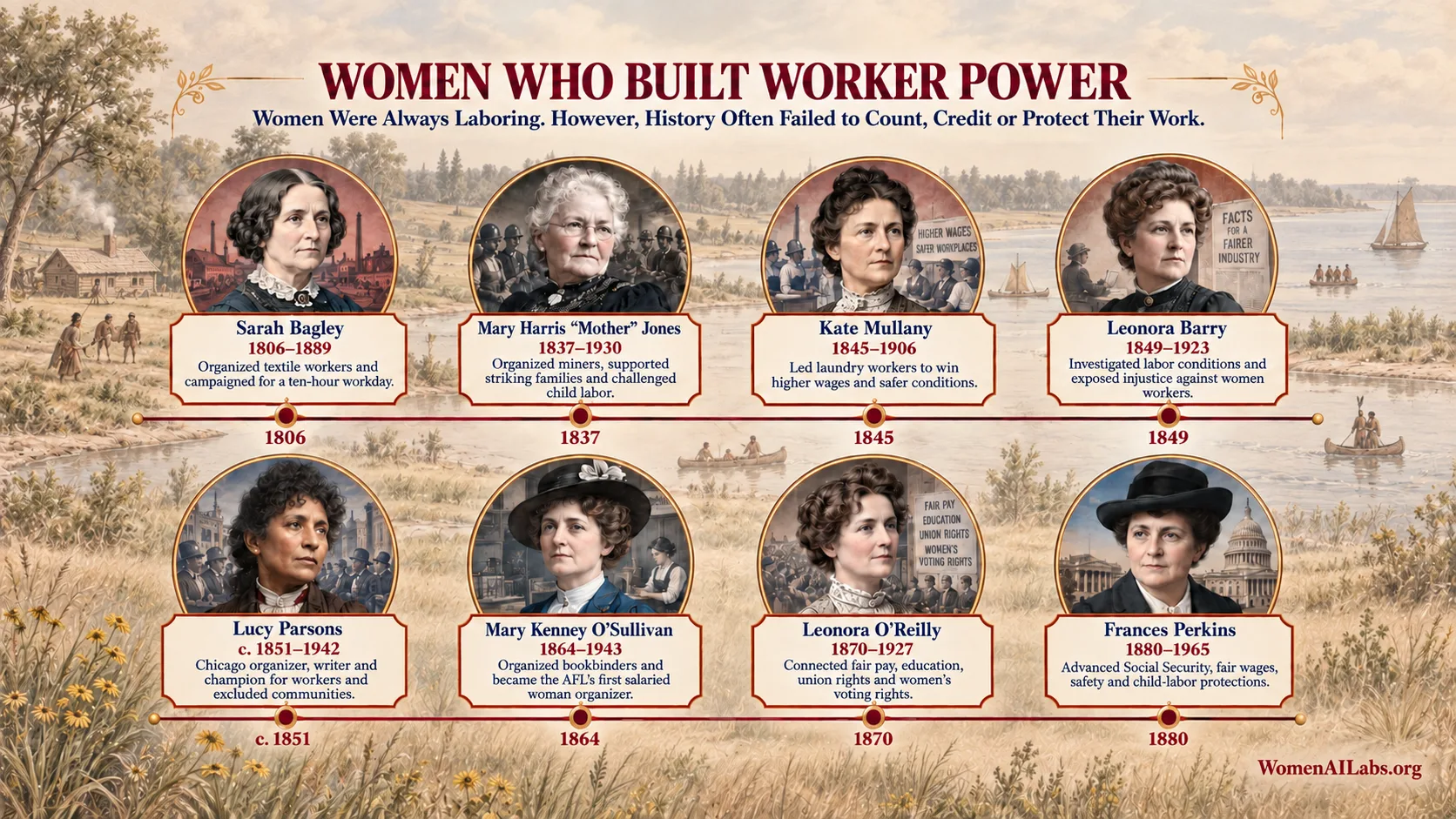
Women organized long before the federal government recognized Labor Day. They led strikes, formed unions, investigated workplace abuse, raised relief funds and sustained families while labor campaigns continued.
Select each woman’s name to explore her story:
- Sarah Bagley | 1806–1889
Bagley organized textile workers and led the campaign for a ten-hour workday. - Kate Mullany | 1845–1906
Mullany organized hundreds of laundry workers and led a successful strike for higher wages and safer working conditions. - Leonora Barry | 1849–1923
Barry became the first woman paid to investigate labor conditions. She exposed low wages, unsafe workplaces and the mistreatment of women workers. - Lucy Parsons | c. 1851–1942
Parsons became a powerful Chicago organizer, writer and speaker who championed workers, women, immigrants and impoverished communities. Historians continue to debate details of her early life and birth year. - Mary Kenney O’Sullivan | 1864–1943
O’Sullivan organized women bookbinders and became the American Federation of Labor’s first salaried female organizer. - Leonora O’Reilly | 1870–1927
O’Reilly entered factory work at age 11. Later, she connected fair pay, education, union rights and women’s voting rights. - Mary Harris “Mother” Jones | 1837–1930
Mother Jones organized miners, supported striking families and challenged the exploitation of child laborers. - Frances Perkins | 1880–1965
Perkins became the first woman to serve in a presidential Cabinet. She helped advance Social Security, minimum wages, overtime protections, workplace safety and restrictions on child labor.
Yet these recognized leaders represent only part of the story.
Black laundresses, immigrant garment workers, domestic workers, nurses, teachers, farmworkers, caregivers and factory workers also built the movement. Although history failed to preserve many of their names, their labor and organizing changed America.
Women did not simply participate in labor history.
Women helped build it.
What Does Fair Labor Look Like Today?
Today, people work in offices, hospitals, schools, restaurants, warehouses, homes, vehicles, factories and digital platforms. Some employees work remotely. Others receive assignments through an application.
Meanwhile, artificial intelligence increasingly influences who employers recruit, interview, hire, schedule, evaluate, promote or dismiss.
The workplace has changed. However, the defining questions remain:
- Who receives opportunity?
- Who makes the decision?
- Who benefits from productivity?
- Who carries the risk?
- Who gets heard?
- Who can challenge an unfair outcome?
Fair labor today requires safe working conditions, equitable compensation, accessible career opportunities, responsible benefits and meaningful worker participation.
Additionally, it requires responsible technology.
What Does the Evidence Show?
Current evidence reveals several continuing challenges:
- In 2025, women working full time earned median weekly wages of $1,089, compared with $1,326 for men. Therefore, women earned approximately 82.1% of men’s median weekly earnings. Review the U.S. Bureau of Labor Statistics earnings data.
- Women averaged 2.38 hours of household activities per day in 2025, compared with 1.58 hours for men. Explore the BLS American Time Use Survey.
- The EEOC processed 88,201 new discrimination charges and resolved 90,743 charges during fiscal year 2025. Read the EEOC’s fiscal year 2025 results.
- Researchers have found racial and gender disparities in some automated résumé-screening and candidate-selection systems. Review findings from the University of Washington and Stanford Institute for Human-Centered AI.
These findings do not prove that every employer or technology produces the same result. Instead, they show why organizations must test each policy, system and employment workflow.
Choose Your Action Path
Workers and employers hold different responsibilities. Therefore, each group needs a clear path forward.
| Workers and allies | Employers and leaders |
|---|---|
| Learn your workplace rights | Complete a fair-labor assessment |
| Save evidence of suspected bias | Examine pay and promotion outcomes |
| Request an accessible process | Remove unnecessary employment barriers |
| Ask for human reconsideration | Audit automated hiring systems |
| Mentor or sponsor someone | Fund training and returnship programs |
| Report recurring harm | Protect workers who raise concerns |
| Submit a WomenAILabs challenge | Publish corrective actions and results |
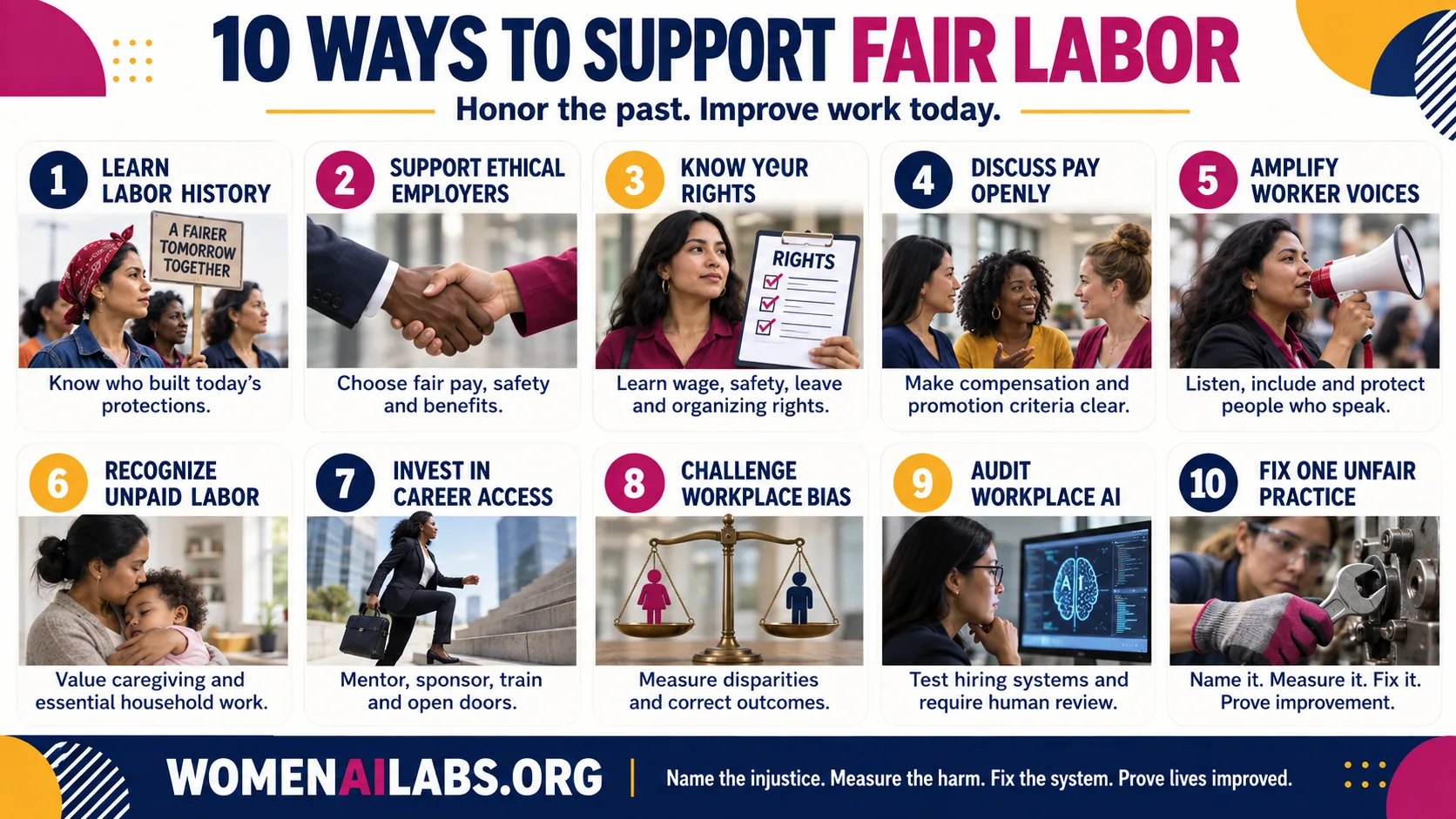
Then apply the WomenAILabs Fair Labor Action Cycle:
- See the barrier.
- Name the injustice.
- Measure the harm.
- Include affected workers.
- Fix the system.
- Test the outcome.
- Publish the evidence.
- Scale what works.
This WomenAILabs framework provides an action methodology. It does not replace independent research, legal review or statistical validation.
Test Your Enterprise Applicant Tracking System
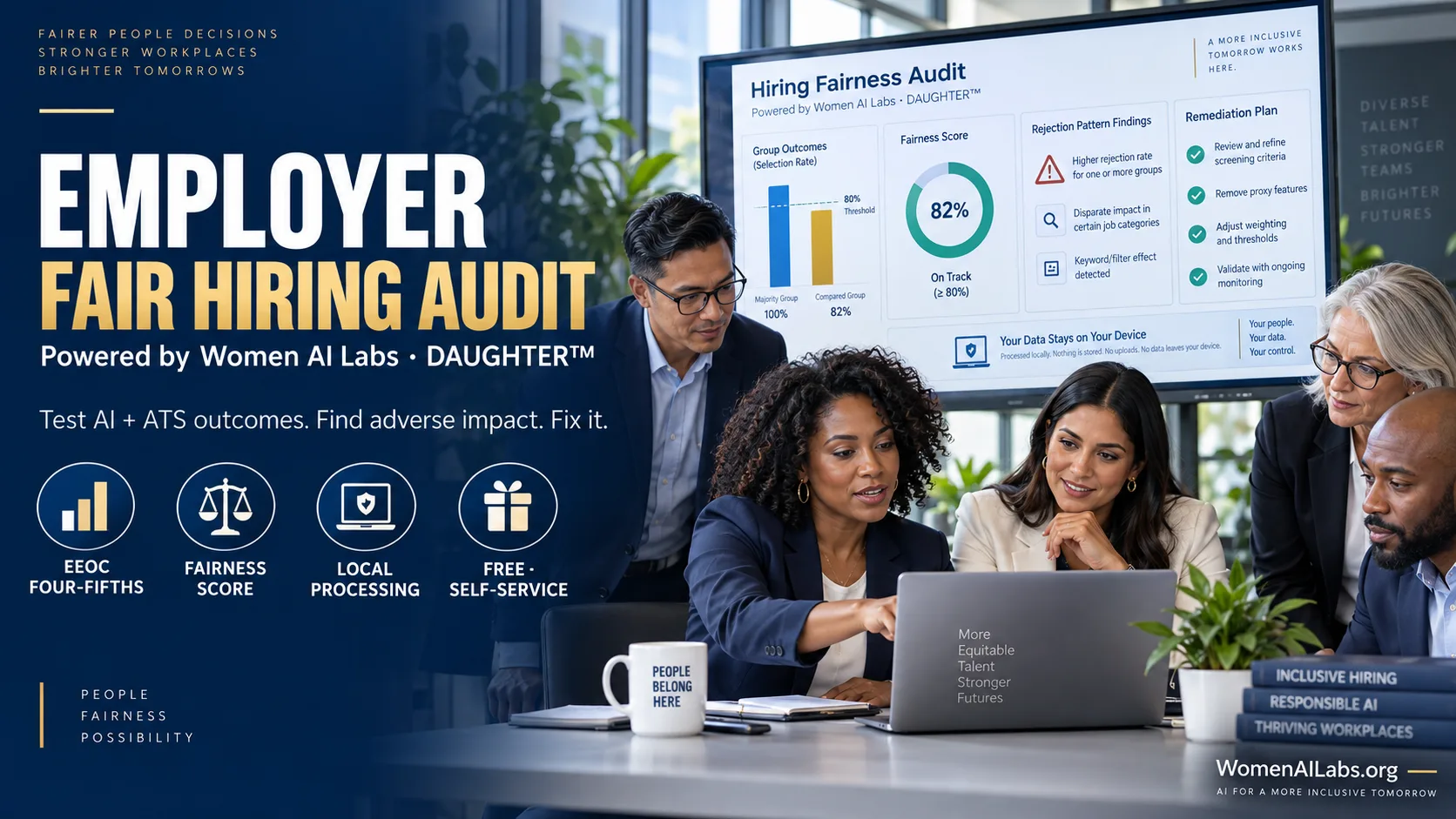
Use this Fair Hiring Audit Tool to identify immediate risks from candidate reports of rejected applications.
Answer yes or no:
- Do candidates know when automation evaluates them?
- Can applicants request an accessible alternative?
- Can rejected candidates request human reconsideration?
- Has the employer tested demographic selection rates?
- Does each screening criterion measure an actual job requirement?
- Has the employer tested whether career gaps affect results?
- Must technology vendors provide validation evidence?
- Can a trained reviewer reverse the automated recommendation?
- Does the organization investigate qualified applicants who receive automatic rejections?
- Does leadership review fairness results and corrective actions?
Fair Hiring Readiness
- 8–10 yes answers: Leading
- 5–7 yes answers: Improving
- 0–4 yes answers: High risk
A high score does not prove compliance or fairness. However, a low score reveals an urgent need for stronger governance.
Ask for Human Review
Applicants rarely know whether a recruiter, knockout question, applicant-tracking rule or AI model rejected them.
Use this request:
Please confirm whether an automated system materially influenced my application. I would also like to know which job-related qualifications the system evaluated and whether human reconsideration is available.
When a disability affects the application or assessment process, consider requesting an accommodation:
I am requesting an accessible alternative to the automated assessment as a reasonable accommodation. Please explain the available process.
These templates provide general information, not individual legal advice.
Illinois AI Hiring Rights
Illinois applicants and employees receive additional protections.
Effective January 1, 2026, Illinois Public Act 103-0804 amended the Illinois Human Rights Act. It prohibits employers from using AI in employment decisions when that use causes unlawful discrimination. It also addresses notice and the use of ZIP codes as proxies for protected characteristics. Read Illinois Public Act 103-0804.
Additionally, the Illinois Artificial Intelligence Video Interview Act requires covered employers to provide notice, explain how AI evaluates recorded interviews and obtain applicant consent before using the analysis. Read the Illinois Artificial Intelligence Video Interview Act.
However, these protections do not guarantee that a person will review every résumé. Federal and state civil-rights protections still apply when automated screening causes unlawful discrimination.
Who Faces Compounding Barriers?
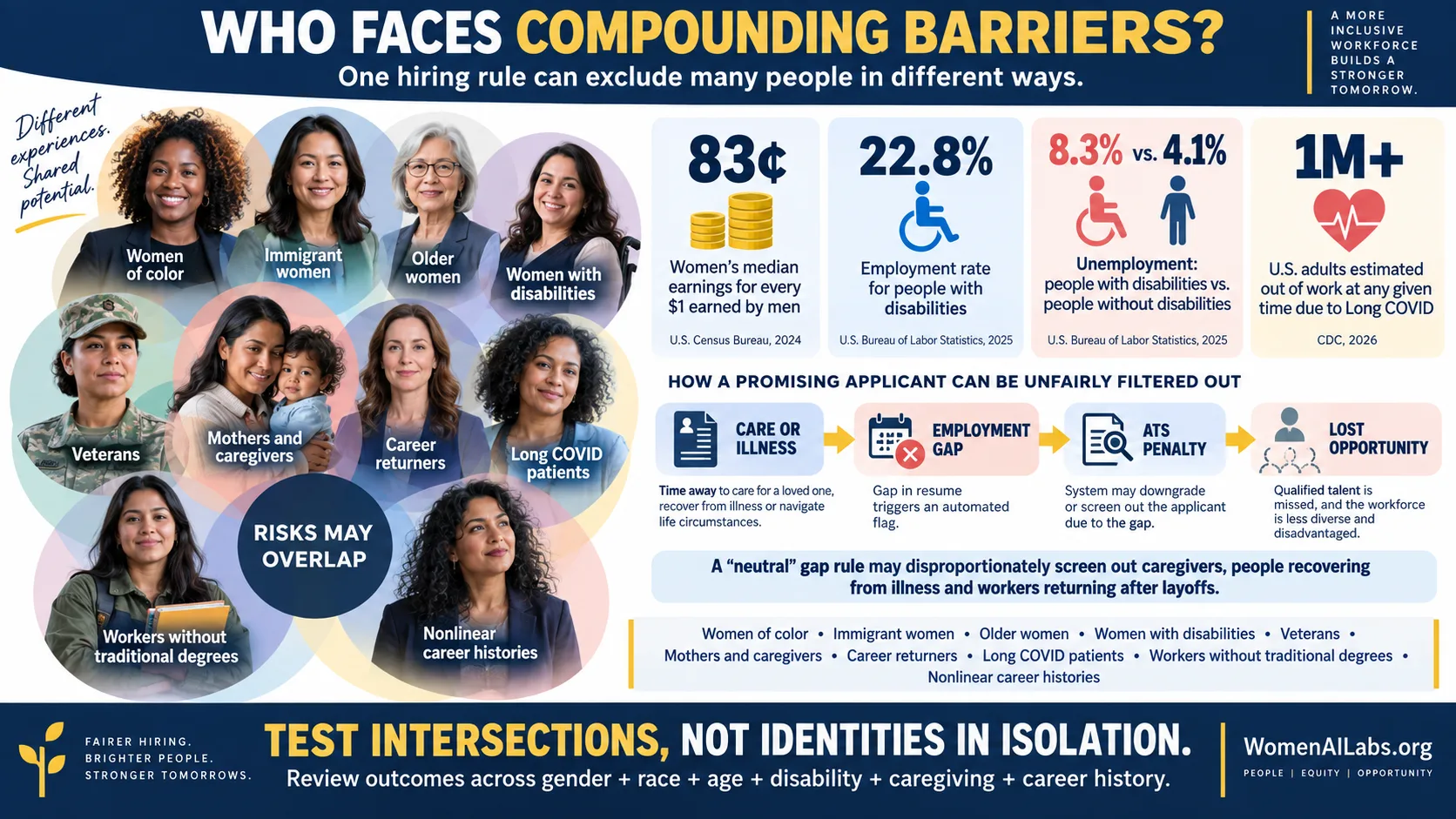
Automated employment systems may create different risks and harms:
For example, an automated system may treat an employment gap as a negative signal. That rule may disproportionately affect caregivers, people recovering from illness and workers returning after a layoff.
Therefore, employers must test intersectional outcomes rather than reviewing gender, race, age and disability in isolation.
Why Does Fair Labor Help Business?
Fair labor does more than reduce legal and reputational risk.
It can also help organizations:
- Reach a larger qualified-talent pool
- Improve candidate trust
- Retain experienced employees
- Strengthen workforce data
- Reduce avoidable turnover
- Improve employer reputation
- Make better hiring decisions
- Build more trustworthy AI
- Protect institutional knowledge
- Share productivity gains more fairly
When employers remove irrelevant barriers, they do not lower standards. Instead, they focus hiring on the qualifications that truly predict success.
Help Build the Evidence
WomenAILabs seeks to turn individual experiences into measurable evidence and practical solutions.
A proposed anonymous “Did AI Reject You?” research initiative could examine:
- Applicant location and demographic information
- Position and industry
- Applicant qualifications
- Speed of rejection
- Employer disclosure of automation
- Career gaps or nonlinear experience
- Availability of human review
- Accommodation requests
- Reconsideration outcomes
WomenAILabs should publish the research questions, methodology, sample size, limitations and anonymized findings. This transparency will allow researchers, employers, policymakers and communities to evaluate the evidence responsibly.
Submit a Fair-Labor Challenge
What unfair labor practice should we fix first?
Submit challenges involving:
- Automated résumé rejection
- Pay inequity
- Caregiver penalties
- Age-related screening
- Inaccessible applications
- Unfair promotion decisions
- Biased performance scoring
- Algorithmic workforce monitoring
- Unexplained layoff selection
- Missing career pathways
Then help the community prioritize the work.
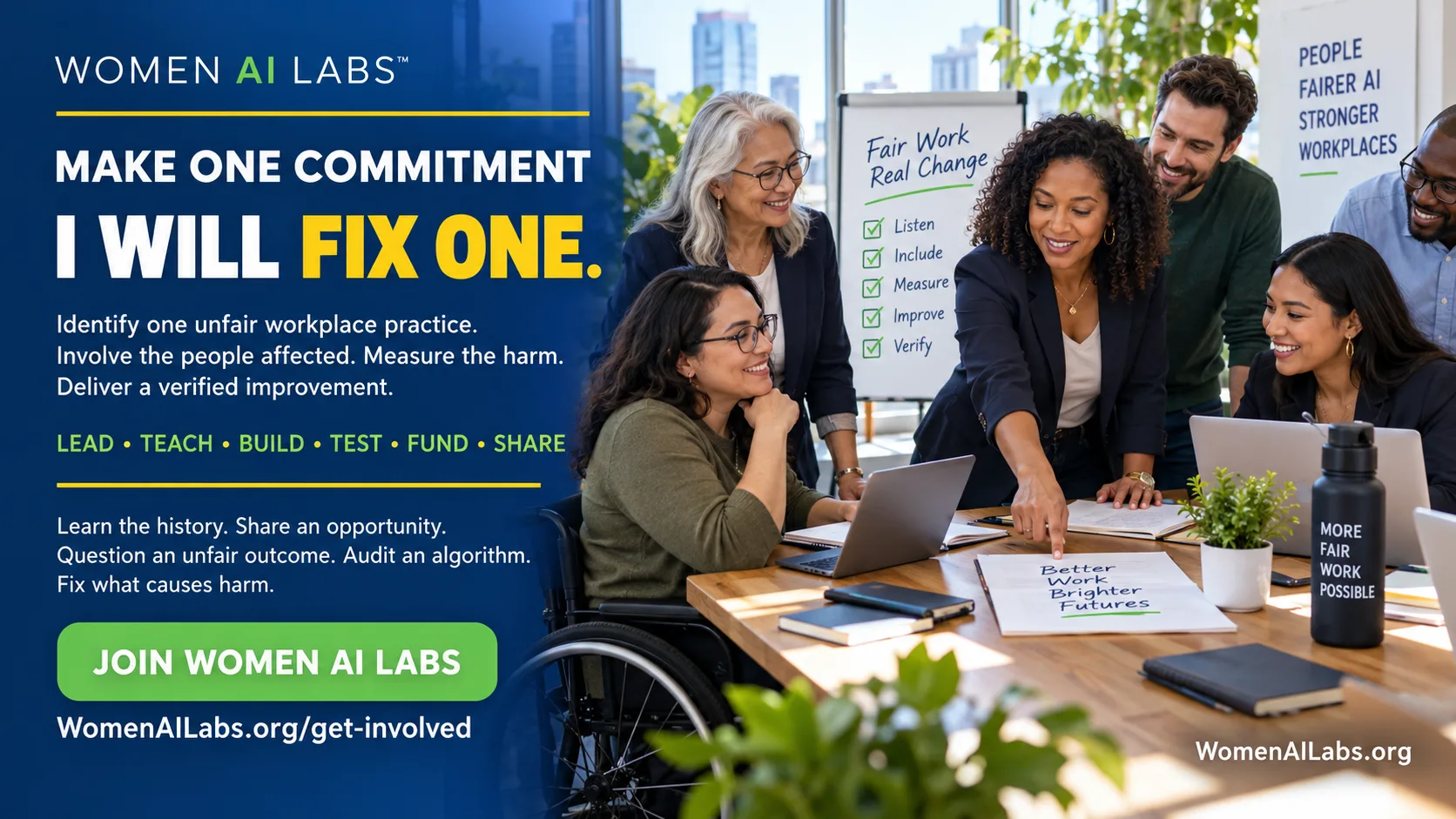
Participants can:
- Lead a challenge
- Support a team
- Teach what they know
- Research laws and evidence
- Build and test solutions
- Fund responsible innovation
- Share opportunities
- Measure outcomes
Frequently Asked Questions
Why does Labor Day exist?
Labor Day recognizes the social and economic contributions of American workers. It also honors the labor movement that fought for safer workplaces, reasonable hours, fair wages and stronger worker protections.
How can individuals support fair labor?
Individuals can learn worker history, understand employment rights, support ethical employers, discuss pay, mentor job seekers, amplify worker concerns and challenge unfair practices.
How can employers support fair labor?
Employers can provide transparent compensation, safe conditions, accessible career pathways, responsible benefits, worker participation and accountable employment technology.
Why should employers audit hiring AI?
Automated hiring systems can apply irrelevant criteria, reproduce historical disparities or reject qualified candidates before a recruiter reviews them. Audits help employers identify adverse impact, correct harmful processes and verify better outcomes.
Does human review guarantee fair hiring?
No. People can repeat or reinforce an automated recommendation. Employers need trained reviewers, documented criteria, independent evidence and the authority to reverse unfair results.
How does Women AI Labs support fair labor?
Women AI Labs connects people who identify algorithmic bias, measure its human impact, build practical solutions and demonstrate better outcomes in hiring and other high-impact systems.
Sources and Methodology
This article separates independent evidence from organizational advocacy.
Independent statistical, legal and historical sources
- U.S. Bureau of Labor Statistics earnings data
- BLS American Time Use Survey
- U.S. Department of Labor history
- U.S. Department of Labor major-laws guide
- U.S. Equal Employment Opportunity Commission
- National Labor Relations Board
- Illinois General Assembly
- University of Washington résumé-screening research
- Stanford Institute for Human-Centered AI hiring research
Resources
WomenAILabs and DawnCSimmons.com provide original frameworks, education, advocacy and solution-building resources. Government data and independent academic research support the article’s primary statistical and legal claims.
WomenAILabs Fair Labor Principle
Name the injustice. Measure the harm. Fix the system. Prove that lives improved.