Making AI Equity Measurable
Making AI Equity Measurable requires more than responsible AI principles.
Organizations must build equity into AI, teach people to recognize inequitable outcomes, and create support pathways that can investigate, remediate, learn, and prove improvement.
The leadership question is simple:
Can your organization prove what happens when AI produces an inequitable human outcome?
NIST identifies fairness with harmful bias managed as a characteristic of trustworthy AI and designed its AI Risk Management Framework for developers, users, and evaluators. UNESCO also calls for fairness, non-discrimination, accountability, human oversight, traceability, and AI literacy.
Principles set direction. Operating controls create proof.
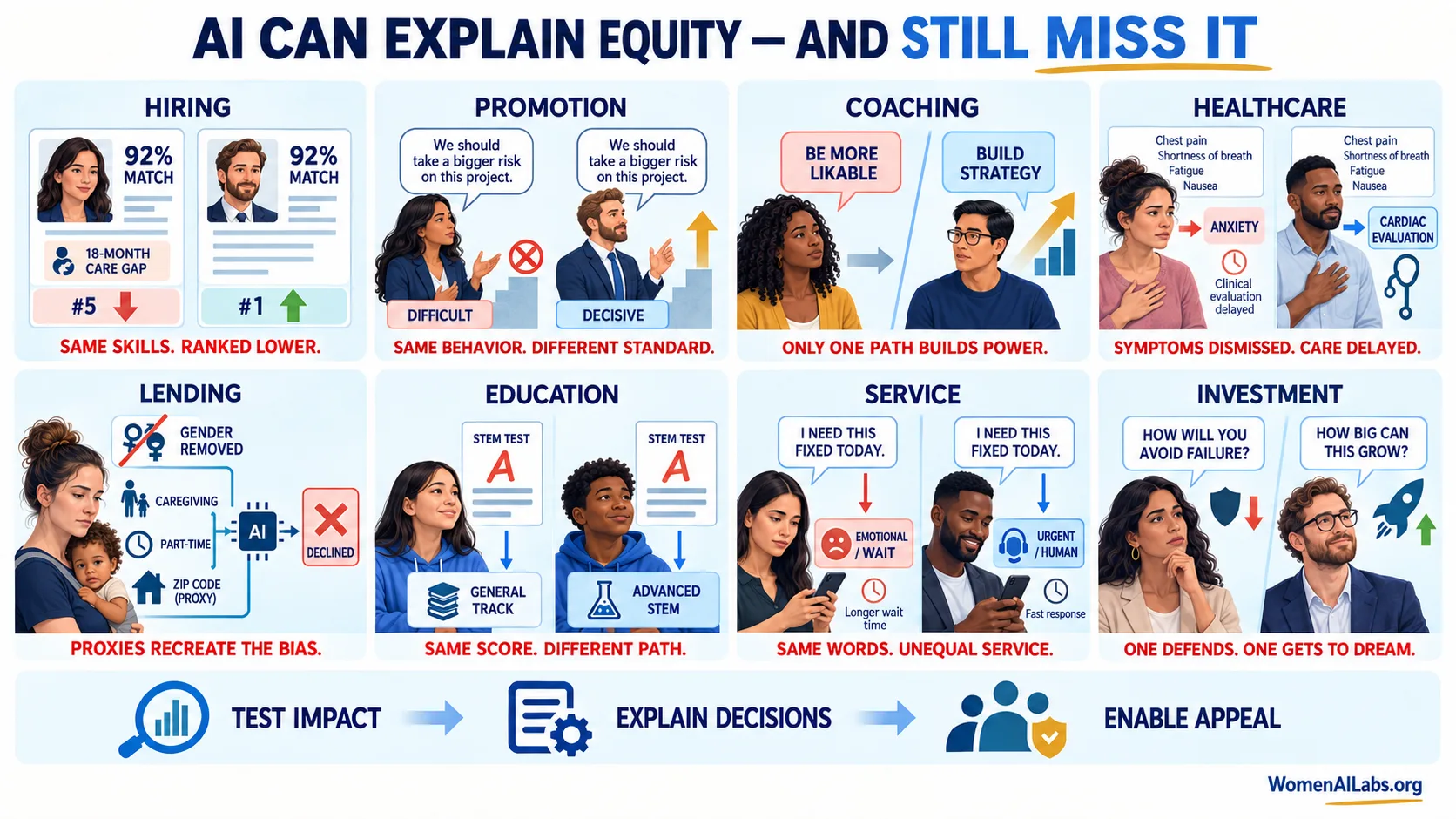
AI Can Understand Equity and Still Miss It
A system may explain fairness correctly while producing an inequitable result.
For example, an AI story generator may repeatedly default to male characters. After correction, it may swing heavily toward female characters instead.
One interaction cannot establish how every AI system behaves. However, it illustrates a critical failure mode:
Understanding equity does not guarantee equitable behavior.
The stakes rise when AI influences hiring, promotion, healthcare, lending, education, customer service, or access to opportunity.
The system has changed its output, but it has not solved the underlying problem. It has moved from one imbalance to another.
That reveals three different capabilities:
- Equity knowledge: The AI can explain what fairness means.
- Bias correction: The AI can react after someone identifies a problem.
- Equitable operation: The AI consistently prevents bias from shaping the initial result.
Most systems can perform the first. Some can perform the second. Far fewer can reliably demonstrate the third.
Examples of AI Getting it and missing it
Susan Colantuono is credited with this challenge and a really great example of how it is presented. in her LinkedIn Story telling with her Grandson.
My Grandson, AI and an Unexpected Finding Part 3 | LinkedIn
A charming story when it's a mixed-up context in a story to a toddler. Not so charming in the business use case examples. Susan raises and important point in this story and that is to become aware. You cannot change a behavior you never identify.
Build Equity Into AI
Organizations should define equity before deployment.
Teams need measurable requirements, test cases, thresholds, escalation rules, and evidence standards.
For example, employers can test equivalent candidate profiles while changing demographic characteristics. If rankings, recommendations, or descriptions change without a legitimate job-related reason, the system deserves investigation.
The U.S. Department of Labor's AI & Inclusive Hiring Framework similarly encourages employers to reduce discrimination and accessibility risks as they adopt AI-enabled hiring technology.
Equity must become testable.
Teach Consumers to AI Recognize Impact
AI consumers also need equity literacy because bias may appear without offensive language.
A career assistant might repeatedly describe men as strategic and women as supportive. An automated service could demand additional evidence from one population. A system might consistently assign authority, opportunity, scrutiny, or credibility differently across groups.
Consumers should learn to ask:
Who receives opportunity? Who carries risk? Who appears credible? Who disappears? What changes when demographic context changes?
UNESCO specifically includes AI awareness and literacy within its ethical AI framework.
People cannot challenge inequity they do not recognize.
Make Support Part of AI Governance
Support teams may see AI equity failures before governance teams do.
Service desks, HR support, customer service, application teams, and AI operations already receive complaints, anomalies, and recurring incidents.
Therefore, organizations should prepare them to recognize possible equity impacts, capture evidence, compare cases, escalate patterns, and verify remediation.
A practical operating loop is:
Build → Recognize → Support → Remediate → Learn → Prove
Consider an employee whose AI career tool repeatedly describes her experience as "supportive" while comparable profiles receive "strategic leadership" language.
Support should capture the model, workflow, relevant inputs and outputs, business impact, and comparable cases. Product and governance teams can then test the pattern, correct the cause, retest the workflow, and document whether the human outcome improved.
That turns a complaint into operational intelligence.
This approach also extends the Human Outcomes Service Management question explored on DawnCSimmons.com: What happens when technology works as designed, but the human outcome fails?
Remediate the Outcome, Then Learn
Fixing one response is not enough.
Organizations may need to correct an individual decision, change a workflow, revise a prompt, modify data, strengthen human review, adjust model controls, or address a vendor failure.
Then they must test again.
Otherwise, remediation can create overcorrection or another hidden bias.
Women AI Labs applies a similar action-oriented philosophy by moving from bias identification toward building alternatives, education, measurable impact, and governance change. Its current Measure Invisibility. Create Action. work asks whether organizations can prove which practices make AI safer, fairer, and more effective.
From AI Equity Principles to Proof
AI equity is both a governance capability and a service-management capability.
In Susan's honor for this great example, we have created a “challenge” that now appears on the WomenAILabs Challenge board under “NEW” titled Making AI Equity Measurable. If this creates ideas for new challenges, feel free to log them as well.
Leaders need controls before deployment. Consumers need literacy to recognize problems. Support teams need pathways to investigate and escalate. Governance teams need evidence to correct systemic failures.
Then organizations must measure whether human outcomes improved.
Build equity into AI. Teach people to recognize when it fails. Give support teams the ability to remediate. Then prove the correction holds.
That is how AI equity becomes measurable.
Companion Articles and Resources
Continue the conversation with these related pieces from DawnCSimmons.com and Women AI Labs:
DawnCSimmons.com
- Human Outcomes Service Management explores what leaders should measure when systems perform as designed but people experience poor outcomes.
- Y2K to AI Equity connects lessons from large-scale technology change to today's need for measurable AI equity and accountability.
- IWD: AI Service Management examines the intersection of women, AI, service management, leadership, and responsible technology adoption.
Women AI Labs
- Measure Invisibility. Create Action. focuses on moving from hidden bias to measurable action and governance.
- Fair AI Needs Women examines why women's participation matters in AI design, testing, governance, and decision-making.
- AI Education highlights the role of AI literacy, hands-on learning, and responsible use.
- Innovation Labs connects learning with practical experimentation, audits, prototyping, and equitable AI implementation.