Fair AI Needs Women: Why Gender Equity Must Be Built Into AI Governance Now
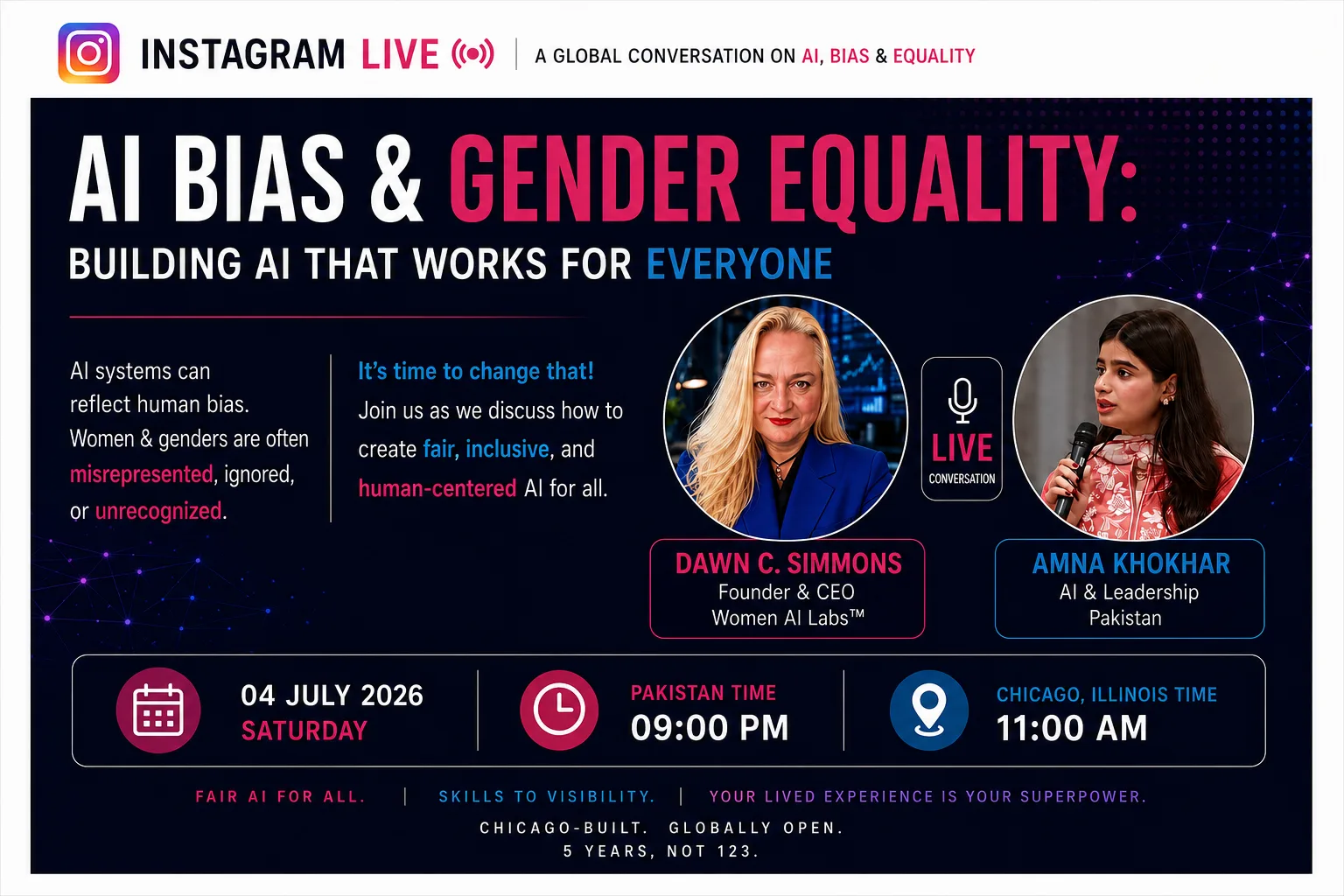
July 4, I joined Amna Khokhar for a live-streamed conversation on Instagram that promised for me to be both global and deeply personal in its value for the people we know and care about. Connected caring is at the heart of all we do worth doing.
Please Join and Share our LinkedIn Group with those who share our interest in fair AI and Gender Equity.
- LinkedIn Group: WomenAILabs- women-of-ai-innovation-initiative
- Get Involved — Women AI Labs
- Silence of the Algorithm White Paper can be requested through today's LinkedIn Invite or through request of either authors Dawn C Simmons or Dr Sreenivasan Narayathan.
AI gender bias is not a future problem. It is already shaping hiring, healthcare, credit, education, workplace visibility, and public policy. Fair AI requires more than technical fixes. It requires women at the table, strong governance, fairness testing, human review, vendor accountability, and practical AI literacy in the communities most affected.
- AI can scale old gender bias at machine speed.
- The World Economic Forum says full gender parity remains 123 years away at the current pace.
- UN Women warns that biased AI can reinforce inequality in hiring and healthcare.
- Fair AI needs fairness testing, explainability, auditability, vendor accountability, and human review.
- Women AI Labs is calling leaders, sponsors, and “do-ers” to help prove measurable change by March 8, 2027.
AI Bias & Gender Eqality: Building AI that works for Everyone - Event Management | LinkedIn
Amna serves as Head of Women Empowerment at the division level in the Office of Malik Qasim Nadeem in Pakistan. She is also a recent United Nations Young Women’s Delegate. Her work brings together government, community leaders, young professionals, education, technology, and women’s leadership.
Why does fair AI need women?
Fair AI needs women because automated systems are already making or influencing decisions that affect women’s lives. When women are excluded from AI literacy, design, governance, and oversight, old patterns can be repeated faster, quieter, and at greater scale.
On July 4, I joined Amna Khokhar for a live-streamed Instagram conversation that felt both global and deeply personal. Amna serves as Head of Women Empowerment at the division level in the Office of Malik Qasim Nadeem in Pakistan and is a recent United Nations Young Women’s Delegate. Her work connects government, community leadership, young professionals, education, technology, and women’s leadership.
That matters.
Because this conversation is not abstract anymore.
A hiring algorithm is not just software. It is a doorway. A credit model is not just a score. It can decide who gets to build, borrow, recover, or grow. A workforce tool is not just automation. It can shape ratings, promotions, layoffs, schedules, and whether someone is seen at all.
Here’s the truth: silence in an automated system is still a signal.
AI Gender Bias Warnings have present not future impact, because Large Language Models are exponentially scaling damage. Because AI is impacting government, boardrooms, and policy circles. It is being felt in classrooms, hiring systems, health decisions, credit access, business operations, and the quiet moments when someone wonders:
“Am I visible? Can you hear me now? I am present, but signals suggest otherwise. Was I screened out before a person ever saw, heard, or considered me?”
For me, this is the heart of The Silence of the Algorithm V7, the recently released white paper I coauthored with Dr. Sreenivasan Narayanan. The paper is written for leaders who know AI is moving fast but need a practical way to understand where bias can hide, how harm can scale, and what responsible governance looks like before damage becomes normal.
The larger context is urgent. The World Economic Forum’s Global Gender Gap Report 2025 found that full gender parity remains 123 years away at the current pace. That number is why this is urgent and must move us to action. As a woman with decades of leading Security Operations and IT Operations Process Improvement, I know we have always been there, and I know we must do better.
Not 123 years, 5 years!
As a Mother, I refuse to leave this problem for my Daughter, when the impact is my children and my children's children. We cannot afford to place women into systems that repeat old patterns at machine speed and then call that progress.
The Vatican's Magnifica Humanatis and the United Nations are raising a similar concern about AI and inequality. In July 2026, the UN Independent International Scientific Panel on Artificial Intelligence released a preliminary report warning that current safeguards are not keeping pace with AI’s growth, especially as benefits and infrastructure remain uneven across countries and communities.
So How Do We Lead the Appropriate Change to Deliver Fair AI
We start by treating AI governance as a people strategy, not a technical appendix.
A hiring algorithm is not just software. It is a doorway. A credit model is not just a score. It is a decision about who can build, borrow, recover, or grow. A workforce tool is not just automation. It can shape performance ratings, promotions, layoffs, schedules, and visibility.
When gender is never directly named, bias can still enter through patterns. Career gaps. Zip codes. School names. Language styles. Job histories shaped by caregiving. Healthcare data that underrepresents women. Economic data that undervalues unpaid labor.
This is why I say: Fix the Algorithm. Build Fair AI for All.
Not because AI is the enemy. It is not. AI literacy in women is the key to widen access, personalize learning, improve services, career resilience, solve problem, support small businesses, and open doors for people who were previously left outside. But only as we ask better questions before, during, and after deployment.
What does responsible AI governance look like?
Responsible AI governance treats AI as a people strategy, not a technical appendix. It asks who benefits, who is burdened, who is missing, and who has the power to challenge an automated decision.
In our white paper, we call leaders to demand five systemic actions:
| Governance Action | Leadership Question |
|---|---|
| Fairness testing | Who benefits, who is burdened, and who is missing? |
| Explainability | Can we understand the reason behind a decision well enough to challenge it? |
| Auditability | Can we prove what happened when something goes wrong? |
| Vendor accountability | Are we outsourcing risk without oversight? |
| Human review | Where must judgment, empathy, and context remain present? |
This may sound like governance language.
UN Women has also warned that AI can amplify gender inequalities when systems are trained on biased data, including in hiring and healthcare. That is why the solution cannot be limited to more tools. We need more literacy, more participation, and more women helping define what responsible use should look like.
Amna’s leadership reflects that same practical truth. Digital inclusion is not just access to a device. It is access to confidence, education, opportunity, and decision-making power.
When women and girls are trained only to use technology, they remain consumers and that is what keeps them marginalized, when they are at the heart of governance, they need an active role in driving fairness.
When they are invited to question it, build with it, govern it, and lead through it, they become architects of the future.
That is the shift Women AI Labs is working toward.
My own conviction has not changed in more than 25 years of technology, workforce, and crisis-response work:
People Matter. Every system we build should be measured against that standard. Not just “Is it efficient?” Not just “Can it scale?” But “Does it protect dignity, expand opportunity, and reduce harm?”
The Application Impact Analysis approach is one way to make this practical. Before leaders approve an AI use case, they should look at business impact across financial, operational, service, contractual, legal, and brand dimensions. Then they should ask what happens to people inside each of those categories.
That is where responsible planning becomes real.
Sprint to Prove Gender Equity: Concise Plan Calendar
Campaign window: July 4, 2026 to March 8, 2027
Core goal: Build and prove a local and global model for measurable AI gender equity change.
Immediate need: Global sponsors and a $25,000 August 6 sponsorship package to fund pilot presentation, recognition, and launch activities.
| Date | Milestone | Purpose | Key Action |
|---|---|---|---|
| July 4, 2026 | Instagram Live Launch | Open the public conversation on women, AI bias, governance, and global collaboration. | Use the live stream as the story anchor for outreach, recap content, sponsor messaging, and white paper requests. |
| July 6–7, 2026 | UN Global Dialogue on AI Governance, Geneva | Align Women AI Labs’ work with the global AI governance conversation. The UN confirms the first session takes place in Geneva, with a second session planned for New York in May 2027. | Position Women AI Labs as the bridge from global governance dialogue to practical local implementation. |
| July 8–17, 2026 | Sponsor Activation Sprint | Secure global sponsors before the Vibe Code-athon. | Send sponsor deck, partner invitations, LinkedIn posts, direct outreach, and corporate sponsor requests. |
| July 18–19, 2026 | Vibe Code-athon | Build the local and global model for proven change. | Convene builders, strategists, community partners, technologists, and advocates to design practical tools, workflows, and pilot concepts. |
| July 20–31, 2026 | Pilot Model Packaging | Turn Code-athon output into a clear pilot plan. | Define success measures, sponsor visibility, implementation steps, participating communities, and governance checkpoints. |
| August 1–5, 2026 | Final Sponsor Push | Prepare for August 6 partnership event. | Confirm the $25,000 sponsorship target, recognition plan, speaker materials, and pilot launch messaging. |
| August 6, 2026 | HDI Chicagoland Partnership Event | Fund and announce the pilot kickoff for the Sprint to Prove Gender Equity. | Present the pilot, recognize sponsors, invite partners, and formally launch the sprint toward March 8, 2027. |
| August–September 2026 | Pilot Launch Phase | Move from concept to implementation. | Recruit pilot participants, finalize governance model, begin workflow mapping, and identify bias-risk areas. |
| October–November 2026 | Testing and Learning Phase | Prove what works across local and global settings. | Run fairness checks, gather feedback, document barriers, refine training, and strengthen governance practices. |
| December 2026–January 2027 | Evidence and Impact Phase | Turn pilot activity into measurable proof. | Compile outcomes, sponsor impact stories, partner results, and recommendations for scaling. |
| February 2027 | Scale Readiness Phase | Prepare public reporting and next-stage funding. | Finalize impact report, recognition materials, case studies, and expansion roadmap. |
| March 8, 2027 | Sprint to Prove Gender Equity Report | Share results, recognize partners, and call for broader adoption. | Release findings, celebrate sponsors, announce next-phase commitments, and invite new partners into the model. |
Core Positioning Message
The UN Global Dialogue on AI Governance is happening on the world stage, but AI governance cannot stay there. It must reach HR teams, operations leaders, nonprofit boards, school systems, founders, community programs, and the women whose lives are already being shaped by automated decisions.
Women AI Labs is partnering visionaries, now its time for the “Do-ers” building that bridge.
The July 18–19 Vibe Code-athon will create the local and global model for proven change.
The August 6 HDI Chicagoland partnership event will help fund, recognize, and launch the pilot. By March 8, 2027, the goal is to show measurable progress, not just intention.
The question for every leader is simple: are we adopting AI faster than we are preparing people to understand it?
Who do we need at the table, to solve what success looks like women and girls gaining AI literacy early. It looks like managers knowing how to question automated recommendations. It looks like vendors proving fairness before contracts are signed. It looks like organizations creating review boards that include legal, operations, HR, community, and lived experience.
Most of all, success looks like moving from silence to accountability.
Because algorithmic harm is often quiet. It does not always announce itself. It can look like a missing interview, a denied loan, a delayed diagnosis, or a career path that never opens.
But silence is not neutrality.
Silence is a signal that governance is missing.
I invite leaders, technologists, educators, policymakers, and career changers to read The Silence of the Algorithm V7 and join the Women AI Labs conversation on LinkedIn. Bring your questions. Bring your field experience. Bring your concerns about workflows, hiring, training, service delivery, and opportunity.
We do not have 123 years to wait. The work we must do is now.