AI Gender Fairness Colleges ranked by LinkedIn Top 50 schools, increasingly shapes who gets hired, promoted, financed, educated, insured and treated. Therefore, the colleges represented in LinkedIn’s Top 50 must prepare tomorrow’s AI leaders to do far more than code, analyze data and build machine-learning models.
They must also teach students how to detect algorithmic bias, measure unequal outcomes, protect human rights, govern automated decisions and design AI systems that work fairly for women and historically excluded communities.
WomenAILabs™ seeks to partner with leading companies, universities and research institutions that share this mission. Specifically, we look for partners committed to creating fair and equitable AI, advancing measurable gender parity and building better systems that produce more inclusive outcomes.
Therefore, this analysis examines the Top 50 Colleges for AI and Gender Fairness represented in LinkedIn’s 2026 ranking of the best U.S. colleges for long-term career success.
However, career outcomes alone do not tell the full story.
This review adds a distinct and increasingly urgent question:
Which top colleges are best preparing students to build, audit, govern and improve fair artificial intelligence?
Why AI Fairness Education Matters
AI systems now influence decisions across employment, lending, healthcare, insurance, education, public benefits and professional advancement. Consequently, universities must prepare students to understand both the technical power and the social consequences of automated decision-making.
An algorithm can perform exactly as designed and still create discriminatory outcomes.
For example, an AI system may rank candidates efficiently while disadvantaging women. A healthcare model may accurately predict general outcomes while producing higher error rates for underrepresented populations. Similarly, an automated lending or insurance system may scale decisions while reproducing historical disparities hidden in its training data.
Because of these risks, the best artificial intelligence programs must combine technical excellence with accountability, transparency, governance and measurable fairness.
In other words, responsible AI cannot remain an elective discussion at the edge of computer science. It must become a core design, testing and leadership discipline.
What This Analysis Evaluates
This ranking evaluates colleges across five connected capabilities.
1. AI Fairness and Accountability
Strong programs examine algorithmic bias, disparate impact, transparency, explainability and unequal outcomes.
They also teach students how to identify who benefits from an AI system, who carries the risk and who may experience higher error rates.
2. Responsible and Trustworthy AI
Leading responsible AI colleges address model safety, robustness, privacy, interpretability and human oversight.
Additionally, they prepare students to test whether an AI system remains reliable across different populations, environments and use cases.
3. Gender Studies and Gender Parity
The strongest universities connect AI education with research on gender inequality, employment, compensation, promotion, leadership and workplace decision-making.
This connection matters because artificial intelligence often learns from historical data produced by unequal institutions.
4. AI Ethics, Law and Governance
Top AI governance programs connect technology with civil rights, public policy, regulation, risk management and organizational accountability.
As AI systems become more influential, future leaders must know who can approve, challenge, pause or stop an automated decision.
5. Interdisciplinary Leadership
Finally, the best colleges bring together computer science, sociology, economics, law, healthcare, public policy, organizational behavior and gender studies.
This interdisciplinary model gives students a more complete understanding of how AI affects real people, institutions and communities.
The Best Colleges Connect Technology and Equity
The strongest AI gender fairness colleges do not treat responsible AI and gender parity as separate academic subjects.
Instead, they connect technical design with measurable human outcomes.
For example, computer scientists may develop fairness metrics while sociologists examine structural inequality. Economists may measure pay and promotion disparities, while legal scholars evaluate discrimination and accountability. At the same time, public-policy researchers may establish governance standards, and gender-studies scholars may identify impacts that technical teams overlook.
Together, these perspectives create stronger artificial intelligence systems.
They also help colleges move beyond broad ethical promises toward practical evidence, measurable outcomes and accountable decision-making.
Questions Future AI Leaders Must Ask
The next generation of AI professionals must learn to ask:
- Who is represented in the training data?
- Who is missing or underrepresented?
- Which groups experience the highest error rates?
- Do women receive equitable recommendations, opportunities and outcomes?
- Does the system reproduce historical discrimination?
- Can affected people understand an automated decision?
- Can they challenge or appeal that decision?
- Is human oversight meaningful or merely symbolic?
- Who has the authority to pause or stop a harmful AI system?
- What evidence proves that the system is fair?
- How does the organization report and remediate adverse impacts?
These are no longer optional AI ethics questions.
Instead, they are essential requirements for responsible AI design, algorithmic auditing, artificial intelligence governance and executive leadership.
Leading Colleges for AI Fairness
Several institutions in LinkedIn’s Top 50 stand out because they combine strong artificial intelligence programs with responsible AI research, gender-equity scholarship, public policy and interdisciplinary leadership.
Stanford University
Stanford University offers one of the strongest human-centered AI ecosystems in the United States.
Its work connects computer science, medicine, education, law, ethics, public policy and the social sciences. Moreover, Stanford combines technical artificial intelligence research with scholarship on workplace inequality, gender bias and organizational change.
Notable areas include:
- Human-centered artificial intelligence
- Responsible AI research
- AI policy and governance
- Workplace gender bias
- Organizational inequality
- Socially responsible innovation
Key leaders include Fei-Fei Li, known for human-centered AI, and Shelley Correll, known for gender inequality, hiring bias and workplace advancement.
For these reasons, Stanford ranks among the best colleges for students and partners seeking a globally influential AI fairness and gender-equity ecosystem.
Harvard University
Harvard University provides an exceptional combination of algorithmic accountability, public-interest technology, behavioral science, policy and measurable gender equality.
Its strengths include:
- Algorithmic fairness
- Data privacy
- Public-interest technology
- AI policy and regulation
- Gender equality by design
- Workplace and leadership parity
Key leaders include Latanya Sweeney, a pioneer in algorithmic fairness, privacy and public-interest technology, and Iris Bohnet, a leading authority on gender equality and organizational decision-making.
Consequently, Harvard offers a strong environment for students and organizations focused on AI hiring fairness, workplace equity, public policy and evidence-based gender parity.
University of California, Berkeley
The University of California, Berkeley offers one of the strongest responsible and equitable AI research ecosystems.
Berkeley connects technical artificial intelligence with public policy, social inequality, algorithmic accountability and interdisciplinary research.
Its strengths include:
- Responsible AI
- Equitable artificial intelligence
- Algorithmic fairness
- AI policy
- Technology and society
- Gender and leadership research
Notable leaders include Genevieve Smith, whose work emphasizes responsible and equitable AI, and Laura Kray, whose research addresses gender, negotiation, leadership and workplace outcomes.
Berkeley is therefore a leading option for students and partners interested in responsible AI standards, algorithmic auditing and public-interest technology.
Carnegie Mellon University
Carnegie Mellon University remains one of the strongest technical institutions for artificial intelligence, machine learning, fairness and explainability.
Its programs and research connect:
- Fair machine learning
- Explainable AI
- Societal computing
- Responsible system design
- Organizational inequality
- Gender and negotiation outcomes
Key leaders include Hoda Heidari, whose work focuses on fairness, accountability and responsible machine learning, and Linda Babcock, whose research examines gender gaps in negotiation, workload and workplace advancement.
As a result, Carnegie Mellon stands out for students seeking rigorous technical AI fairness education.
Massachusetts Institute of Technology
MIT combines advanced artificial intelligence research with healthcare fairness, data ethics, structural inequality and feminist technology studies.
Its strengths include:
- Fair and robust machine learning
- Healthcare AI fairness
- Data feminism
- Structural inequality
- Technology ethics
- Human-centered design
Notable leaders include Marzyeh Ghassemi, whose research addresses fair and robust machine learning in healthcare, and Sally Haslanger, whose scholarship examines gender, race and structural injustice.
Therefore, MIT is especially strong for students interested in healthcare AI, technical fairness and the social impact of data systems.
Princeton University
Princeton University offers strong research in algorithmic accountability, technology policy, fairness and public governance.
Its strengths include:
- Algorithmic fairness
- Information technology policy
- AI accountability
- Public-interest technology
- Gender and sexuality studies
- Law and governance
Notable leaders include Arvind Narayanan, known for algorithmic accountability and technology policy, and Christina Lee, a leader in gender and sexuality studies.
Princeton is particularly well suited for students who want to connect computer science with law, policy and public institutions.
Cornell University
Cornell University has a broad interdisciplinary foundation spanning information science, algorithmic auditing, employment inequality and technology ethics.
Its strengths include:
- Algorithmic auditing
- Fairness and causal inference
- Information science
- Employment inequality
- Occupational segregation
- Technology law and ethics
Key leaders include Allison Koenecke, whose research focuses on algorithmic fairness and societal inequities, and Kim Weeden, whose work examines gender inequality and occupational stratification.
Cornell is therefore a strong choice for students interested in practical AI auditing and measurable social outcomes.
Illinois Colleges for AI and Gender Fairness
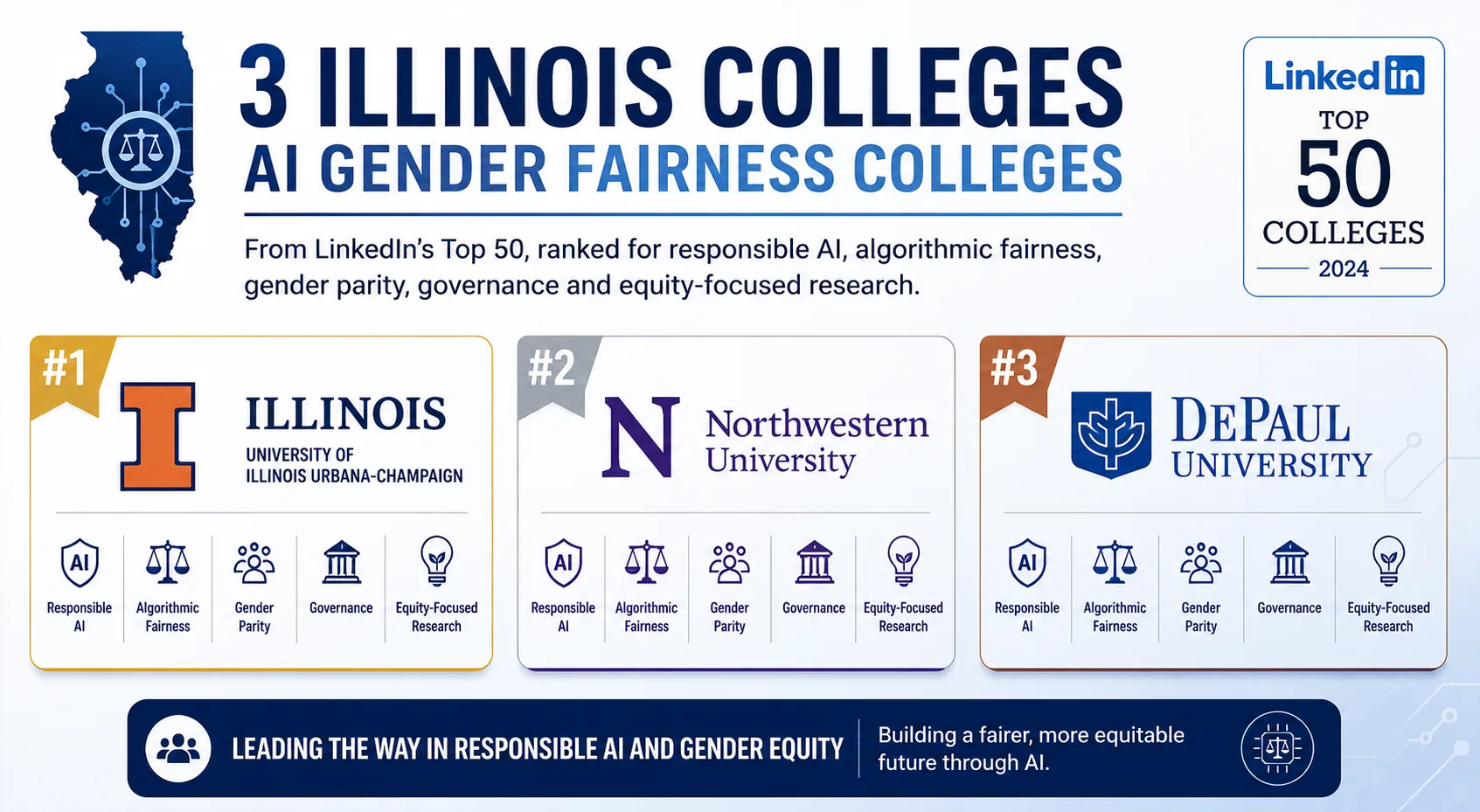
This analysis also includes every Illinois institution represented in LinkedIn’s Top 50:
- University of Illinois Urbana-Champaign
- Northwestern University
- University of Chicago
Together, these universities create one of the strongest regional combinations of artificial intelligence, public policy, workplace-equity research and gender studies in the United States.
University of Illinois Urbana-Champaign
The University of Illinois Urbana-Champaign offers the strongest Illinois combination of technical AI fairness research and established gender-equity infrastructure.
Its capabilities include:
- Fairness, accountability, transparency and ethics
- Trustworthy machine learning
- AI safety and robustness
- Large language model bias
- Global gender equity
- Intersectional inequality
- Community-based research
Notable leaders include Bo Li, Han Zhao, Zhiwen “Jerome” You, Colleen Murphy and Ruby Mendenhall.
Together, their work covers trustworthy AI, explainability, LLM gender bias, global gender equity and the experiences of Black women.
As a result, UIUC offers significant partnership potential for technical model testing, gender-equity research, healthcare AI and community-centered innovation.
Northwestern University
Northwestern University stands out for connecting algorithmic accountability with hiring, workplace inequality, communication and organizational systems.
Its strengths include:
- Algorithmic transparency
- Computational journalism
- Human-computer interaction
- Hiring discrimination
- Workplace inequality
- Media accountability
- Gendered organizational systems
Notable leaders include Nicholas Diakopoulos, Lauren Rivera, Kate Weisshaar and Moya Bailey.
Northwestern is especially strong for research involving AI hiring discrimination, workplace parity, algorithmic accountability and public transparency.
Therefore, it represents a valuable partner for WomenAILabs initiatives focused on employment, leadership, human review and organizational decision-making.
University of Chicago
The University of Chicago combines technical AI ethics with public policy, privacy, behavioral economics, healthcare bias and gender-parity research.
Its strengths include:
- AI ethics and governance
- Engineering for fairness and privacy
- Human-computer interaction
- Healthcare algorithmic bias
- Gender-pay disparities
- Promotion inequality
- Public policy and regulation
Notable leaders include Blase Ur, Marshini Chetty and Heather Sarsons.
Their combined work addresses ethical AI, privacy, deceptive technology design, workplace gender bias, promotion and compensation.
Accordingly, the University of Chicago is well positioned for partnerships involving AI governance, healthcare fairness, economic analysis and evidence-based policy.
Best Colleges by AI Fairness Focus
Different institutions lead in different areas.
| Focus Area | Leading Colleges |
|---|---|
| Technical algorithmic fairness | Carnegie Mellon, UC Berkeley, Stanford, Princeton, UIUC |
| Responsible and trustworthy AI | Stanford, MIT, Carnegie Mellon, UIUC |
| AI governance and public policy | Harvard, Princeton, Stanford, UC Berkeley, University of Chicago |
| Gender parity in employment | Harvard, Stanford, Northwestern, Cornell, University of Chicago |
| Healthcare AI fairness | MIT, Stanford, Harvard, University of Chicago |
| Feminist technology studies | MIT, Northwestern, Stanford, UC Berkeley |
| Algorithmic auditing | Cornell, Carnegie Mellon, Harvard, UC Berkeley |
| AI hiring and workplace bias | Northwestern, Harvard, Stanford, Cornell |
| AI law and accountability | Harvard, Princeton, Berkeley, Cornell, University of Chicago |
| Interdisciplinary AI fairness | Stanford, Harvard, Berkeley, MIT, UIUC |
WomenAILabs Partnership Priorities
WomenAILabs seeks partnerships that move AI fairness and gender parity from principles into measurable practice.
The strongest university partners will demonstrate more than academic interest. They will show the ability to connect research, curriculum, governance, evidence and real-world implementation.
Potential partnership priorities include:
- AI fairness curriculum development
- Algorithmic-bias research
- Gender-parity measurement
- Responsible AI certification
- AI hiring audits
- Healthcare AI testing
- Public-interest technology
- Faculty and student research labs
- Community-based AI education
- Executive and board-level AI governance
- Evidence-based remediation
- Women-led AI innovation
A practical partnership model would pair technical AI researchers with gender-equity scholars, public-policy experts and organizational leaders.
This structure would help ensure that gender parity does not remain separate from model design, data quality, system testing and AI governance.
The Illinois Partnership Opportunity
Illinois offers a particularly strong opportunity for a multi-university AI fairness partnership.
A three-institution consortium could align:
- UIUC: trustworthy AI, technical testing and global gender equity
- Northwestern: hiring bias, organizational inequality and algorithmic accountability
- University of Chicago: governance, healthcare bias, economics and public policy
Together, these institutions could support the complete responsible AI lifecycle:
Design the system → test the model → identify unequal outcomes → audit decisions → govern deployment → document evidence → remediate harm.
This model could position Illinois as a national center for responsible AI, gender fairness and equitable technology innovation.
From Principles to Proof
AI fairness cannot remain an optional course, an isolated research paper or a general statement of ethical intent.
Instead, colleges must teach students how to convert responsible AI principles into operational practices.
That requires:
- Representative and documented data
- Defined fairness requirements
- Independent model testing
- Disaggregated performance metrics
- Meaningful human oversight
- Clear escalation authority
- Transparent governance controls
- Documented evidence
- Public accountability
- Effective remediation
Ultimately, the next generation of artificial intelligence leaders will determine whether automated systems reproduce existing inequalities or help remove them.
The best colleges for AI and gender fairness will not simply teach students how to create more powerful AI systems.
They will teach students how to test those systems, challenge them, govern them and prove that they produce fairer outcomes.