Secure Ethical HR AI Is a Business Imperative: Artificial intelligence has moved beyond experimentation and into everyday Human Resources operations. Today, organizations use AI to recruit talent, streamline onboarding, personalize learning, forecast workforce needs, support career development, and improve employee services. As AI adoption accelerates, HR leaders must balance innovation with accountability, security, and trust.
At the same time, Human Resources has become one of the most valuable sources of enterprise data. HR systems store employee identities, payroll information, compensation records, performance evaluations, benefits data, and other sensitive information. Consequently, these platforms attract cybercriminals seeking financial gain, identity theft opportunities, or unauthorized access to enterprise networks.
Moreover, generative AI introduces new opportunities and new risks. While AI can automate repetitive administrative work and improve decision support, poorly governed systems may generate inaccurate recommendations, expose confidential information, or amplify patterns present in historical data. Therefore, organizations should establish governance processes that emphasize transparency, explainability, human oversight, and continuous monitoring.
Rather than treating AI as a standalone technology initiative, leading organizations increasingly integrate Responsible AI, cybersecurity, data governance, privacy, risk management, and compliance into a unified enterprise strategy. This integrated approach helps organizations protect employee data, strengthen regulatory readiness, improve workforce planning, and increase confidence in AI-assisted decisions.
Ultimately, Secure Ethical HR AI is not simply about deploying new technology. Instead, it is about creating a resilient, trustworthy, and human-centered workplace where AI augments people, supports informed decision-making, and advances organizational goals while respecting employee rights and organizational values.
Featured Snippet: What Is Secure Ethical HR AI?
Secure Ethical HR AI is the practice of designing, deploying, and governing artificial intelligence in Human Resources using trusted data, strong cybersecurity, transparent decision-making, meaningful human oversight, and continuous risk management. Organizations that adopt this approach seek to improve workforce outcomes, strengthen compliance, protect employee information, and support fair, accountable, and explainable AI-assisted decisions.
Why Ethical HR AI Matters for Enterprise Risk Management
Artificial intelligence now influences many of the most important moments in an employee's journey—from recruitment and onboarding to learning, performance management, succession planning, and career mobility. Consequently, AI governance is no longer solely an HR responsibility; it is an enterprise risk management priority.
Furthermore, AI systems rely on workforce data that must be accurate, current, secure, and well governed. Inconsistent job titles, incomplete employee records, duplicate identities, or outdated organizational structures can reduce the quality of AI recommendations. Strengthening HR data quality before deploying advanced AI helps organizations improve accuracy, reliability, and decision support.
In addition, HR leaders should evaluate AI systems using the same disciplined approach applied to cybersecurity and privacy programs. Organizations that document AI decision logic, assess potential risks, maintain audit trails, and regularly review system performance are generally better positioned to adapt to changing business needs and regulatory expectations.
HR Cybersecurity and AI Governance: Two Sides of the Same Strategy
As organizations digitize HR operations, the boundaries between Human Resources, cybersecurity, and enterprise governance continue to blur. Every AI-enabled HR workflow—from recruiting to payroll—depends on secure identities, protected APIs, reliable data, and resilient infrastructure.
For example, cybercriminals frequently target HR teams through payroll diversion fraud, business email compromise, phishing campaigns, identity theft, and social engineering because HR systems contain high-value personal and financial information. At the same time, organizations increasingly use AI to automate employee communications, evaluate resumes, recommend learning opportunities, and support workforce planning. Without strong governance, these systems may expose sensitive information or produce unreliable recommendations.
Therefore, organizations should treat HR AI as part of their broader cybersecurity strategy. Integrating AI governance with identity management, access controls, data protection, vendor risk management, incident response, and continuous monitoring helps reduce operational risk while strengthening organizational resilience.
The Top Five Findings from the Executive Guide
Analysis of current HR, AI, cybersecurity, and workforce transformation trends highlights five strategic priorities for executive leaders.
1. AI Governance Has Become an Executive-Level Responsibility
Organizations increasingly establish cross-functional governance teams that include Human Resources, Information Technology, Legal, Security, Privacy, Compliance, Risk Management, and executive leadership. These teams define accountability, approve AI use cases, document decision logic, and oversee ongoing monitoring.
2. HR Data Quality Drives AI Performance
Reliable AI depends on reliable data. Organizations that improve data governance, standardize workforce information, validate employee records, and monitor data quality create a stronger foundation for trustworthy AI and more informed workforce decisions.
3. Workflow Automation Requires Security by Design
Modern HR platforms connect recruiting, payroll, finance, identity management, learning systems, and AI agents through APIs and workflow automation. Secure integration, strong authentication, encryption, audit logging, and continuous monitoring help reduce operational risk as organizations scale automation.
4. Responsible AI Depends on Continuous Monitoring
Organizations should continuously evaluate AI performance, monitor workforce outcomes, review model behavior, document changes, and maintain meaningful human oversight for high-impact employment decisions. Ongoing governance strengthens transparency, accountability, and organizational trust.
5. Workforce Transformation Is Ultimately About People
Although AI automates repetitive tasks, people remain at the center of organizational success. Consequently, organizations that invest in AI literacy, workforce reskilling, change management, internal mobility, and transparent communication are better prepared to adapt to the future of work.
What You'll Learn in This Executive Guide
This guide explores how executive leaders, HR professionals, cybersecurity teams, AI practitioners, and governance leaders can work together to:
- Build secure, ethical, and human-centered AI governance programs.
- Improve HR data quality before expanding AI adoption.
- Reduce operational and cybersecurity risks across HR workflows.
- Monitor AI systems for reliability, transparency, and accountability.
- Strengthen workforce resilience through AI literacy and reskilling.
- Protect employee information while supporting innovation and organizational performance.
- Develop practical governance strategies that align technology investments with measurable business outcomes.
The future of Human Resources belongs to organizations that treat AI as both a strategic opportunity and a governance responsibility. By combining trusted data, responsible AI, strong cybersecurity, and human-centered leadership, organizations can build workplaces that are more resilient, more transparent, and better prepared for the evolving world of work.
Section 2: AI Governance, HR Cybersecurity, and Enterprise Risk Management
Why AI Governance and HR Cybersecurity Must Work Together
Artificial intelligence has fundamentally changed how Human Resources manages talent, workforce planning, and employee services. At the same time, cybercriminals have shifted their focus toward HR platforms because they contain high-value personal, financial, and identity information. Consequently, organizations can no longer separate AI governance from enterprise cybersecurity.
Forward-thinking organizations now view HR as part of their critical business infrastructure. Therefore, executive leaders increasingly align Human Resources, Information Security, Privacy, Legal, Compliance, Internal Audit, and Enterprise Risk Management under a shared AI governance strategy. This collaborative approach strengthens resilience while supporting innovation, regulatory readiness, and employee trust.
Rather than reacting to security incidents after they occur, mature organizations proactively identify AI risks, secure workforce data, validate automated decisions, and continuously monitor system performance throughout the AI lifecycle.
HR Cybersecurity Risks Continue to Expand with AI and Workflow Automation
Digital transformation has significantly increased the number of systems connected to Human Resources. Today, HR platforms routinely exchange information with payroll providers, identity management systems, finance applications, recruiting platforms, learning management systems, benefits administrators, and AI-powered assistants.
Although these integrations improve productivity, every API, cloud service, third-party application, and AI model introduces additional security considerations.
Consequently, organizations should continuously evaluate:
- Identity and access management
- API security
- Third-party vendor risk
- Cloud security posture
- Employee identity verification
- Privileged account management
- Data encryption
- Audit logging
- AI model governance
- Sensitive workforce data classification
When organizations secure every connection, they reduce both cyber risk and operational disruption.
The Growing HR Cyber Threat Landscape
Cybercriminals increasingly target Human Resources because HR teams process nearly every employee transaction within an organization. Furthermore, attackers recognize that HR professionals routinely receive resumes, payroll requests, tax forms, direct deposit changes, employment verification requests, and benefits documentation.
As a result, threat actors frequently exploit trusted HR workflows.
Common HR cyber threats include:
Payroll Diversion Fraud
Attackers impersonate employees and request changes to direct deposit information. Without strong identity verification, payroll funds can be redirected to fraudulent accounts.
Recommended Controls
- Require multi-factor authentication for payroll changes.
- Verify requests through secondary communication channels.
- Monitor unusual banking changes.
- Review payroll exception reports regularly.
Business Email Compromise (BEC)
Cybercriminals spoof executives, HR leaders, or payroll administrators to authorize fraudulent financial transactions or disclose confidential employee information.
Recommended Controls
- Implement email authentication protocols.
- Train employees to recognize impersonation attempts.
- Require approval workflows for financial transactions.
- Monitor executive email activity for anomalies.
Identity Theft and Employee Data Exposure
HR databases often contain Social Security numbers, tax records, banking information, healthcare data, and government-issued identification. Consequently, compromised HR systems can expose employees to identity theft and financial fraud.
Recommended Controls
- Encrypt sensitive employee records.
- Limit privileged access.
- Apply role-based access controls.
- Conduct routine access reviews.
- Secure employee self-service portals.
Deepfake Recruiting and Executive Impersonation
Artificial intelligence now enables attackers to generate convincing voice recordings, video interviews, and digital identities.
Consequently, recruiters and hiring managers should verify candidate identities before extending offers or granting system access.
Recommended practices include:
- Identity verification during hiring.
- Secure video interview procedures.
- Digital credential validation.
- Background verification.
- Multi-step onboarding approvals.
AI-Enhanced Social Engineering
Generative AI allows attackers to create highly personalized phishing emails, fake job offers, fraudulent recruiter messages, and convincing executive communications.
Organizations should strengthen both employee awareness and technical security controls because sophisticated phishing campaigns continue to evolve rapidly.
AI Governance Is Enterprise Governance
Responsible AI extends beyond model development. Instead, organizations should govern AI throughout its entire lifecycle—from planning and procurement to deployment, monitoring, auditing, and retirement.
Effective governance addresses:
- Strategic alignment
- Ethical considerations
- Regulatory compliance
- Cybersecurity
- Privacy
- Data governance
- Vendor management
- Workforce impacts
- Continuous improvement
Accordingly, AI governance should become a standing responsibility within enterprise governance committees rather than an isolated technology project.
Building a Cross-Functional AI Governance Council
Successful organizations establish governance councils that represent multiple business functions.
Typical participants include:
- Chief Human Resources Officer
- Chief Information Security Officer
- Chief Information Officer
- Chief Privacy Officer
- Chief Compliance Officer
- Chief Legal Officer
- Enterprise Risk Management
- Internal Audit
- HR Operations
- Data Governance Leaders
- AI Product Owners
- Business Executives
Together, these leaders evaluate AI initiatives, prioritize risks, approve governance policies, and monitor organizational performance.
Enterprise AI Governance Checklist
Organizations preparing to scale HR AI should consider the following governance questions.
Strategy
- Does AI support measurable business objectives?
- Have executives defined acceptable risk?
- Is AI aligned with organizational values?
Governance
- Are AI policies formally documented?
- Has executive leadership approved governance standards?
- Are governance roles clearly assigned?
Security
- Have security teams reviewed AI deployments?
- Are APIs protected?
- Is privileged access monitored?
- Are AI systems included in incident response planning?
Privacy
- Is sensitive employee information properly classified?
- Are retention schedules documented?
- Does AI comply with applicable privacy requirements?
Data Quality
- Are employee records complete?
- Have duplicate identities been removed?
- Are workforce datasets standardized?
- Is metadata consistently maintained?
Human Oversight
- Can employees request human review of significant AI-assisted decisions?
- Are high-impact employment decisions reviewed by qualified personnel?
- Are AI recommendations explainable to decision-makers?
Real-World HR AI Use Cases
Organizations across industries increasingly integrate AI into everyday HR operations.
Recruiting
AI helps prioritize candidate applications, summarize resumes, identify required skills, and automate interview scheduling. Human recruiters remain responsible for evaluating candidates and making hiring decisions.
Employee Service Centers
AI assistants answer common HR questions about benefits, leave policies, payroll, and onboarding. Complex or sensitive requests are escalated to HR professionals.
Workforce Planning
Predictive analytics support succession planning, identify future skill gaps, and inform reskilling strategies. Leaders validate AI-generated insights before making workforce decisions.
Learning and Development
AI recommends personalized learning pathways based on employee roles, certifications, and career goals while allowing managers and employees to adjust recommendations as needed.
Compliance Monitoring
AI helps identify missing documentation, overdue training, policy acknowledgments, and audit exceptions, enabling HR teams to address issues more efficiently.
AI Governance Success Story: Standardized Oversight Improves Consistency
A multinational organization implemented standardized AI governance for its recruiting processes by requiring documented model reviews, structured approval workflows, periodic performance assessments, and human oversight for hiring decisions.
As a result, recruiters reduced administrative effort, governance teams improved audit readiness, and leadership gained greater visibility into AI-assisted hiring processes. Although outcomes vary by organization, this example illustrates how governance can improve consistency and accountability without removing human judgment.
Executive Takeaway
Artificial intelligence and cybersecurity now share a common objective: protecting organizational trust.
Organizations that integrate AI governance with cybersecurity, privacy, data governance, and enterprise risk management create stronger foundations for responsible innovation. Furthermore, leaders who continuously monitor AI systems, secure workforce data, verify identities, and maintain meaningful human oversight are better positioned to reduce operational risk while improving employee confidence.
The most resilient organizations recognize that secure HR AI is not simply a technology initiative. Instead, it is an enterprise-wide governance capability that protects people, data, and business outcomes while enabling responsible workforce transformation.
Section 3: HR Data Quality, AI Fairness, and Proactive Gender Bias Risk Management
Why HR Data Quality Is the Foundation of Responsible AI and Workforce Analytics
Artificial intelligence can only produce reliable workforce insights when organizations build it on trusted, high-quality data. Consequently, HR leaders should strengthen data governance before expanding AI-powered recruiting, workforce planning, performance management, compensation analysis, or employee experience initiatives.
Moreover, HR data often originates from multiple enterprise systems, including Human Resource Information Systems (HRIS), Applicant Tracking Systems (ATS), payroll platforms, learning management systems, identity management solutions, finance applications, and employee engagement tools. Without consistent governance, these systems may contain duplicate records, outdated job classifications, inconsistent skills data, incomplete demographic information, or conflicting organizational hierarchies.
Therefore, organizations that invest in HR data quality improve AI accuracy, strengthen workforce analytics, simplify regulatory reporting, and increase confidence in AI-assisted decisions.
Why Data Quality Directly Influences AI Performance
Every AI model learns from the information it receives. As a result, inaccurate, incomplete, or inconsistent workforce data can reduce model performance and weaken executive decision-making.
High-quality HR data helps organizations:
- Improve recruiting recommendations.
- Enhance workforce planning.
- Strengthen succession planning.
- Support skills-based talent strategies.
- Increase reporting accuracy.
- Improve employee experience.
- Reduce operational risk.
- Strengthen regulatory compliance.
- Improve executive decision support.
- Increase confidence in AI-generated insights.
Simply stated:
Better Data → Better Analytics → Better AI → Better Workforce Decisions
The Five Dimensions of HR Data Quality
Organizations should continuously evaluate workforce data across five core dimensions.
1. Accuracy
Employee information should reflect current organizational records.
Examples include:
- Correct employee names
- Accurate job titles
- Current reporting structures
- Updated compensation information
- Verified employment status
- Current certifications
Even small inaccuracies can affect workforce analytics and AI recommendations.
2. Completeness
Incomplete employee records reduce AI reliability.
Organizations should review:
- Missing job descriptions
- Missing skill profiles
- Incomplete career histories
- Unverified certifications
- Incomplete learning records
- Missing demographic information where lawfully collected and appropriate
Complete records improve workforce planning and learning recommendations.
3. Consistency
Data should remain consistent across every connected HR platform.
For example:
A Software Engineer should not appear as:
- Software Engineer
- Software Eng.
- SWE
- Programmer II
- Developer
Standardized job architectures improve AI classification and workforce reporting.
4. Timeliness
Organizations should update workforce information regularly.
Important examples include:
- Promotions
- Department transfers
- Manager changes
- New certifications
- Salary adjustments
- Internal mobility
- Organizational restructuring
Outdated information can reduce AI relevance.
5. Integrity
Organizations should protect workforce information throughout its lifecycle.
Integrity includes:
- Data validation
- Access controls
- Encryption
- Backup procedures
- Audit logging
- Change tracking
- Version management
Trusted AI begins with trusted data governance.
Why Historical Data Requires Careful Review
Historical HR information reflects previous business practices, workforce demographics, organizational structures, and hiring processes. Consequently, historical datasets may not fully represent current business objectives or today's workforce.
Organizations should evaluate historical data before training or deploying AI systems.
Examples include:
- Legacy job requirements
- Outdated skills expectations
- Historical promotion pathways
- Previous recruiting strategies
- Inconsistent performance ratings
- Changing organizational structures
Reviewing historical data helps organizations determine whether updates or additional validation are appropriate before using AI to support employment-related decisions.
Proactive Data Quality Practices That Support Fair AI Outcomes
Organizations can strengthen AI reliability by implementing proactive governance practices before deploying AI models.
Recommended practices include:
Standardize Workforce Taxonomies
Develop consistent definitions for:
- Job titles
- Job families
- Skills
- Competencies
- Career levels
- Organizational units
Standardization reduces ambiguity and improves model performance.
Validate Data Before Model Training
Review datasets for:
- Missing values
- Duplicate records
- Invalid entries
- Conflicting information
- Outdated employee records
- Inconsistent formatting
Routine validation improves analytical accuracy.
Document Data Lineage
Organizations should understand:
- Where data originated
- How data changed
- Who modified records
- Which systems exchanged information
- How AI uses workforce data
Clear lineage strengthens transparency and audit readiness.
Establish Data Stewardship
Assign business owners for workforce datasets.
Typical responsibilities include:
- Data quality monitoring
- Governance reviews
- Metadata management
- Policy compliance
- Issue resolution
- Continuous improvement
Shared accountability produces stronger governance.
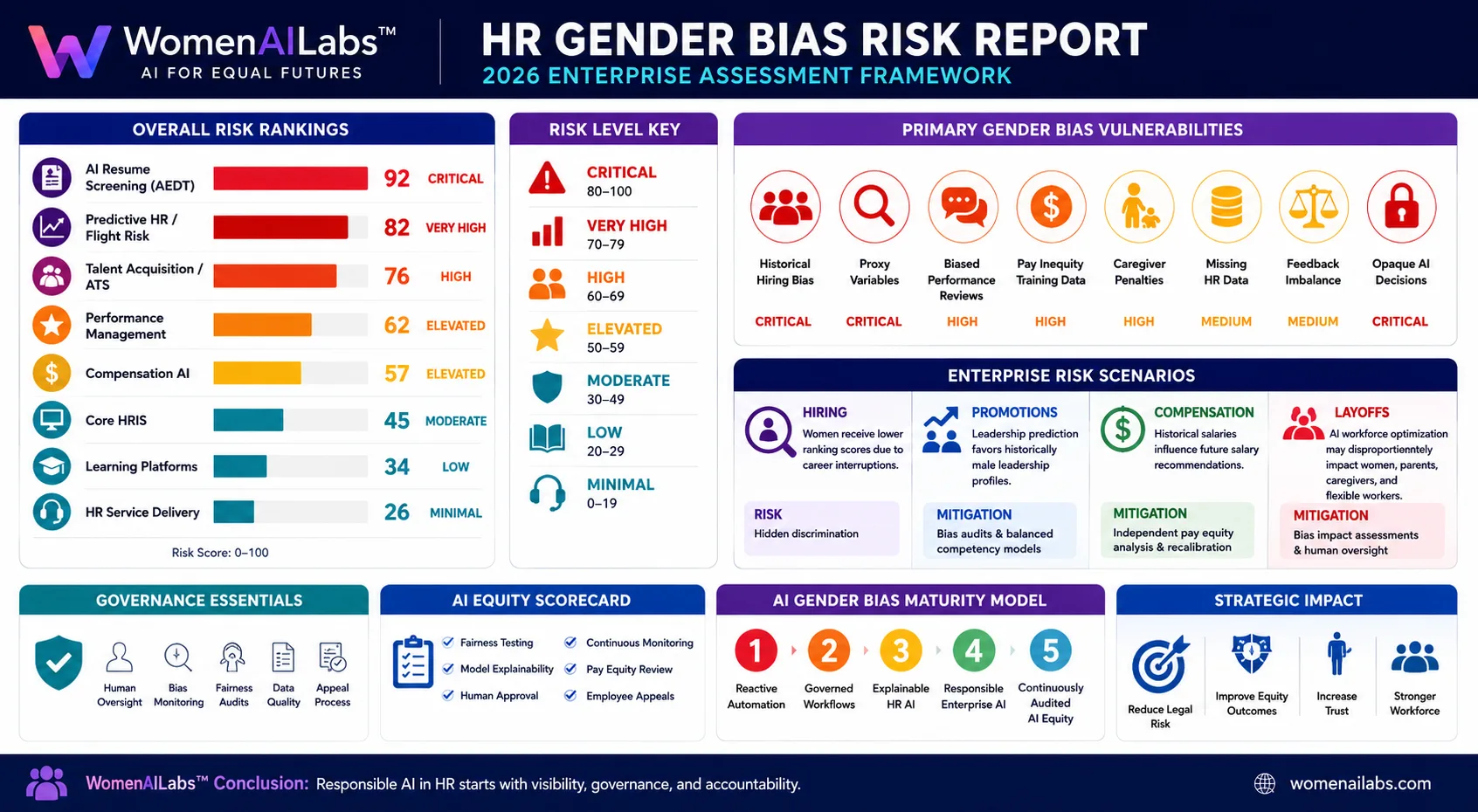
Proactive Gender Bias Risk Management in HR AI
Responsible AI governance includes evaluating workforce outcomes to identify patterns that may warrant additional review. Importantly, organizations should avoid assuming bias exists while remaining attentive to unexpected disparities that merit investigation.
Practical governance activities include:
- Review hiring recommendations across relevant groups.
- Compare promotion outcomes over time.
- Evaluate compensation analyses for consistency.
- Assess career development recommendations.
- Monitor learning opportunities and certification access.
- Review performance evaluation trends.
- Validate succession planning recommendations.
- Document governance decisions.
- Maintain appropriate human oversight for significant employment actions.
When organizations observe meaningful differences, they should investigate contributing factors, review data quality, validate model performance, and consider whether process improvements are appropriate.
Real-World Use Cases
Use Case: Recruiting
A global organization standardized job descriptions, removed duplicate candidate records, aligned skills taxonomies, and required recruiter review before final hiring decisions.
Results included:
- Improved search relevance
- More consistent candidate matching
- Reduced administrative effort
- Better reporting consistency
- Greater transparency
Use Case: Workforce Planning
An enterprise consolidated employee data from multiple business units into a single governed workforce dataset.
Consequently, workforce planners gained more consistent visibility into:
- Skills inventories
- Internal mobility
- Retirement planning
- Leadership succession
- Future hiring needs
Use Case: Performance Management
An organization reviewed historical performance ratings before implementing AI-assisted talent analytics. After identifying inconsistent rating practices across departments, leaders standardized evaluation criteria, trained managers, and refreshed analytical models using updated information.
As a result, leadership improved reporting consistency and increased confidence in workforce analytics.
Top Five Recommendations for Improving HR Data Quality and AI Fairness
1. Govern Data Before Governing AI
Create enterprise-wide standards for workforce information, assign accountable data stewards, and establish ongoing quality reviews before deploying AI solutions.
2. Standardize Workforce Information
Use consistent job architectures, skills taxonomies, competency frameworks, and organizational hierarchies to improve interoperability and AI performance.
3. Continuously Monitor Workforce Outcomes
Review hiring, promotions, learning opportunities, career mobility, and compensation trends regularly to identify patterns that may require additional analysis or process improvements.
4. Keep Humans Accountable
Ensure qualified HR professionals review significant employment decisions, document governance activities, and provide oversight for AI-assisted recommendations.
5. Treat Data Quality as a Strategic Asset
View workforce data as critical business infrastructure. Organizations that continuously improve data quality strengthen analytics, AI performance, compliance, cybersecurity, and employee trust.
| Domain | Core Controls | Executive Readiness Questions | Desired Outcome |
|---|---|---|---|
| Data Governance | Data ownership; stewardship; governance councils; quality standards | Have we assigned data owners? Do we monitor workforce data quality? | Accountable, consistent, well-governed HR data |
| Privacy | Data minimization; employee transparency; retention policies; secure disposal | Do we collect only necessary employee data? Do employees understand how data is used? | Lower privacy risk and stronger employee trust |
| Security | Role-based access; encryption; identity management; multi-factor authentication | Is sensitive employee information encrypted? Do we regularly review access permissions? | Protected HR systems and reduced cyber risk |
| Compliance | Audit trails; regulatory reporting; documentation; change management | Can we produce audit evidence? Do we document HR data and AI changes? | Stronger audit readiness and regulatory alignment |
| AI Governance | Model documentation; validation procedures; human oversight; performance monitoring | Have we validated training data? Do we document model assumptions? Can we explain AI-assisted recommendations? Do we maintain meaningful human oversight? | Transparent, explainable, monitored AI decisions |
| Accuracy | Current employee records; verified reporting structures; updated compensation and role data | Are employee records current? Are organizational structures correct? | More reliable analytics and AI recommendations |
| Completeness | Skills profiles; learning records; certifications; career history; lawful demographic data where appropriate | Are skills profiles complete? Are learning records up to date? | Better workforce planning and talent mobility |
| Consistency | Standardized job titles; common definitions; aligned job families; shared data taxonomy | Have we standardized job titles? Do systems use common definitions? | Fewer data conflicts across HR systems |
| AI Readiness | Training data validation; assumption documentation; explainability; escalation paths | Can leaders explain AI outputs? Are exceptions reviewed by humans? | Responsible AI adoption with stronger trust |
Executive Takeaway
High-quality data is the cornerstone of secure, ethical HR AI. Organizations that invest in data governance, standardized workforce information, transparent AI oversight, and continuous monitoring create stronger foundations for responsible innovation. By improving data quality first and evaluating AI outcomes thoughtfully, leaders can enhance workforce planning, strengthen decision support, reduce operational risk, and build greater confidence in AI-enabled Human Resources.
- 6 DQ Dimensions: Complete Guide, Examples, Methods
- 6 Data Governance Principles for Reports and Dashboards
- 8 DQ Core Dimensions: A Guide to Data Excellence – SixSigma.us
- Data Ethics and Governance – Explores the ethical implications of poor data quality and how governance frameworks can mitigate risk.
- Data Governance Institute (DGI) – A leading best practices data governance organization.
- Data Science Foundations Data Structures & Data Quality
- DAMA International – A global association for data management professionals
- Master Data Quality Dimensions