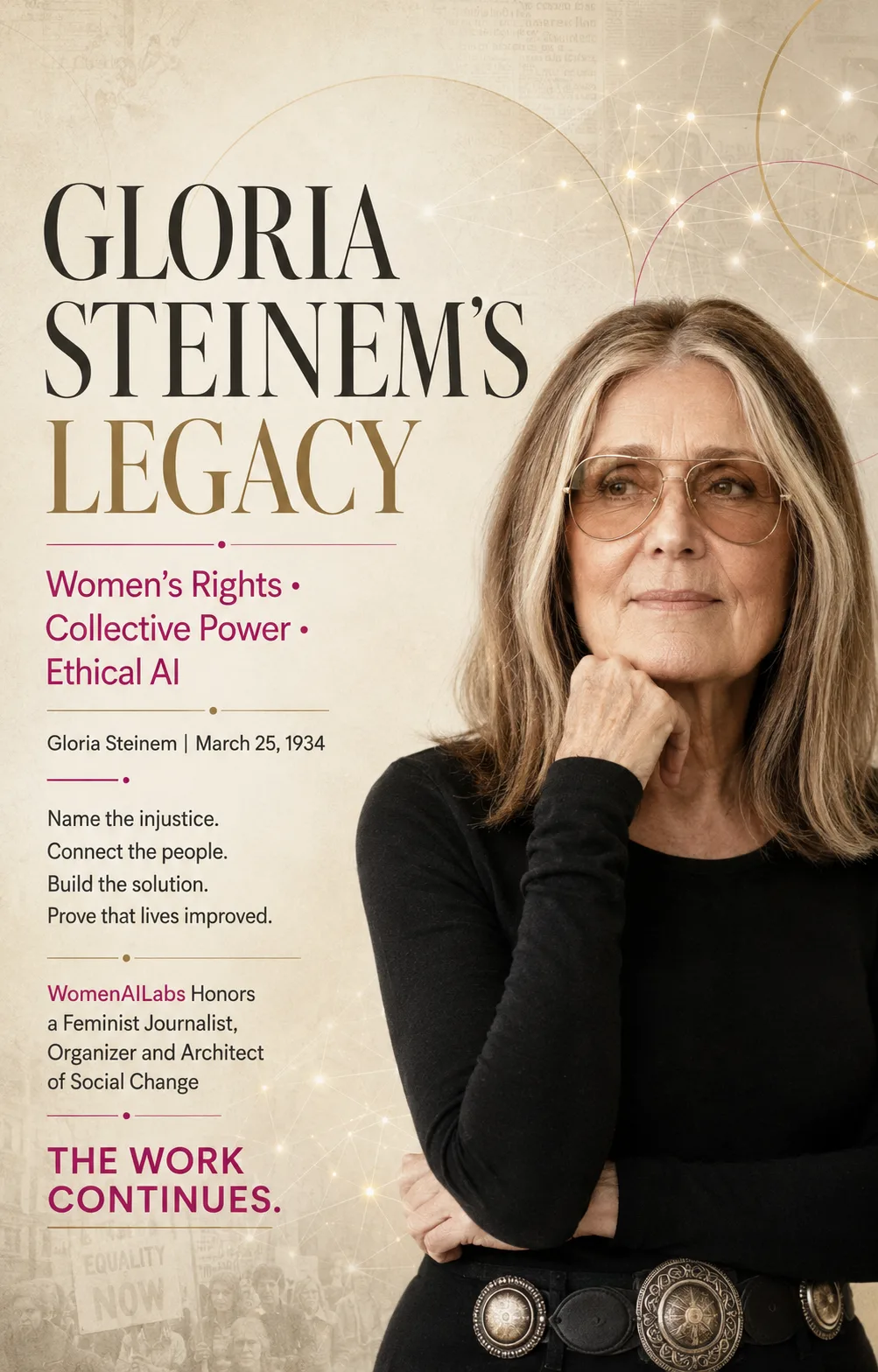
Gloria Steinem’s Powerful Legacy reaches far beyond her remarkable historic influence on women’s rights. As a journalist, author, political activist and feminist organizer, she exposed systemic discrimination, connected people through shared experiences and helped build institutions that could sustain progress.
Gloria Steinem | March 25, 1934 to September 2, 2026
What Is Gloria Steinem’s Powerful Legacy?
Gloria Steinem’s powerful legacy rests on her ability to expose injustice, connect people, build strategic partnerships and create institutions that could sustain progress.
As an American journalist, author, political activist and feminist organizer, Steinem helped shape the modern women’s rights movement. She made overlooked experiences visible, connected individual concerns to systemic inequality and helped people convert awareness into action.
Steinem died peacefully at her New York home on September 2, 2026, at age 92. However, her influence continues through her writing, the leaders she supported and the organizations she helped establish. Associated Press
WomenAILabs honors Steinem because her approach remains urgently relevant to artificial intelligence:
Name the injustice. Connect the people. Build the solution. Prove that lives improved.
This statement represents a WomenAILabs interpretation of Steinem’s work. It is not a verified Gloria Steinem quotation.
Who Was Gloria Steinem and Why Did She Matter?
Gloria Steinem became one of the most influential voices in modern feminism. Yet she accomplished far more than public speaking.
Through investigative journalism, she revealed workplace exploitation. Through grassroots organizing, she connected people facing similar barriers. Through political partnerships, she strengthened women’s representation. Finally, through institution-building, she created pathways for future generations to lead.
Steinem helped the public understand that unequal pay, gender violence, employment discrimination, restricted reproductive freedom and political exclusion were not simply private difficulties. Instead, they reflected systems that distributed opportunity, safety and authority unequally.
As a result, people who once felt isolated began to recognize shared patterns and collective influence.
Gloria Steinem’s Most Significant Accomplishments
Investigative Journalism Exposed Workplace Discrimination
In 1963, Steinem worked undercover as a Playboy Bunny at the New York Playboy Club. Her two-part article, “A Bunny’s Tale,” appeared in Show magazine and documented employment practices, sexual demands and degrading working conditions.
By reporting from inside the organization, she made hidden workplace harm visible to a national audience. The investigation also demonstrated how journalism could challenge an institution with evidence rather than assumption.
Ms. Magazine Expanded Feminist Journalism
In 1971, Steinem helped launch Ms. as an insert in New York magazine. The independent preview issue followed in 1972, with Steinem serving among its founding editors.
The publication gave women a national platform to investigate work, health, family, sexuality, politics and equality from their own perspectives. Furthermore, it connected readers who previously had few places to see their experiences represented in mainstream media.
Political Networks Increased Women’s Representation
Steinem became a founding member of the National Women’s Political Caucus in 1971. She worked alongside leaders including Bella Abzug, Shirley Chisholm, Betty Friedan and Myrlie Evers-Williams.
Together, they created an organization that recruited, trained and supported women seeking elected and appointed office. Consequently, the caucus connected public advocacy with political participation and institutional authority.
Women’s Organizations Created Lasting Infrastructure
Steinem helped establish or advance several influential organizations:
- Women’s Action Alliance connected grassroots groups with national knowledge and resources.
- Ms. Foundation for Women directed funding toward community-led solutions.
- Voters for Choice strengthened reproductive rights advocacy.
- The National Women’s Political Caucus expanded political representation.
- The Women’s Media Center increased women’s visibility and authority across journalism and public discourse.
Each partnership addressed a different requirement for sustainable progress. One created media access. Another supported candidates. Others supplied funding, voter engagement, local coordination or professional visibility.
Therefore, Steinem did not rely on one organization to solve every challenge. She helped build a connected ecosystem. National Women’s History Museum
Civil Rights Advocacy Connected Multiple Forms of Inequality
Throughout her career, Steinem supported racial justice, LGBTQ+ equality, reproductive freedom, anti-apartheid organizing, peace initiatives and efforts to prevent violence against women.
Her advocacy recognized that gender, race, income, sexuality and political authority can shape one another. Legal scholar Kimberlé Crenshaw later coined the term “intersectionality” in 1989. Steinem did not originate that concept, although her later work often aligned with intersectional feminist principles.
National Recognition Honored Her Contribution
President Barack Obama awarded Steinem the Presidential Medal of Freedom in 2013. The honor recognized her leadership in journalism, civil rights and women’s equality. Obama White House Archives
How Did Gloria Steinem Build Partnerships That Produced Results?
Steinem understood that public recognition alone could not change entrenched systems. Instead, she used visibility to connect people who held different forms of influence.
Writers could expose the problem. Community organizers could mobilize participation. Funders could resource the response. Lawyers could challenge discriminatory practices. Candidates could pursue policy reform. Educators could prepare the next generation.
By linking those capabilities, she helped coalitions accomplish more than any participant could achieve independently.
She Listened Before Defining the Solution
Steinem traveled extensively and learned through conversations in homes, community meetings, universities and public forums.
Her memoir, My Life on the Road, describes how listening shaped her understanding of leadership. Rather than entering every room with a predetermined answer, she asked people what they experienced and what they needed.
She Turned Personal Stories Into Shared Evidence
One person’s experience could appear anecdotal. However, hundreds of similar accounts revealed a systemic pattern.
Steinem used journalism to connect those stories, identify recurring barriers and give the public language for discussing them.
She Brought Complementary Leaders Together
Effective coalitions do not require everyone to perform the same role. Steinem worked with journalists, civil rights leaders, political candidates, philanthropists, artists and local advocates.
Accordingly, each participant contributed a distinct capability while supporting a common purpose.
She Shared Visibility With Others
Although the media often presented Steinem as the face of American feminism, she repeatedly emphasized collective leadership.
Her approach centered a critical principle: influence becomes more valuable when it expands another person’s opportunity to lead.
She Created Institutions, Not Temporary Attention
A speech can inspire people. A publication can inform them. Yet an institution can coordinate resources, develop talent, preserve knowledge and continue the work.
For that reason, Steinem paired public advocacy with organizations capable of delivering long-term support.
She Connected Local Experience With National Action
Community stories informed broader campaigns, while national networks returned resources and visibility to local organizers.
This two-way relationship prevented the work from becoming purely centralized or disconnected from lived realities.
Gloria Steinem’s Results-Based Organizing Model
WomenAILabs translates Steinem’s methods into a repeatable seven-stage approach:
Listen → Name → Connect → Organize → Build → Measure → Continue
This sequence is a WomenAILabs framework inspired by Steinem’s career. It is not a formal model created or published by her.
| Stage | Leadership action | Practical result |
|---|---|---|
| Listen | Gather lived experiences from affected communities | Understand the real problem |
| Name | Identify the shared pattern or systemic barrier | Create clear public language |
| Connect | Bring together people with complementary capabilities | Build a stronger coalition |
| Organize | Assign roles, responsibilities and decision rights | Convert interest into coordinated work |
| Build | Create a publication, program, policy or institution | Produce a usable solution |
| Measure | Examine participation, reach and human outcomes | Determine whether conditions improved |
| Continue | Fund, document and transfer the model | Sustain progress beyond one campaign |
What Does “Linked, Not Ranked” Mean?
Steinem used the phrase “We are linked; we are not ranked” to describe relationships based on equality rather than domination.
In a National Geographic interview, she connected the idea with rejecting rigid racial and gender hierarchies. The phrase also appeared on bracelets associated with her public advocacy. National Geographic
For WomenAILabs, “linked, not ranked” means:
- Experience carries value alongside technical expertise.
- Leadership expands when people share opportunity.
- Partnerships work when participants contribute distinct strengths.
- Communities deserve authority over systems affecting their lives.
- Technology should serve humanity rather than reinforce hierarchy.
Why Gloria Steinem’s Legacy Matters to Ethical AI
Artificial intelligence now influences hiring, healthcare, lending, education, insurance, public benefits, workplace decisions and personal safety.
However, people affected by automated systems often remain underrepresented in their design, testing and governance.
That gap creates a familiar risk: institutions may define a problem without listening to those experiencing it.
Steinem’s work offers a practical response. Begin with lived experience. Next, investigate the pattern. Then, connect affected communities with builders, policymakers and decision-makers. Finally, implement the remedy and measure whether outcomes improve.
Women in Artificial Intelligence: Statistics Supporting Inclusive AI
Current studies use different populations, definitions and methodologies. Nevertheless, the findings reveal persistent gaps in representation, leadership and workforce exposure.
- UNESCO reports that women represent approximately 30% of professionals in the broader AI sector. Its Women4Ethical AI platform encourages equal participation in AI design, deployment and governance. UNESCO Women4Ethical AI
- The World Economic Forum reports that women comprise about 41% of the global workforce but only 29% of senior leadership roles. World Economic Forum
- In the United States, women hold 57% of roles expected to experience generative AI disruption, compared with 43% held by men. This statistic describes the distribution of exposed jobs, not the percentage of all women likely to lose employment.
- UNESCO reports that 58% of young women and girls surveyed experienced online harassment, including technology-enabled abuse such as deepfakes and hate speech. UNESCO Gender Bias and AI Harms
Together, these findings support one clear conclusion: people facing the greatest algorithmic consequences need meaningful authority in AI design, evaluation and oversight.
WomenAILabs Partnership Model for Responsible AI
Steinem’s career shows that durable change requires several partners working toward one measurable outcome.
| Partner | Contribution | Shared result |
|---|---|---|
| Affected communities | Lived experience and impact evidence | Relevant problem definition |
| AI builders | Technical analysis and solution development | Corrective system changes |
| Business leaders | Funding, authority and operational ownership | Sustainable implementation |
| Educators | Training and career preparation | Expanded talent pipelines |
| Researchers | Methodology and independent evaluation | Credible findings |
| Policymakers | Public safeguards and accountability | Broader protection |
| Employers | Jobs, apprenticeships and applied experience | Economic opportunity |
| Media partners | Public education and visibility | Informed participation |
The strongest collaboration begins with a specific challenge, names the decision-makers, assigns responsibilities and defines how partners will measure success.
Gloria Steinem’s Books and Essential Reading
Books Written by Gloria Steinem

- Outrageous Acts and Everyday Rebellions examines feminism, journalism, work, politics and everyday resistance.
- Revolution from Within connects self-esteem, personal healing and social transformation.
- Moving Beyond Words explores age, power, gender, sexuality, economics and restrictive cultural expectations.
- My Life on the Road reveals how travel, listening and community conversations shaped Steinem’s organizing.
- The Truth Will Set You Free, But First It Will Piss You Off! gathers observations on feminism, media, leadership and public life.
- Doing Sixty & Seventy, published by Elders Academy Press in 2006, challenges ageism and explores women’s experiences in later life. Gloria Steinem’s Written Works
Feminist Thought, Civil Rights and Leadership Reading List
The following works provide historical, literary and political context. They should not be presented as Steinem’s personal recommendations without a direct source.

- The Second Sex by Simone de Beauvoir examines women’s social, political and cultural subordination.
- The Feminine Mystique by Betty Friedan challenges restrictive postwar expectations surrounding domestic life.
- A Room of One’s Own by Virginia Woolf connects economic independence with intellectual freedom.
- The Yellow Wallpaper by Charlotte Perkins Gilman explores confinement and medical paternalism.
- Their Eyes Were Watching God by Zora Neale Hurston examines race, autonomy, identity and voice.
- The Color Purple by Alice Walker addresses abuse, resilience, sexuality and sisterhood.
- Sister Outsider by Audre Lorde analyzes race, class, difference, anger and coalition-building.
- The Autobiography of Malcolm X by Malcolm X and Alex Haley documents political and religious transformation.
- The Autobiography of Eleanor Roosevelt provides insight into public service and human-rights leadership.
- The Feminist Memoir Project preserves firsthand accounts of women’s liberation organizing.
- The Beauty Myth by Naomi Wolf considers beauty standards and social power.
- Gender Outlaw by Kate Bornstein challenges rigid assumptions about gender identity and expression.
- The Autobiography of My Mother by Jamaica Kincaid explores colonialism, motherhood, identity and authority.
Gloria Steinem Videos, Interviews and Speeches
Gloria Steinem on Future Generations and Social Change
This TEDWomen conversation explores courage, friendship, intersectional thinking and responsibility.
Gloria Steinem on Equality and “Having It All”
PBS NewsHour examines workplace expectations, family responsibilities and unfinished gender equity.
Gloria Steinem on Women’s Rights and Peace
Steinem connects gender-based violence, public safety and global peace during this United Nations presentation.
Watch the United Nations video
Gloria Steinem Legacy Frequently Asked Questions
What is Gloria Steinem best known for?
Gloria Steinem is best known for feminist journalism, co-founding Ms. magazine, helping establish major women’s organizations and advancing gender equality through political and community organizing.
What were Gloria Steinem’s greatest accomplishments?
Her major achievements include “A Bunny’s Tale,” Ms. magazine, the National Women’s Political Caucus, the Women’s Action Alliance, the Ms. Foundation for Women and the Women’s Media Center.
How did Gloria Steinem achieve social change?
She listened to affected communities, identified shared patterns, communicated those findings, created strategic coalitions and built institutions that could sustain the response.
Who partnered with Gloria Steinem?
Steinem collaborated with journalists, organizers, civil rights leaders, candidates and advocates, including Dorothy Pitman Hughes, Bella Abzug, Shirley Chisholm, Betty Friedan, Myrlie Evers-Williams, Robin Morgan and Jane Fonda.
What does “linked, not ranked” mean?
The phrase describes relationships based on equality, connection and shared authority rather than domination or rigid hierarchy.
How does Gloria Steinem’s legacy connect with ethical AI?
Her methods offer a practical model for identifying algorithmic bias, listening to affected users, building diverse coalitions and creating accountable solutions.
What can AI leaders learn from Gloria Steinem?
Responsible AI leaders can listen before designing, examine systemic patterns, share decision-making authority, develop partnerships and verify human outcomes.
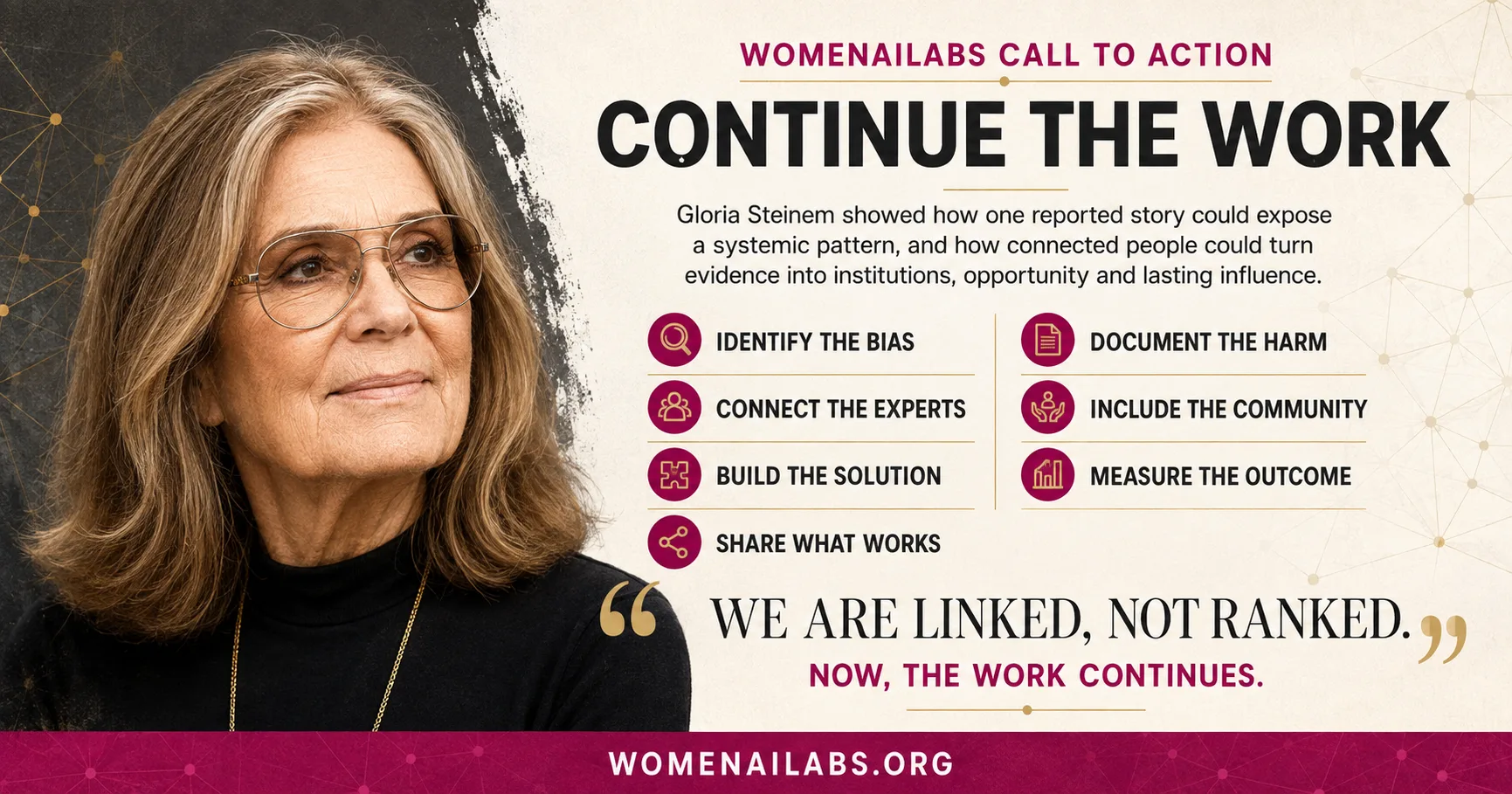
Today, her approach offers WomenAILabs a practical model for ethical artificial intelligence: listen to those experiencing harm, identify the pattern, unite the right allies, build a measurable solution and expand what works.
LinkedIn: women-of-ai-innovation-initiative | Get Involved — Women AI Labs | | Fair Hiring Marketplace