AI Job Search Safety
What Is AI Job Search Safety?
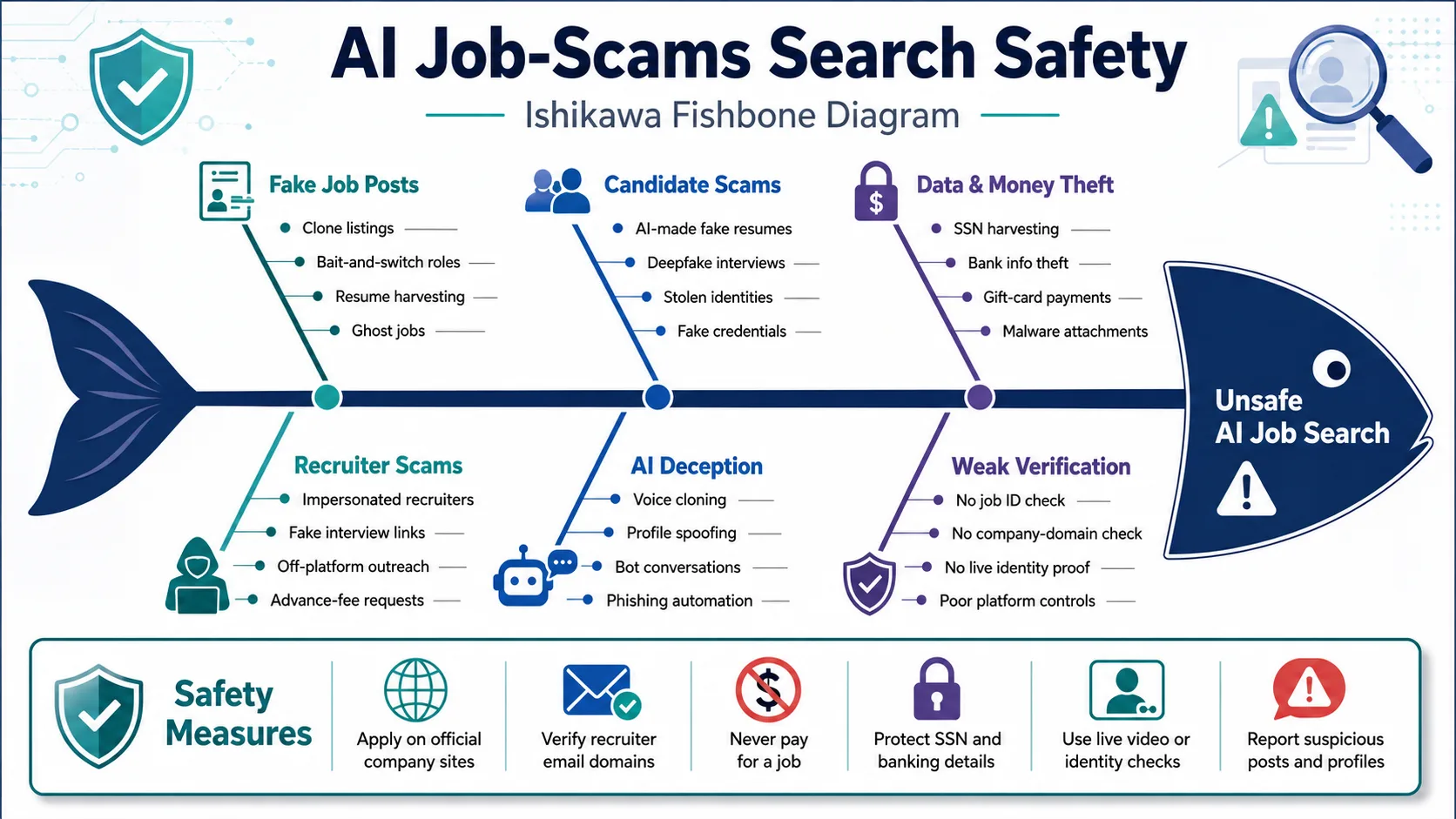
AI job search safety means protecting job seekers from three connected risks:
- AI-related layoffs,
- automated hiring systems that may reject resumes before human review,
- fake recruiters using AI to impersonate real people or companies.
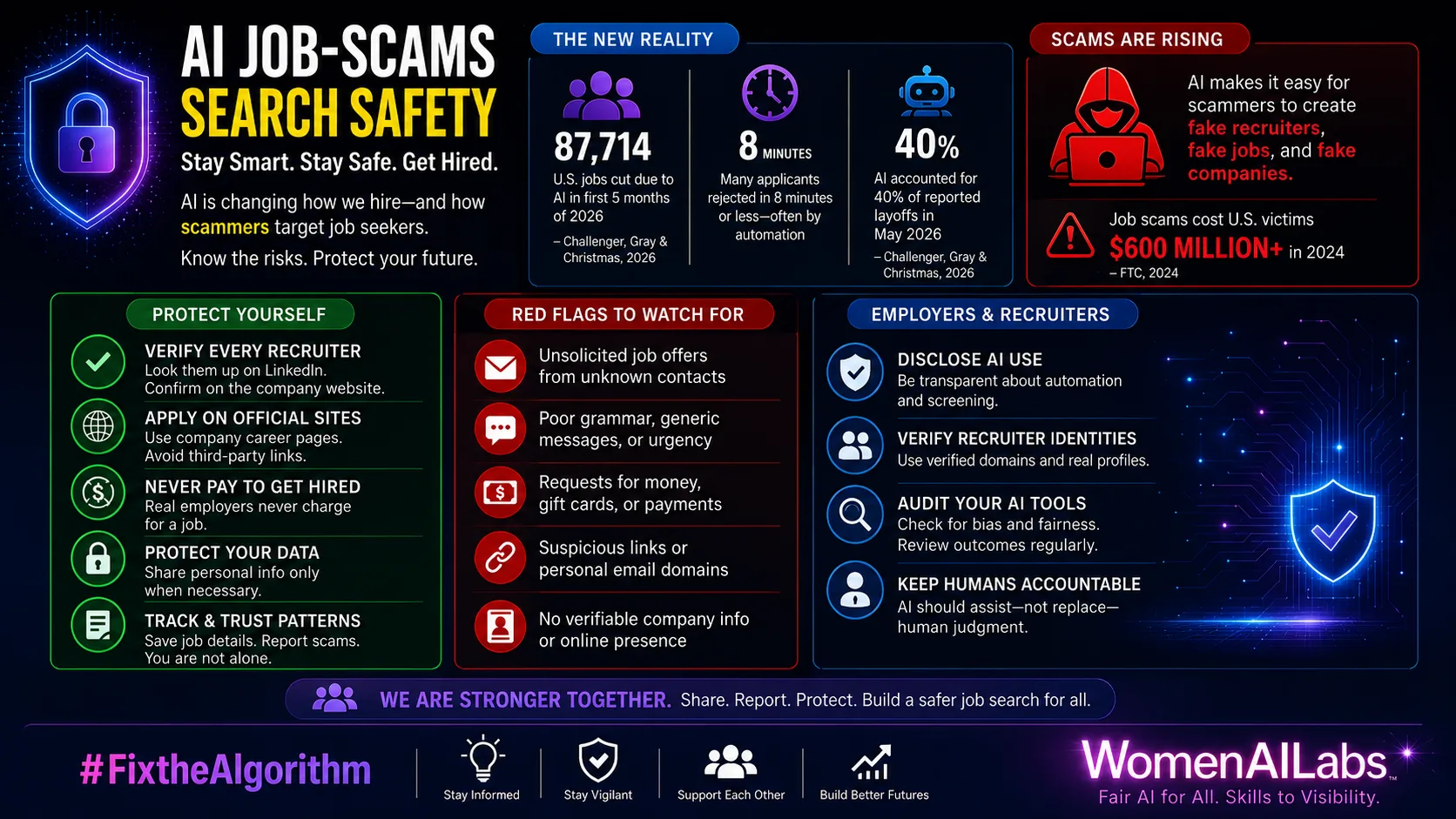
Job seekers should verify every recruiter, apply through official company pages, avoid paying for job access, protect sensitive data, and track rejection patterns. Recruiters and employers should disclose AI use, verify recruiter identities, audit screening tools, and keep humans accountable for final hiring decisions.
AI Layoffs Are Creating a Job-Market Trust Crisis
A job seeker spends three hours tailoring a resume.
They study the job description. Then they rewrite the summary, align keywords, adjust accomplishments, and answer every application question. Finally, they press submit.
Eight minutes later, the rejection arrives.
No interview. No explanation. No visible human review.
That experience may come from a knockout question, an applicant tracking rule, a closed requisition, a ranking threshold, or an automated resume screening system. However, the candidate rarely knows which one made the decision. So the rejection does more than close a door. It creates doubt.
Was I reviewed fairly?
- Did a human see my experience?
- Did a bot reject me before my story had a chance?
That is why AI job search safety is bigger than job scams. It now includes job-market trust, hiring transparency, candidate protection, and proof of fairness.
The numbers make this urgent. Challenger, Gray & Christmas reported that in June 2026, artificial intelligence led all stated reasons for U.S. job cuts for the fourth consecutive month.
AI was cited in 14,029 job cuts in June alone, or 31% of that month’s cuts. AI was cited in 101,743 job cut announcements, about 23% of all cuts. Since Challenger began tracking AI as a distinct job-cut reason in 2023, AI has been cited in 173,568 cuts.
Meanwhile, recruiting teams are also under pressure. LinkedIn’s 2025 Future of Recruiting report says 37% of recruiting organizations are actively integrating or experimenting with generative AI tools, up from 27% the prior year. LinkedIn frames AI as a way to automate time-consuming recruiting tasks so recruiters can spend more time building relationships, improving candidate experience, and advising hiring managers.
Job seekers are navigating a complicated reality.
Companies reduce headcount with AI in the conversation. Job seekers enter crowded applicant pools. Recruiters handle more pressure with fewer resources. Automated systems filter more resumes. Then fake recruiters exploit the pain.
Therefore, the new job search question is not only, “How do I get hired?”
It is also, “How do I know this hiring process is real, fair, and safe?”
Automated Resume Rejection: Why Eight Minutes Feels Like No Human Saw It
Let’s be precise. “Rejected in eight minutes” is not a national statistic. It is a candidate-reported pattern showing up in job-search conversations, LinkedIn posts, career communities, and lived experience.
Still, the pattern matters because it points to a real transparency gap.
The EEOC and DOJ have warned that employers increasingly use AI and software tools to select employees, monitor performance, determine pay or promotions, test applicants, and score resumes. They also warned that these tools may unlawfully screen out people with disabilities if employers fail to add safeguards and accommodations.
Recent research also shows why human review matters. A 2026 paper on AI-mediated hiring for blind and low-vision job seekers states that the job search becomes harder when employers use AI-driven systems to screen resumes before a human sees them. The researchers found that AI hiring systems can misrepresent professional identities and create dehumanizing interactions.
Another 2026 study, Resume Screening, Fast and Slow, found that when people spent more time viewing resumes, candidates who were not recommended by AI had a 3% to 4% higher chance of selection. The same study found people may spend up to 55.6% longer reviewing resumes when AI recommendations are not shown.
In plain language, time, Attention, Human review matters.
So when a job seeker receives an automated rejection in minutes, they feel disappointed. They feel processed. Those feeling damages trust, especially for people with nontraditional career paths, caregiving gaps, disabilities, immigration transitions, military backgrounds, career changes, entrepreneurship, community leadership, or skills learned outside traditional pipelines.
Recruiter and career coach Kristen Fife adds a useful corrective for job seekers. She cautions that people should not blame AI for every rejection because many companies have cut recruiting teams and specialized hiring staff. In her words, “clarity beats creativity.”
That is practical advice. Still, clarity should not be the candidate’s burden alone. Employers must also clarify when AI, automation, knockout questions, or ranking tools influence decisions.
Fake Recruiter Scams: How AI Makes the Trap Look Real
Now add fraud to the mix.
The FTC warned in April 2026 about fake recruiters sending job-offer texts for fake remote roles. These messages often claim to represent legitimate companies. They mention daily or weekly pay, use vague job titles such as “remote position,” and ask people to reply “YES” or “INTERESTED.” Once a job seeker engages, the scammer may move toward a fake check scam, a task scam, or a request for money.
The FBI’s 2025 Internet Crime Report shows how large the AI fraud environment has become. The FBI received 1,008,597 total complaints in 2025. For the first time in the report’s nearly 25-year history, it included a section on artificial intelligence. AI-related complaints totaled 22,364 and cost Americans nearly $893 million. The FBI said scammers use fake social profiles, voice clones, identification documents, and believable videos.
In other words, fake recruiter scams no longer look sloppy.
AI helps scammers write better messages, personalize outreach, clone professional language, create fake profiles, produce realistic documents, and mimic recruiter workflows. Because job seekers often publish their resumes, LinkedIn profiles, layoff updates, certifications, and target roles online, scammers can tailor a message that sounds eerily specific.
They may say:
- “We saw your background in service management.”
- “Your AI governance experience looks aligned.”
- “Our remote role matches your resume.”
- “We need to move quickly because the hiring manager is reviewing finalists today.”
Then they move the conversation off-platform.
LinkedIn’s 2026 Job Search Safety Pulse found that 90% of reported employment scams involved attempts to move conversations off-platform. LinkedIn also found that younger professionals face the highest exposure to scams, and nearly one-third admit to ignoring red flags because of a competitive job market.
- That matters because scammers do not only target carelessness. They target pressure.
- They target hope, candidates who are frustrated with exhaustion; preying on those who need work quickly.
Recruiter Identity Theft: Why Scammers Steal Real Recruiter Names
Fake recruiters often steal or mimic real recruiter identities because trust speeds up the scam.
A real recruiter’s name, company logo, profile photo, and job title create instant credibility. A scammer may copy a recruiter’s LinkedIn profile, use a similar email domain, create a fake company page, or reference a real job posting. Then they contact candidates who already feel vulnerable because of layoffs or repeated rejection.
The motive usually falls into four categories.
- First, they want money. They may ask job seekers to pay for equipment, background checks, onboarding, resume updates, training, or application processing.
- Second, they want identity data. They may request a Social Security number, passport, driver’s license, home address, birth date, banking details, or tax forms before a verified offer.
- Third, they want account access. They may send phishing links, fake portals, or “assessment” pages that capture passwords.
- Fourth, they want fake work. In task scams, they may ask job seekers to complete ratings, reviews, crypto tasks, or small assignments before requiring deposits to unlock earnings.
Kristen Fife has been direct about one common scam pattern. She warned job seekers not to fall for people pretending to be recruiters in order to sell resume services, writing, “NO RECRUITER WILL NEVER TRY AND SELL YOU RESUME UPDATE SERVICES.”
That blunt warning belongs in every job-search safety checklist.
AI Resume Screening and Recruiter Trust: What Job Seekers Should Watch For
Job seekers should watch for signs that the opportunity may be fake, unsafe, or unfair.
Be cautious when a recruiter uses Gmail, Outlook, WhatsApp, Telegram, or text-only communication for official hiring. Also pause when the job pays unusually high wages for vague work, the recruiter refuses to share a company email, the job does not appear on the company’s official careers page, or the process moves from application to offer without a real interview.
- Next, watch for pressure. Scammers often create urgency because urgency short-circuits judgment. They may say the role closes today, the hiring manager already approved you, or payroll needs your information immediately.
- Also watch for money. The FTC gives three simple rules: ignore generic unexpected texts or WhatsApp and Telegram job messages, never pay to get paid or get a job, and do not trust anyone offering money for ratings, likes, or online tasks.
- Finally, watch for fake professionalism. A polished message does not prove legitimacy. AI can make scam messages sound warm, specific, and grammatically clean.
Therefore, job seekers need a new habit: verify before you trust.
What Job Seekers Should Do Before Sharing a Resume, ID, or Bank Details
| Validate a Recruiter or Job | Resume-to-Job Match + Enhancement |
|---|---|
Protect yourself before you click, share, or apply. Features: • Verify recruiter identity • Check company and job link • Spot fake email or URL risks • Flag money, ID, or banking requests • Review unrealistic pay claims • Recommend: apply, verify, or avoid | Prove your fit before you submit. Features: • Compare resume to job description • Score resume-to-job match • Find missing skills and keywords • Improve ATS readability • Strengthen bullets and summary • Recommend: apply now or improve first |
Check the latest Job Search Tools and Resources
Start with the company’s official website. Search for the role on the employer’s careers page. If the job does not appear there, slow down.
- Then verify the recruiter. Check whether the recruiter has a verified profile, a real company email, credible work history, and activity that matches their profession. If you receive an email, compare the domain carefully. Scammers often use lookalike domains that swap one letter, add a hyphen, or use a different ending.
- Next, keep the conversation on the platform until you verify the person. LinkedIn’s own safety guidance highlights verification and staying on-platform as key ways to reduce risk.
- After that, protect your data. Do not share your Social Security number, bank information, passport, driver’s license, direct deposit form, or tax documents until you have verified the employer, completed a credible process, and received a legitimate offer through official channels.
- Also document everything. Save screenshots, job links, recruiter names, email headers, phone numbers, payment requests, interview invitations, and attachments. If something goes wrong, this evidence helps you report the scam.
Report US suspected fraud to the FTC through ReportFraud and report cyber-enabled fraud to the FBI’s IC3. The FBI advises people to document the scammer or company name, contact methods, dates, payment methods, destination of funds, and a description of the interaction.
What Recruiters and Employers Should Do to Rebuild AI Hiring Trust
Recruiters are not the enemy in this story.
Many recruiters are also working inside strained systems. They manage large applicant pools, reduced teams, faster hiring demands, shifting requirements, and new AI tools they did not design. Yet recruiters can become the trust bridge if employers give them authority, training, and clear governance.
- First, employers should disclose when they use AI or automated tools in screening, ranking, assessments, interview evaluation, or candidate matching.
- Second, they should explain what the tool considers, what it does not consider, and when a human reviews the output.
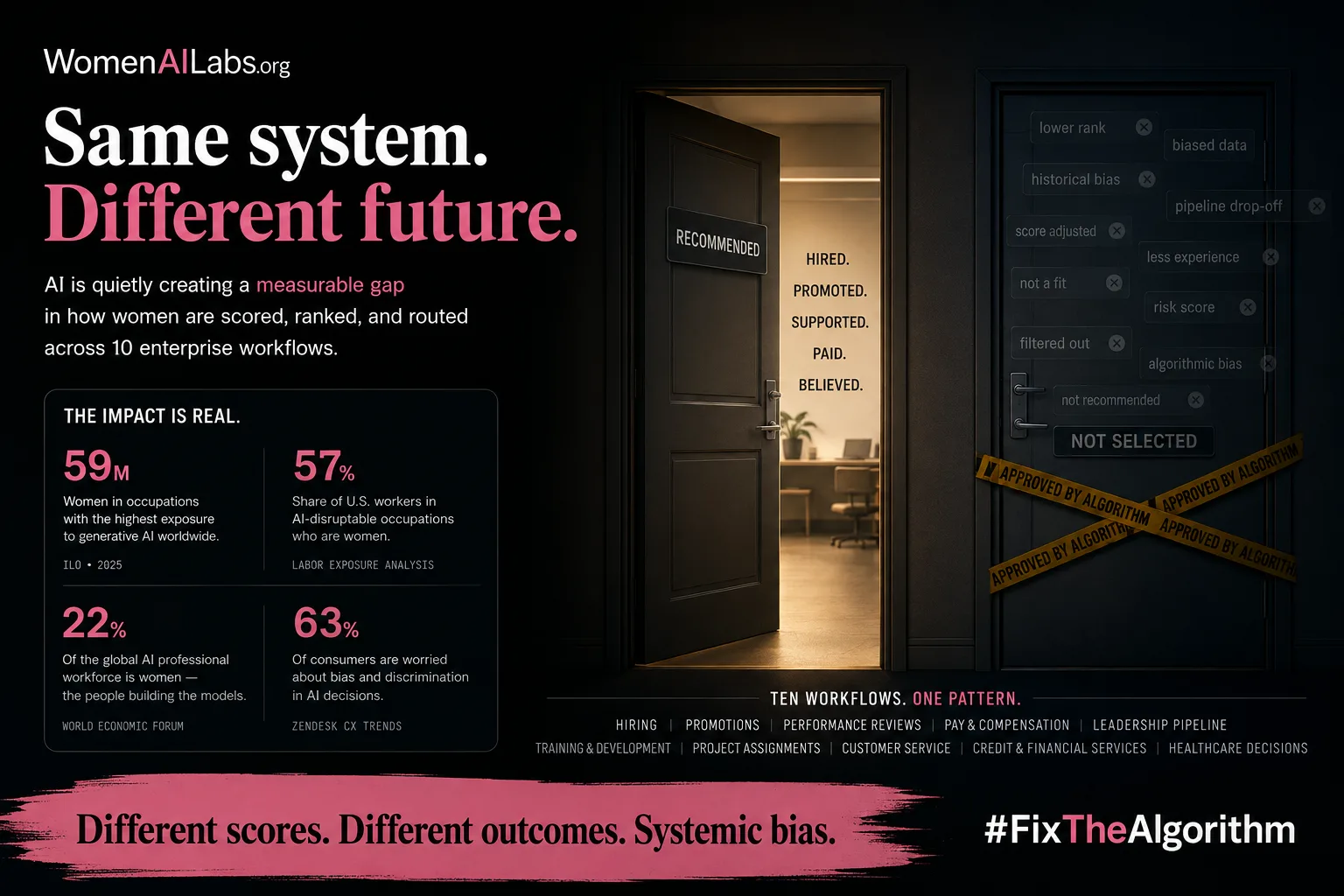
- Third, they should audit hiring outcomes across protected characteristics, disability accommodations, career gaps, nontraditional pathways, and role requirements.
- Fourth, they should verify recruiter credentials. LinkedIn has moved in this direction by requiring people who add or update recruitment-related job titles to verify their workplace, often through company email. The change aims to help job seekers identify legitimate recruiters and avoid scams.
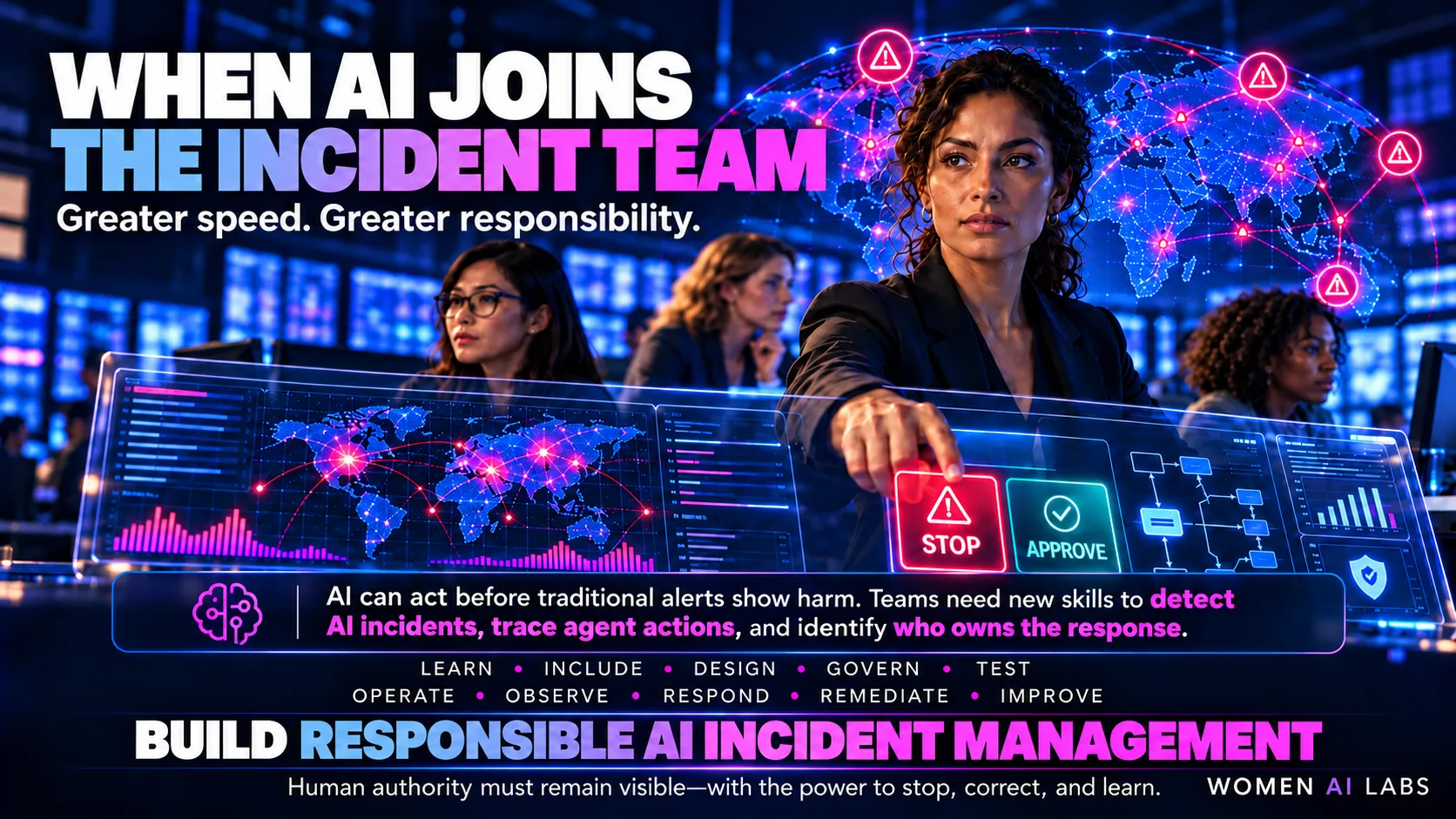
- Fifth, employers should create a human escalation path. If a candidate reports a fast rejection, inaccessible assessment, scam impersonation, or possible automated error, someone should own the review.
That is not only compliance. It is candidate experience. It is brand trust. It is workforce equity.
As Dawn C. Simmons has written, “Systems process transactions. People live with outcomes.”
Hiring leaders should keep that sentence close.
Women AI Labs Tools for Job Seekers: Build Proof, Visibility, and Safety
Women AI Labs approaches AI job search safety from a practical lens: job seekers need literacy, visibility, trusted tools, and evidence.
The Women AI Labs AI Tool Directory includes career resources such as the Jobs N Career Success Loop Board, described as quick, efficient, lightweight career resources for jobs and layoff support. It also includes tools such as Calming Career Coach, DAUGHTER Equity Analyzer, and career-related AI resources designed to help people navigate uncertainty with more structure.
Dawn C. Simmons’ Vibe-Coding Career Visibility framework gives job seekers a stronger way to move from invisible to visible. It encourages practical tools such as resume match engines, proof portfolio builders, referral mappers, recruiter directories, rejection trackers, and fairness dashboards. It also describes fairness trackers that collect anonymized signals about fast rejections, automated screening, candidate notices, audit disclosures, appeal paths, and rejection patterns.
That is the mindset shift.
- Do not only apply more.
- Build proof.
- Track patterns.
- Verify people.
- Protect your data.
Use AI to clarify your story, not erase your voice.
Kristen Fife’s resume guidance fits here too. She says recruiters do not care whether you use AI to draft your resume or cover letter. They care about the actual content.
So use AI carefully. Let it help you organize, compare, practice, and improve. However, do not let it invent experience, inflate skills, or turn your resume into generic buzzwords. The safest job search still depends on truthful proof.
Other Trusted Search Resources for AI Job Scams and Recruiter Verification
Use trusted sources before you respond to a recruiter, pay a fee, share identity documents, or accept a remote offer.
Start with the FTC’s job scam guidance and ReportFraud reporting path. Then use the FBI’s IC3 for cyber-enabled fraud. Next, check LinkedIn’s Job Search Safety Pulse and verified recruiter guidance. Also search the company’s official careers page, not only the job board listing. Finally, use Women AI Labs’ Jobs N Career Success Loop Board and AI Tool Directory for community-centered job search support.
For recruiter research, job seekers can also look for established recruiting organizations, recruiter profiles with verified employment, and professional networks such as LinkedIn Recruiter communities or Global Recruiters Network listings. However, a logo or profile alone is not enough. Always verify through the employer’s official contact information.
The New Rule: Trust, But Verify the Recruiter
AI can improve hiring. It can reduce repetitive work, help recruiters find aligned candidates, and speed up communication. LinkedIn has already launched agentic AI hiring products that let recruiters instruct AI agents to search profiles for follow-up by human recruiters. Reuters reported that LinkedIn’s AI hiring products were on track to generate $450 million in sales in the coming year.
However, AI can also accelerate exclusion, confusion, and fraud.
- That is why job seekers need safety habits, and employers need accountability habits.
- Job seekers should not have to prove their humanity to a system that will not prove its fairness.
- Recruiters should not have their identities stolen by fraud bots.
- Employers should not ask for trust while hiding behind automation.
- The better future is not anti-AI. It is pro-human accountability.
So, the next time a rejection lands in minutes, where you were a match, a recruiter appears out of nowhere, or a remote job sounds too perfect, pause.
- Verify the role.
- Verify the recruiter.
- Protect your data.
- Track the pattern.
- Then keep building proof that a human can understand.
Because the job market does not only run on applications.
It runs on trust.
FAQ: AI Job Search Safety, Fake Recruiters, and Automated Rejections
What is AI job search safety?
AI job search safety means protecting job seekers from fake recruiters, AI-enabled job scams, unsafe data requests, automated resume rejection, and unclear AI hiring systems.
Can AI reject my resume before a human sees it?
Some employers use automated tools, knockout questions, resume scoring, ranking systems, or AI-assisted screening. In those cases, a candidate may be filtered before meaningful human review. Employers should explain when and how they use these tools.
Why did I get rejected in eight minutes?
A fast rejection may come from a knockout question, eligibility rule, location or salary mismatch, closed role, applicant tracking workflow, or automated screening threshold. Without transparency, candidates cannot know which factor applied.
How do fake recruiters use AI?
Fake recruiters use AI to write polished messages, personalize outreach, create fake profiles, mimic company language, generate fake documents, and move job seekers into scams involving money, identity theft, phishing, or fake tasks.
What are the biggest fake recruiter red flags?
Red flags include starting on a big platform like LinkedIn or a job board and suggesting you move off to WhatsApp or Telegram outreach, personal email accounts, vague remote jobs, unusually high pay, pressure to act fast, requests for money, fake checks, early requests for identity documents, and jobs missing from official company career pages.
What should job seekers do before responding to a recruiter?
Job seekers should verify the recruiter’s company email, search for the role on the official careers page, keep communication on-platform until verified, avoid upfront payments, protect sensitive data, and report suspicious activity to the FTC or FBI.
How can companies and recruiters rebuild trust in AI hiring?
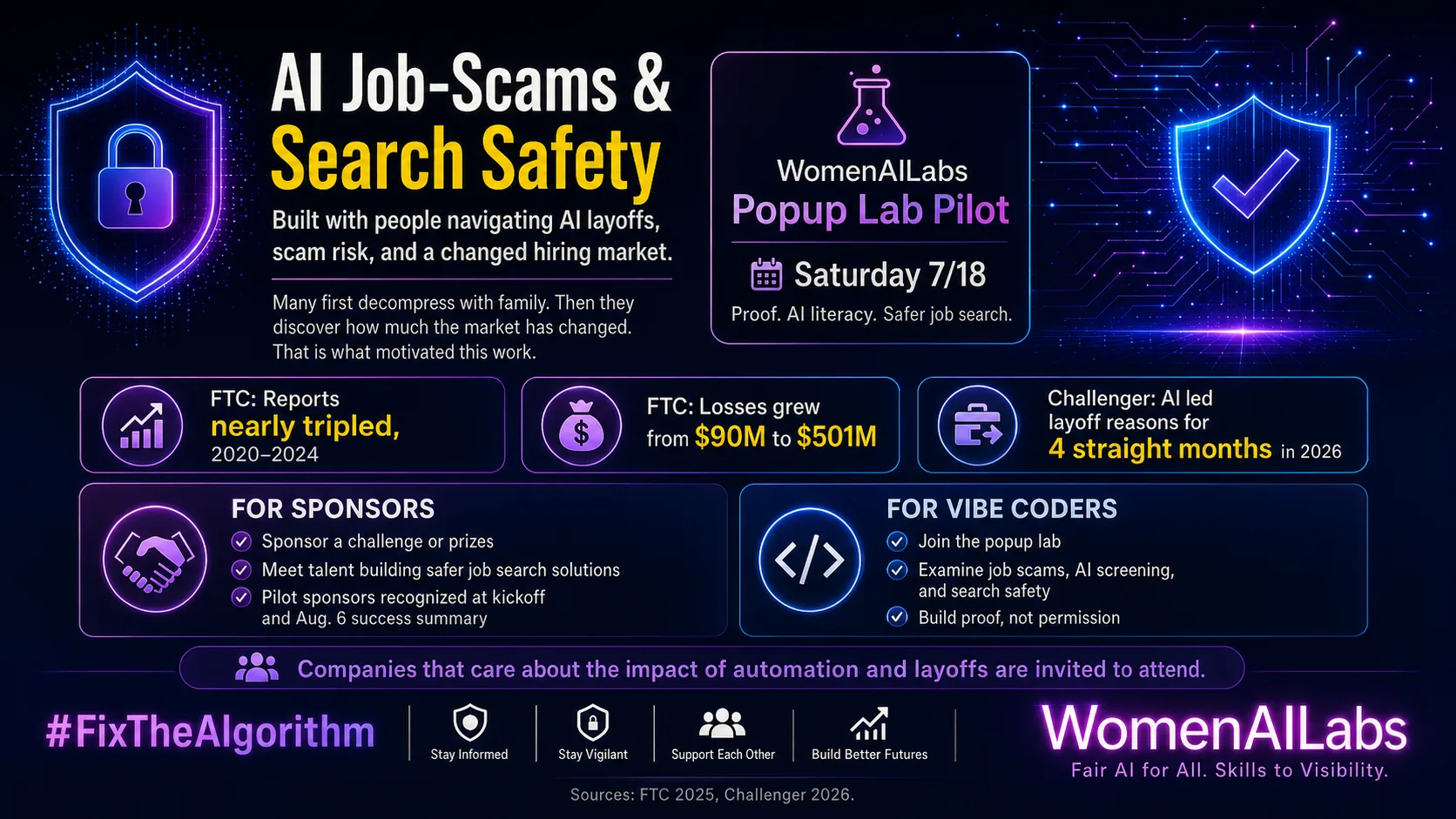
Companies who participate in our vibe coding solution get access to the brightest students and talent. Sponsor a challenge and get your pick of entry solutions from those who participate to vibe code fairer recruiting and jobs process solutions and training.
Recruiters and employers can disclose AI use, verify recruiter credentials, audit tools for bias, provide human review, document selection criteria, and create escalation paths for candidates who may have been wrongly screened out.
What Women AI Labs tools help employers, recruiters and job seekers?
Women AI Labs offers an AI Tool Directory with Fraud analysis tools, resume scoring, Jobs N Career Success Loop Board, Calming Career Coach, DAUGHTER Equity Analyzer, and related tools. Got a great tool to help in recruiting or hiring? Share it! Check our tools to create your career advantage. Dawn C. Simmons’ Vibe-Coding Career Visibility framework also helps job seekers build proof portfolios, referral maps, rejection trackers, and fairness dashboards.